On this page
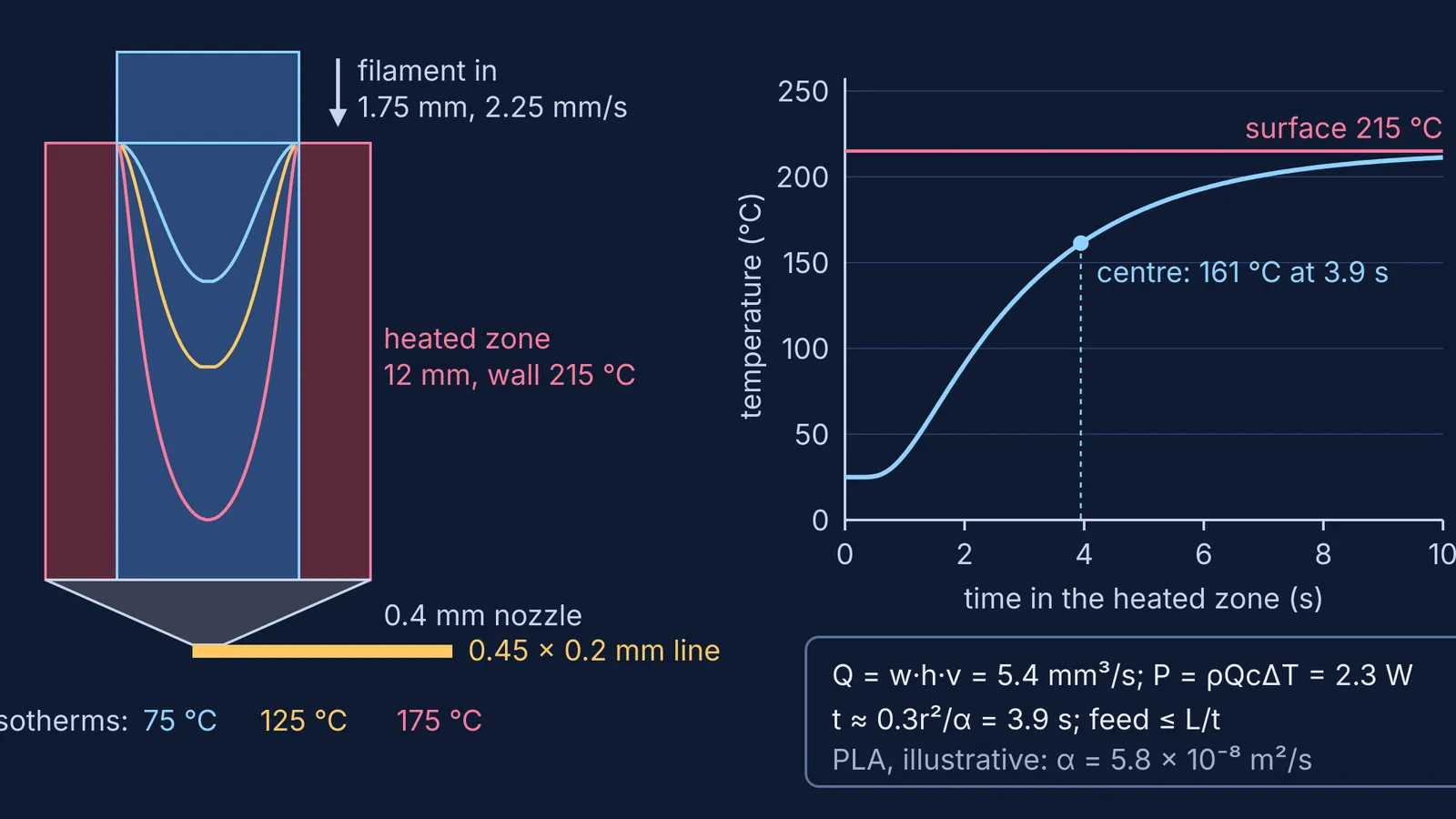
A desktop 3D printer of the common FDM type (fused deposition modelling, also called fused filament fabrication) pushes a plastic thread, 1.75 mm across, into a heated metal block called the hot end. Molten plastic squeezes out of a 0.4 mm nozzle, and the printer draws your part one thin line at a time. Anyone who has waited hours for a print has asked: why not just push faster? The heater is not the problem. It has plenty of power. The problem is time. Heat needs a few seconds to soak into the middle of the plastic thread, and that sets a speed limit.
How much plastic does a 3D printer push per second?
By continuity, the volume leaving the nozzle each second equals the cross-section of the printed line times the print speed:
Q = (line width) × (layer height) × (print speed)
The same volume must enter as filament, so the filament feed speed is Q divided by the filament's cross-section, πr². This is the same idea as water speeding up in a narrow pipe, only running the other way.
How much power does it take to melt PLA?
PLA is a common printing plastic. In practice it has no single sharp melting point: it softens above its glass transition and flows more easily as it gets hotter. One peer-reviewed measurement on a PLA filament found a glass transition of 62.8 °C and a small melting peak for its crystalline part at 171.4 °C (Blanco et al., 2022). Below we take a print temperature of 215 °C as an illustrative value.
The heating power is just Q = mcΔT per second: P = ρQcΔT. If you need a refresher on specific heat, see the method of mixtures for specific heat.
Why does heat take seconds to reach the middle of a filament?
Plastic is a poor conductor of heat. Heat soaks into a solid by diffusion, and the time it needs to reach a depth r is of order r²/α, where α = k/(ρc) is the thermal diffusivity. Doubling the radius makes the wait four times longer, not twice.
For a long cylinder whose surface is suddenly held hot, the exact solution is a series of Bessel functions. Its first terms give the centre's progress:
at t = 0.3r²/α the centre has made about 72% of the temperature rise;
at t = 0.48r²/α it has made 90%.
We use t ≈ 0.3r²/α as an order-of-magnitude estimate of "soft enough in the middle". The filament must stay in the heated zone at least that long, so the feed speed is capped at roughly (length of heated zone) ÷ t. How heat crosses a solid by conduction is covered in heat conduction and thermal resistance.
How fast can a desktop 3D printer go? A worked example
Take round illustrative values for PLA: ρ = 1,240 kg/m³, c = 1,800 J/kg K, k = 0.13 W/m K. Measured values vary between filaments; the Blanco study, for example, cites 0.16 W/m K. Heat from 25 °C to 215 °C, so ΔT = 190 K. Print a line 0.45 mm wide and 0.2 mm high at 60 mm/s.
Volume flow. Q = 0.45 × 0.2 × 60 = 5.4 mm³/s.
Filament feed. The filament's area is π × 0.875² = 2.41 mm². Feed = 5.4 ÷ 2.41 = 2.25 mm/s.
Heating power. P = 1,240 × (5.4 × 10⁻⁹) × 1,800 × 190 = 2.29 W. Units: kg/m³ × m³/s × J/kg K × K = J/s = W. That is tiny, so heating power is not what holds the printer back.
Diffusivity. α = 0.13 ÷ (1,240 × 1,800) = 5.8 × 10⁻⁸ m²/s.
Soak time. r²/α = (0.875 × 10⁻³)² ÷ (5.8 × 10⁻⁸) = 13.1 s, so t ≈ 0.3 × 13.1 = 3.9 s. By then the centre is at about 160 °C, while the surface is at 215 °C.
Speed cap for a 12 mm heated zone. Feed ≤ 12 ÷ 3.9 = 3.0 mm/s. That is 3.0 × 2.41 = 7.3 mm³/s, or about 81 mm/s of printing for this line size.
A longer, "high-flow" zone of 25 mm. Feed ≤ 6.3 mm/s, about 15 mm³/s, or about 169 mm/s.
Our 5.4 mm³/s is 19 cm³ per hour. A peer-reviewed study of printer speed limits found that desktop and professional FFF machines both build at "tens of cm³/h" at about 0.2 mm layer thickness, and named conduction of heat to the filament core as one of three limits, alongside the force the drive can push with and the speed of the gantry (Go et al., 2017). Our estimate sits in the same range.
Why not just turn up the heater?
Three reasons, and none is about power.
The surface would overheat. A hotter wall drives heat in faster, but the outer plastic would sit far above its working temperature, and risk degrading, while the centre catches up.
The time scale does not change. r²/α depends only on size and material. A hotter wall shortens the wait only by asking the centre to reach a smaller fraction of a bigger rise.
Melting is not the only limit. Molten PLA is very viscous. Pushing more of it through a 0.4 mm hole needs more force, which is one of the other limits Go and colleagues identified.
The practical fix is to attack the soak time: make the heated zone longer, so the filament spends more time in it at the same feed speed. A thicker filament makes things worse: 2.85 mm filament has (2.85/1.75)² = 2.65 times the soak time, about 10.5 s.
A thermal inkjet printer has the opposite problem: it needs a tiny volume of ink heated in microseconds, which works only because the heated layer is extremely thin. That story is in how a thermal inkjet fires a drop.
For more conduction and specific-heat numericals, the Fermi Problem Library has a step-by-step solver that explains the reasoning.
Quick checklist
Continuity: Q = width × height × speed; filament feed = Q ÷ πr².
Heating power is small: P = ρQcΔT ≈ 2.3 W for a typical PLA print.
Heat soaks in over a time of order r²/α; for 1.75 mm PLA about 4 s (an estimate).
Feed speed is capped near (heated length) ÷ (soak time).
Longer melt zones and thinner filament raise the cap; a hotter wall mostly burns the surface.