

On this page
The inkjet printer at home has no pump in its print head. Each of its nozzles sits over a tiny thin-film resistor. To print a dot, the printer sends a pulse of current lasting a couple of microseconds. The resistor heats a thin film of ink so fast that it flashes into a vapour bubble, and the bubble shoves a drop out of the nozzle. HP called this thermal inkjet; Canon developed the same idea independently and called it Bubblejet. Every step can be estimated with Class 11 thermal physics: Q = mcΔT, the distance heat spreads in a short time, and ½mv².
How is a thermal inkjet different from a continuous inkjet?
The printers that stamp dates on milk packets fire a non-stop stream of drops and steer the unwanted ones into a gutter with electric charge. That is covered in how continuous inkjet printers steer charged droplets. A home printer is drop-on-demand: a nozzle fires only when a dot is needed.
There are two common ways to make that one drop. A thermal head uses heat and a vapour bubble. A piezoelectric head uses a crystal that flexes when a voltage is applied and squeezes the ink chamber. This post is about the thermal kind.
According to HP's own review of the technology (HP Journal, August 1992), the firing pulse lasts about 2 to 5 µs, the resistor surface briefly reaches temperatures up to about 400 °C, and the bubble pushes ink out of the nozzle at typically 10 m/s.
Why does the ink not simply boil?
Ordinary boiling starts at tiny gas pockets on a surface, a few degrees above 100 °C. When heating is very fast, those sites do not have time to act. The liquid next to the heater is driven far past 100 °C while staying liquid, which is called superheating. It then turns to vapour almost all at once.
HP's 1985 paper on thermal inkjet thermodynamics by Allen, Meyer and Knight explains that repeatable drops come only when the ink at the heater approaches its superheat limit, about 90% of the critical temperature. For their inks that was about 330 °C at atmospheric pressure. For water, 0.9 × 647 K = 582 K, or about 309 °C, so "near 300 °C" is a fair round figure. The same paper says high heating rates suppress the low-temperature nucleation sites, the vapour forms in about a microsecond, and peak pressures approach 14 atmospheres.
You have met the same physics before. A smooth flask can superheat and then bump, which is why chemists add boiling chips to give bubbles somewhere to start. A thermal inkjet does the opposite on purpose: it heats so fast that the ink cannot boil gently.
How thick is the layer of ink that gets heated?
In a time t, heat spreads into a material a distance of roughly √(αt), where α is the thermal diffusivity (thermal conductivity divided by density times specific heat). For water, α ≈ 1.4 × 10⁻⁷ m²/s. The distance grows only as the square root of time, so a microsecond pulse heats only a very thin skin.
Worked example: the energy budget of one drop
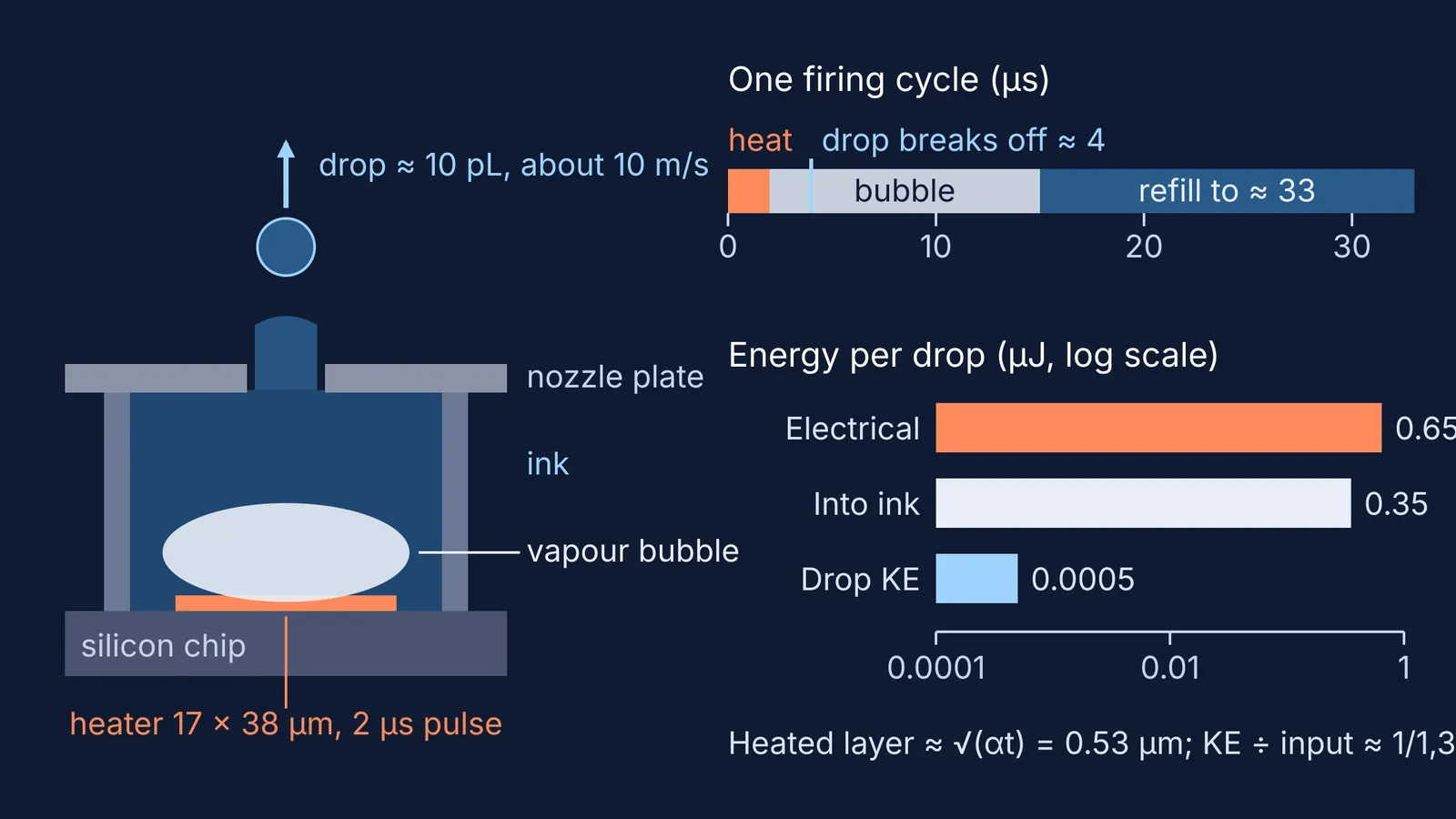
These are illustrative round values, with ink treated as water. Heater: 17 µm × 38 µm, the size used in a 2022 simulation study of a thermal inkjet chamber in Micromachines. Pulse: 2 µs. Heater power density: about 500 MW/m², the typical value HP's 1985 paper gives for pulses of a few microseconds. Drop: 10 pL at 10 m/s. Specific heat of water: 4180 J/(kg K).
Thickness of the heated layer. √(αt) = √(1.4 × 10⁻⁷ × 2 × 10⁻⁶) = 5.3 × 10⁻⁷ m, about 0.53 µm.
Volume of that layer. Heater area = 17 × 38 = 646 µm². Volume = 646 × 0.53 = 342 µm³. Since 1 pL = 1000 µm³, that is 0.34 pL, about 3% of the drop that will be fired.
Heat to bring it to the superheat limit. Mass = 3.4 × 10⁻¹³ kg. Q = mcΔT = 3.4 × 10⁻¹³ × 4180 × (300 − 25) = 3.9 × 10⁻⁷ J, about 0.39 µJ.
Heating rate. 275 K in 2 µs is 1.4 × 10⁸ K/s.
Electrical energy. E = power density × area × time = 5 × 10⁸ × 6.46 × 10⁻¹⁰ × 2 × 10⁻⁶ = 6.5 × 10⁻⁷ J, about 0.65 µJ. A simple conduction estimate puts roughly half into the ink and half into the chip.
Kinetic energy of the drop. Mass = 10 × 10⁻¹⁵ m³ × 1000 kg/m³ = 1.0 × 10⁻¹¹ kg. KE = ½ × 1.0 × 10⁻¹¹ × 10² = 5.0 × 10⁻¹⁰ J, or 0.0005 µJ.
Efficiency. 5.0 × 10⁻¹⁰ / 6.5 × 10⁻⁷ = 7.7 × 10⁻⁴, about 0.08%, or 1 part in 1,300.
Check the units: power density (W/m²) × area (m²) × time (s) gives J, and kg × (m/s)² gives J. The drop's diameter is (6V/π)^(1/3) = 27 µm, close to the size of the nozzle, which is what you expect.
The tiny efficiency is not a design failure. The heat is the price of a fast, simple pump with no moving parts. HP's 1985 paper notes that in actual operation the heat spreads into the chip, the ink and the nozzle plate, and that a thermal inkjet still needed only about 0.04 mJ per printed dot in 1985, against 3.4 to 6 mJ per dot for the impact and thermal-paper printers of the time.
What happens in the microseconds after the pulse?
The 2022 Micromachines simulation gives a clear timeline for one firing:
0 to about 2 µs: the heater pulse (1.8 µs in the study); the ink at the surface superheats and nucleates.
About 1 to 3 µs: the bubble expands and a column of ink pushes out of the nozzle.
About 4 µs: the column breaks off and the drop forms.
About 15 µs: the bubble has collapsed. Heat leaves the vapour, it condenses, and the pressure falls.
About 33 µs: surface tension has drawn fresh ink back in and the chamber is full again.
A cycle of about 33 µs allows about 30,000 firings per second from one nozzle in that design; the paper compares this with about 15 kHz for current heads. A collapsing bubble is a smaller cousin of the flash-to-steam event in why a geyser erupts with superheated water.
To revise thermal conduction and specific heat, the Concept Library covers every concept in physics, chemistry, biology, mathematics and computing.
Quick checklist
Thermal inkjet: a microsecond pulse in a thin-film resistor makes a vapour bubble that pushes out a drop.
Fast heating superheats the ink to near its superheat limit (about 300 °C for water) before it flashes to vapour.
Heated depth ≈ √(αt): about 0.5 µm for water in 2 µs.
Q = mcΔT for the layer is a few tenths of a µJ; the drop's KE is about 0.0005 µJ.
Less than 0.1% of the electrical energy becomes drop KE; the rest heats the chip and ink.
Piezo printers use a flexing crystal instead of heat.


