

On this page
In the lab you are told to drop one or two small chips into a flask before you light the burner. It looks like a ritual, but it is physics about how bubbles are born, and skipping it can throw hot liquid out of the flask.
What is bumping in chemistry?
Bumping is what happens when a liquid boiled in a test tube or other container superheats and then, once a bubble finally forms, boils so fast that liquid is thrown out of the container (Wikipedia: Bumping)). The same article notes that it typically happens in smooth, clean glassware.
Superheating means the liquid is above its boiling point but bubbles have not yet formed, because there is nowhere for them to start (LibreTexts, Nichols: Controlled Boiling/01%3A_General_Techniques/1.04%3A_Heating_and_Cooling_Methods/1.4B%3A_Controlled_Boiling)).
The hard part of boiling is the first bubble. Surface tension squeezes a bubble, and the extra pressure inside it is inversely proportional to its diameter, so the tiniest bubbles are the hardest to grow (Wikipedia: Superheating). Like a balloon, it is hardest to inflate at the start, then grows explosively.
Why are boiling chips added before heating a liquid?
Boiling stones, or boiling chips, are small pieces of black porous rock, often silicon carbide, that contain trapped air and have a large surface area (LibreTexts, Nichols/01%3A_General_Techniques/1.04%3A_Heating_and_Cooling_Methods/1.4B%3A_Controlled_Boiling)).
As the liquid warms, that trapped air bubbles out, and the rough pores act as nucleation sites: places where vapour bubbles can form. So instead of one violent burst after a long silent wait, you get a steady stream of small bubbles, and the liquid boils gently near its normal boiling point. For the dissolved-air side of the story, see why water bubbles before it boils.
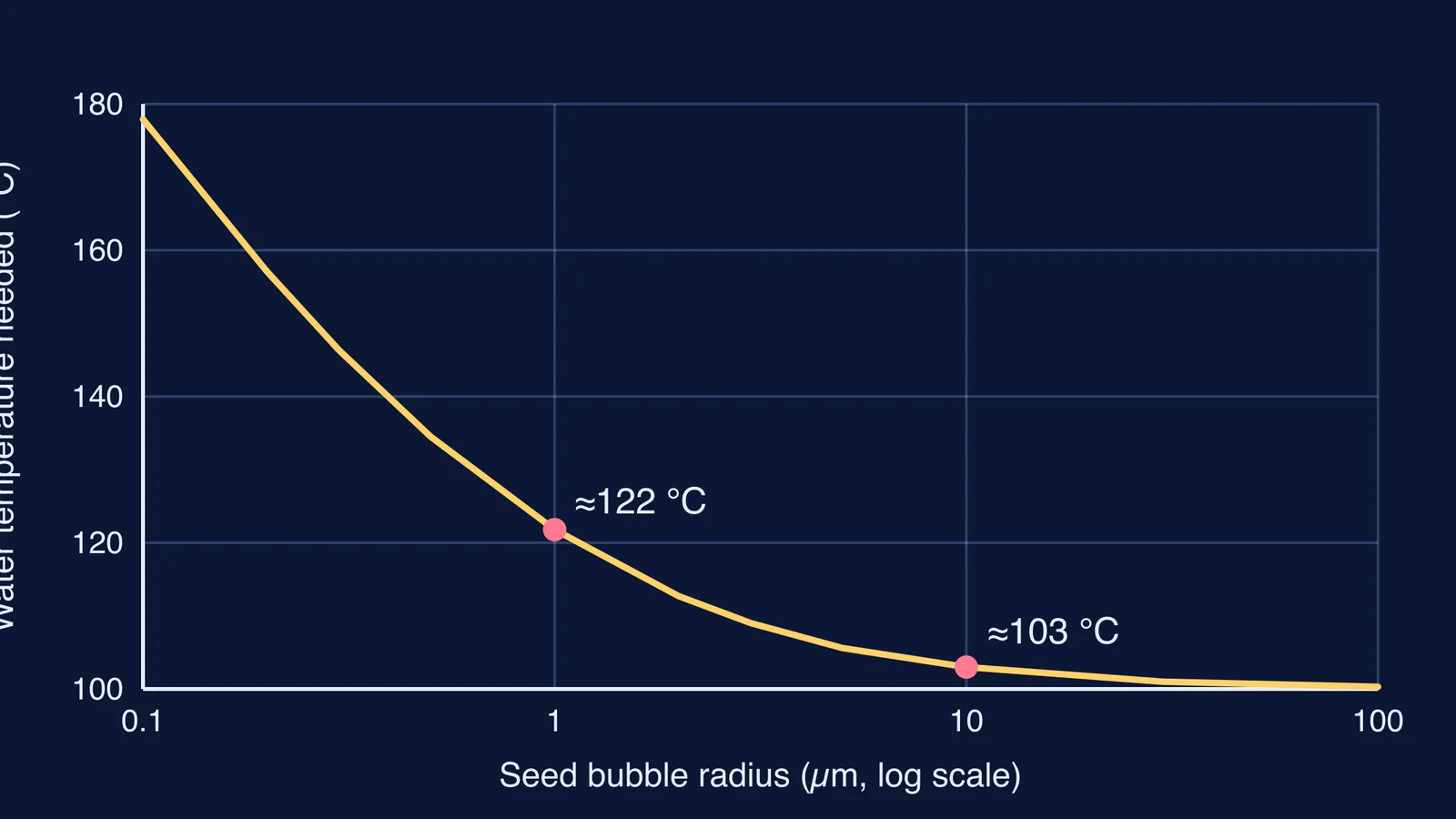
How much hotter does water need to get without a seed bubble?
Here is a worked estimate using the textbook bubble formula. A vapour bubble of radius r can only grow if the water's vapour pressure beats the outside pressure plus the surface-tension pressure, 2σ/r.
The surface tension of water at 100 °C is 58.92 mN/m, falling to 54.97 mN/m at 120 °C (IAPWS release on the surface tension of water); below we use the IAPWS value at the temperature the water ends up at. Vapour pressures come from the NIST Chemistry WebBook saturation table for water.
Case 1: the first bubble has to start with a radius of 1 micrometre (1 µm).
Outside pressure at sea level: about 1.01 bar.
Surface-tension pressure: 2 × 0.0546 N/m ÷ 0.000001 m ≈ 109,000 Pa, about 1.09 bar.
So the vapour inside must reach about 2.10 bar.
NIST lists 1.84 bar at 117.67 °C and 2.21 bar at 123.43 °C, so the water needs to be at roughly 122 °C.
Case 2: a pocket of trapped air already gives you a bubble of radius 10 µm.
Surface-tension pressure: 2 × 0.0583 N/m ÷ 0.00001 m ≈ 0.12 bar.
The vapour needs about 1.13 bar, which NIST puts at roughly 103 °C.
A seed bubble ten times wider cuts the overshoot from about 22 degrees to about 3. That is the job of a boiling chip. These are estimates from a simple model; real liquids also nucleate on dust and scratches.
What are the rules for using boiling chips safely?
The guidance below comes from the LibreTexts controlled-boiling chapter/01%3A_General_Techniques/1.04%3A_Heating_and_Cooling_Methods/1.4B%3A_Controlled_Boiling) and the Wikipedia entry on bumping).
Add one or two chips while the liquid is still cool.
Use a fresh chip each time you reheat. After one use the crevices fill with liquid, so the chip stops working.
Take extra care with a liquid you have boiled and cooled once: each heating drives out dissolved gas, leaving fewer nucleation sites and making bumping more likely next time.
Alternatives work on the same idea: a stir bar, a wooden boiling stick, or a sealed capillary tube.
Use a boiling tube or flask rather than a narrow test tube, and point the mouth away from people.
The same physics turns up at home: undisturbed water heated in a microwave can go above its normal boiling point (Wikipedia: Superheating), so avoid over-heating plain water.
How do you answer the boiling chips question in a viva?
A good answer covers three ideas, in this order. A short model answer:
"Boiling chips are porous and hold trapped air."
"They provide nucleation sites, so bubbles form steadily at the boiling point."
"This prevents superheating and the sudden violent boiling called bumping. They must be added to a cool liquid and replaced after cooling."
You will meet the same apparatus in distillation set-ups, so it is worth pairing this with how steam distillation works and the Class 9 melting and boiling point practical.
If surface tension, vapour pressure or nucleation still feel shaky, the Fermi Concept Library gives each concept in physics and chemistry its own lesson and its place in the map. To practise numericals like the worked estimate above, the Fermi Problem Library has worked problems with a step-by-step solver that explains the reasoning rather than printing an answer.


