

On this page
The lab gives you a beaker, a thermometer, a burner and some ice, and asks for two numbers. What you need to get right is the set-up, knowing when to read the thermometer, and explaining why the reading stops moving.
What does the Class 9 practical ask you to do?
In the CBSE Science curriculum for Classes IX and X (2025-26), experiment 6 on the Class IX list is "Determination of the melting point of ice and the boiling point of water", under Unit I, Matter: Its Nature and Behaviour. It gives practical work 5 of the 20 internal assessment marks. Lists change, so confirm this year's with your teacher.
How do you find the melting point of ice?
Fill a beaker about three-quarters full with crushed ice, which packs around the bulb better than big cubes.
Clamp the thermometer in a stand so the bulb sits in the middle of the ice, touching neither the sides nor the bottom.
Stir gently and read the thermometer every minute.
The reading that holds steady for several minutes as the ice melts is the melting point.
Professional labs are more careful. NIST Special Publication 1088, from the US national measurement laboratory, makes its "ice point" from ice shaved into particles 2 mm to 5 mm across, packed with distilled water, and warns that salt from sweaty hands can contaminate it. So use a clean thermometer and clean ice, and keep your fingers out of the beaker.
How do you find the boiling point of water?
Half-fill a beaker with water and put it on a wire gauze over the burner.
Clamp the thermometer so the bulb is in the water, clear of the bottom and sides.
Heat and read every minute. Small bubbles appear before boiling (here is why water bubbles before it boils), so don't stop early.
Once the water is boiling steadily, record the reading that stops rising.
You may not get exactly 100 °C. The NIST Chemistry WebBook steam tables give water's boiling point as 99.97 °C at standard sea-level pressure (101.325 kPa), but only 93.49 °C at 80 kPa. Air pressure is lower in hill towns, so a lower reading there is physics, not a mistake.
Why does the temperature stay constant during melting and boiling?
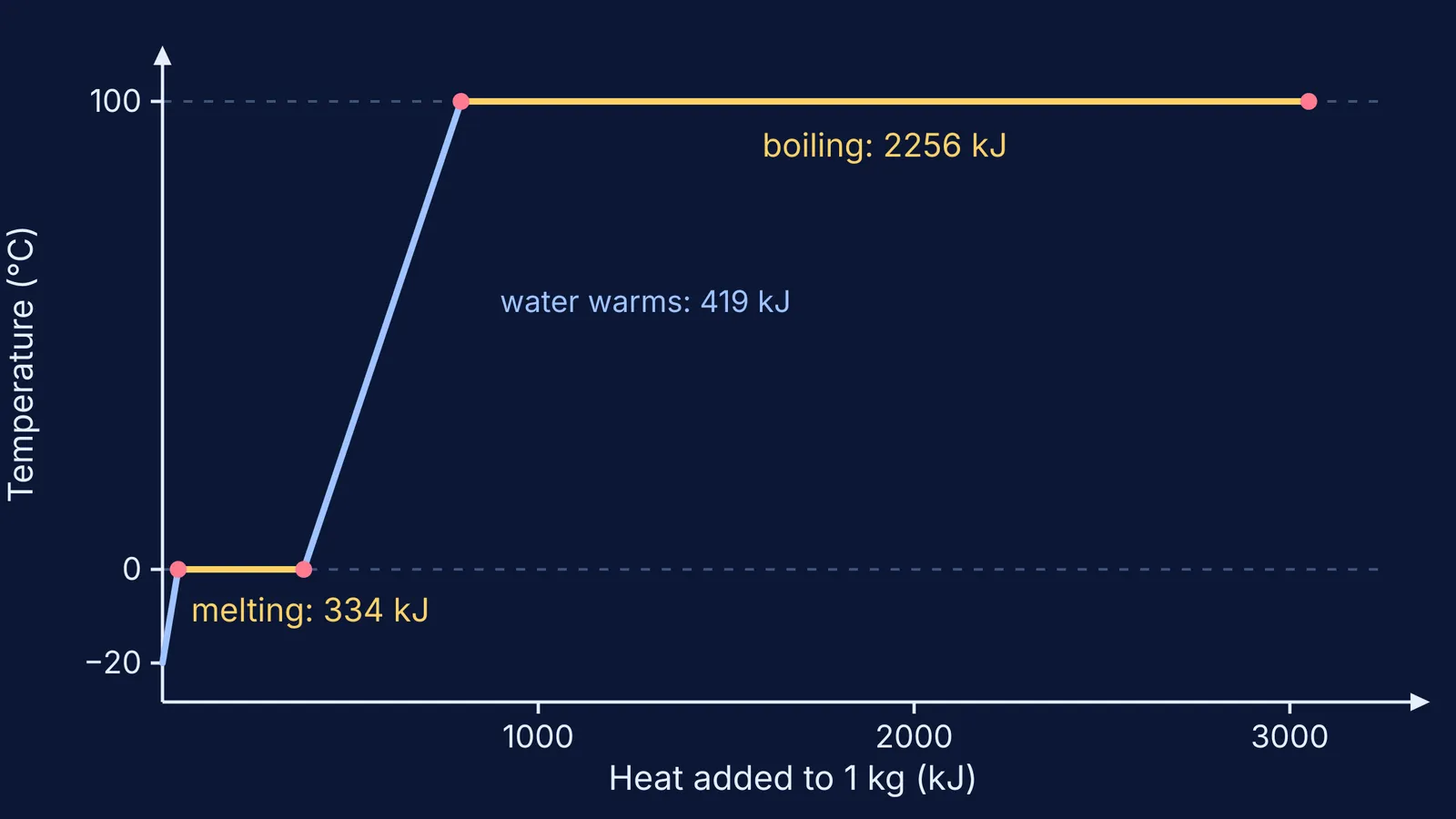
The heat goes into changing state, not raising temperature. The OpenStax College Physics chapter on phase change and latent heat explains that when a solid melts, "the cohesive bonds between the molecules in the solid must be broken apart", so "there is no rise in temperature". The heat absorbed this way is called latent heat.
The latent heat of fusion of water is 334 kJ/kg, and its latent heat of vaporisation is 2256 kJ/kg (OpenStax). Water's specific heat is 4186 J/kg °C (OpenStax), so warming 1 kg of water from 0 °C to 100 °C takes about 419 kJ. Boiling it away takes more than five times as much, which is why the boiling plateau lasts so long. For the particle-level picture, read why temperature stays constant during melting and boiling and why latent heat of vaporisation is greater than fusion.
If latent heat still feels like a word to memorise, the Fermi Concept Library gives each concept its own lesson and its place in the map, so you can see how it links to specific heat.
How do you read a lab thermometer correctly?
The first three tips come from NIST SP 1088:
Look straight at it. Keep your eye level with the top of the liquid column, at right angles to the thermometer; otherwise "parallax error may be significant".
Immerse it properly. The wrong immersion depth "can result in large measurement errors". If yours has an etched immersion line, immerse it to that line.
Give it time. In NIST's ice-point method, a mercury thermometer settles in about three minutes, but one filled with an organic liquid needs about 15 minutes.
Know your least count. Work out what one small division is worth, and record readings to that precision.
Worked example: turning readings into a result
Say your minute-by-minute readings are 4, 2, 0.5, 0.5, 0.5, 0.5 °C for ice and 28, 45, 63, 80, 94, 98.5, 98.5, 98.5 °C for water.
Result: melting point of ice = 0.5 °C, boiling point of water = 98.5 °C.
In kelvin: add 273.15, as given in NIST's SI temperature guide. That gives 273.65 K and 371.65 K.
Reasons for the difference: NIST notes that liquid-in-glass thermometers "may drift", which is why labs check them at the ice point. Lower air pressure lowers the boiling point; reading at an angle shifts either number. Impurities lower the melting point and raise the boiling point, so they cannot explain these readings.
Before your viva, practise answering these out loud: Why crushed ice? Why doesn't the reading rise while the ice melts? Why might the boiling point come out below 100 °C?
To practise latent heat numericals afterwards, the Fermi Problem Library has worked problems with a step-by-step solver that explains the reasoning rather than printing an answer.


