On this page
A geyser is a hot spring that cannot keep calm. For an hour or more nothing much happens. Then water spills from the vent, the spill turns into a roar, and a column of boiling water and steam shoots tens of metres into the air. The cause is simple: water under pressure boils at a higher temperature, plus the large latent heat of steam. You can work out the numbers with ρgh, a steam table and one line of calorimetry.
What makes a geyser different from a hot spring?
Both need heat from hot rock below and water that soaks down from rain and snow. The difference is plumbing. The US National Park Service explains in how geysers work that a geyser has a narrow, constricted channel that holds in the mounting pressure, while hot springs have open plumbing. In an open spring, hot water rises and mixes freely, which is the circulation covered in why hot springs are hot. In a narrow geyser tube, the water cannot mix well, so the water at the bottom is heated far more than the water at the top.
Why can water deep in a geyser stay liquid above 100 °C?
Water boils when its vapour pressure equals the pressure on it. At the surface that pressure is 1 atm and water boils at 100 °C. Deep in a water-filled tube, the water also carries the weight of all the water above it:
P = P₀ + ρgh
Each metre of water adds ρg × 1 m = 1000 × 9.81 × 1 = 9.81 kPa, so about 10 m of water adds one atmosphere. Higher pressure means a higher boiling point, exactly as in a pressure cooker, which whistles at its set pressure. Geologists call such water superheated.
The boiling point does not rise in proportion to pressure. Doubling the pressure does not double the boiling point in °C or in kelvin. You must read it from a steam table. The values below are saturation temperatures from the NIST Chemistry WebBook fluid data for water.
How hot is the water at the bottom of a real geyser?
Old Faithful in Yellowstone is one of the most studied geysers. Between 1983 and 1993, researchers lowered probes into its vent. They recorded conditions to nearly 22 m down and found a peak bottom temperature of 118 °C, well above 100 °C (Hutchinson, Westphal and Kieffer, Geology, 1997025%3C0875:ISOOOF%3E2.3.CO;2)).
The US National Park Service gives Old Faithful's eruptions as 30 to 55 m high, lasting 1.5 to 5 minutes and throwing out 14,000 to 32,000 litres of water. The interval between eruptions averages about 90 minutes, with a range of about 50 to 127 minutes (NPS, Old Faithful Geyser). Intervals change over the years, so treat these as typical values.
What sets off the eruption?
Hot rock heats the bottom of the water column. The deep water gets hotter than 100 °C but stays liquid because of the pressure above it.
Water higher up, under less pressure, reaches its own boiling point first. Steam bubbles form there and push some water out of the vent. This is the spill you see before an eruption.
Less water in the tube means less weight on the water below. Its pressure falls.
The deep water is now above the boiling point for its new, lower pressure. Part of it turns to steam at once. This is called flashing.
Steam takes up far more room than liquid water, so it throws out more water above it, the pressure drops further and more water flashes. The process runs away until the tube is emptied.
The same kind of sudden flashing makes firewood crackle and pop, on a much smaller scale.
How much of the water turns to steam?
When the pressure drops to 1 atm, the superheated water cools to 100 °C. The heat it gives up goes into boiling part of it. If a fraction x of a mass m flashes:
m c (T − 100 °C) = x m L, so x = c(T − 100 °C)/L
with c = 4.19 kJ/(kg K) for water and L = 2,257 kJ/kg at 100 °C. This uses c and L as constants, so it is a first estimate. Both change a little with temperature; an enthalpy calculation from the steam table gives answers about 2% higher.
Worked example: water 20 m down in a geyser tube
Assume a tube full of fresh water, ρ = 1000 kg/m³, g = 9.81 m/s², P₀ = 101.3 kPa. These are round textbook values; the tube and the depths are illustrative, not a real geyser.
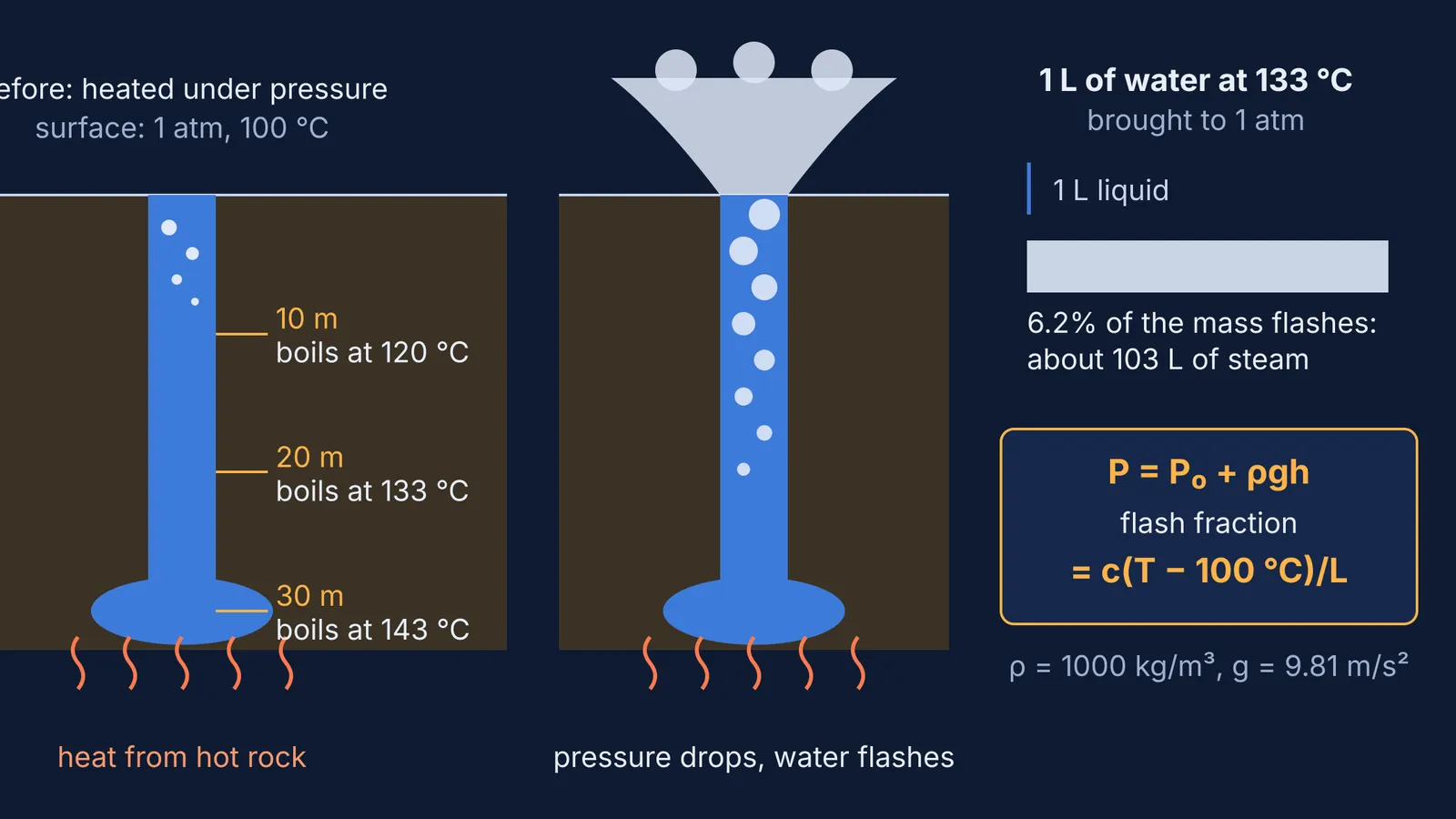
Pressure at 20 m. P = 101.3 + 1000 × 9.81 × 20/1000 = 101.3 + 196.2 = 297.5 kPa, about 2.9 atm.
Boiling point there. From the NIST steam table, water boils at 297.5 kPa at about 133.2 °C. The same method gives 199.4 kPa and 120.1 °C at 10 m, and 395.6 kPa and 143.2 °C at 30 m.
Heat stored above 100 °C. c(T − 100) = 4.19 × 33.2 = 139 kJ per kg.
Fraction that flashes at 1 atm. x = 139/2,257 = 0.062, so 6.2% of the water becomes steam.
Volume of that steam. At 100 °C and 1 atm, steam takes up about 1.673 m³ per kg, or 1,673 litres per kg (NIST). So 0.0616 kg of steam fills 0.0616 × 1,673 ≈ 103 litres.
Compare. About 1 kg of water, roughly 1 litre, makes about 103 litres of steam. Its volume grows about a hundredfold, which is what drives the jet.
Deeper water. At 30 m, x = 4.19 × 43.2/2,257 = 8.0%, which makes about 134 litres of steam per kilogram.
Check the units: kJ/(kg K) × K ÷ kJ/kg leaves a pure number, as a fraction should. One honest correction: hot water is about 7% less dense than cold water (about 932 kg/m³ at 133 °C), so the real pressure at 20 m is a little lower and the boiling point is nearer 132 °C.
For Old Faithful's measured 118 °C, the same formula gives x = 4.19 × 18/2,257 = 3.3% if brought to 1 atm. Real geysers are not simple tubes of pure water, so use these sums for the idea, not for exact predictions.
If you want practice on mixed latent-heat and pressure problems, the Fermi Problem Library has a step-by-step solver that explains the reasoning at each stage.
Is it safe to go near a geyser?
No, keep your distance. The National Park Service's Yellowstone safety page warns that even thermal runoff can be extremely hot and cause burns, that the ground near hot springs can be a thin crust over scalding water, and that burns from thermal features are a common cause of serious injury and death in the park. Stay on boardwalks and marked paths, and never touch the water in a geyser basin or hot spring.
Quick checklist
Geyser: heat, water and a narrow, constricted channel.
P = P₀ + ρgh; about 10 m of water adds one atmosphere.
Boiling point rises with pressure but not in proportion; use a steam table.
When the pressure drops, a fraction c(T − T_b)/L flashes to steam.
Water at about 133 °C flashes about 6%, making roughly 100 times its volume in steam.
Look from the boardwalk; hot water and runoff can scald.