

On this page
In Himachal Pradesh's Parbati Valley, the mountain town of Manikaran is famous for thermal waters that bubble out of the ground at scalding temperatures. Pilgrims at the Manikaran Sahib Gurdwara cook rice and lentils in cloth bags submerged directly in the public springs, where surface discharge temperatures reach 96 °C at an elevation of roughly 1,760 metres, as recorded by Giggenbach et al. (1983)90030-5). Yet the Himalayas harbour no active volcanoes. According to the Ministry of New and Renewable Energy, the Geological Survey of India has mapped approximately 340 hot springs across India, representing an estimated geothermal power potential of 10,000 MW. Understanding why these springs boil requires looking beneath the surface at the coupled physics of conduction, fluid expansion, and buoyant convection.
Why is water hot in hot springs like Manikaran?
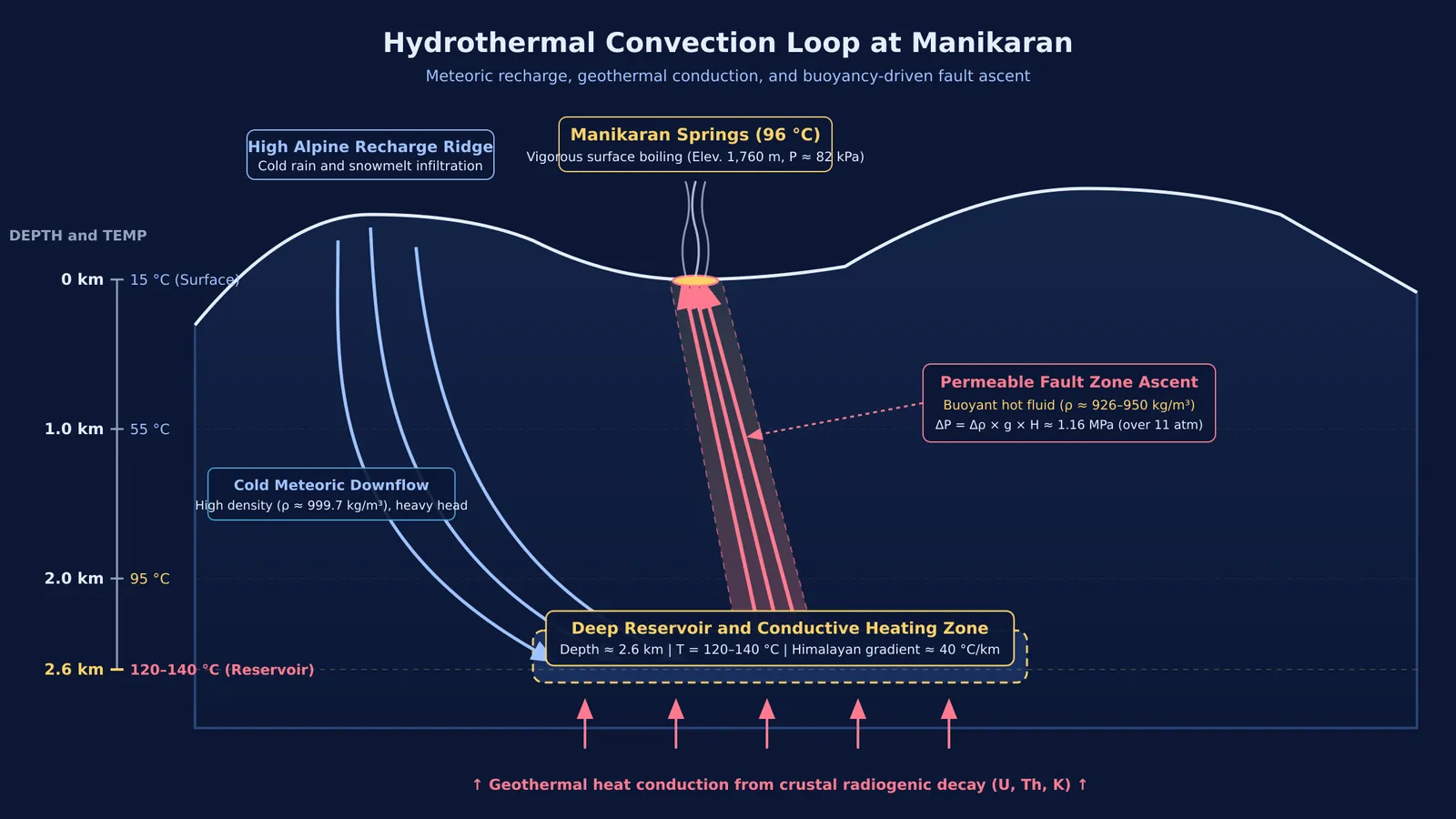
Hot springs do not require shallow magma chambers. Isotopic surveys by Giggenbach et al. (1983)90030-5) established that the thermal waters at Manikaran are meteoric—meaning they originated as atmospheric rain and snowmelt on high Himalayan ridges rather than juvenile volcanic fluid.
As the USGS Water Science School explains, groundwater becomes hot whenever it percolates deep enough to tap into Earth's geothermal gradient before returning quickly to the surface. Gravity pulls precipitation downward into deep tectonic fracture zones and joints within the Manikaran Quartzite. As the water sinks kilometres into the crust, it encounters hot rock, absorbing thermal energy through conduction, convection and radiation pathways.
How does groundwater absorb heat from Earth's interior?
Earth's interior retains heat from primordial accretion and the continuous radioactive decay of long-lived isotopes—principally potassium-40, uranium-238, and thorium-232—in the mantle and crust. This thermal energy conducts outward through bedrock toward the surface.
The global average continental geothermal gradient is roughly 25 °C to 30 °C per kilometre of depth, as noted by the USGS Water Science School. In tectonic collision zones like the Himalayas, crustal thickening elevates this gradient substantially. Chemical geothermometers evaluated by Giggenbach et al. (1983)90030-5) show that deep reservoir fluids beneath Manikaran reach equilibrium temperatures between 120 °C and 140 °C, following the rules of calorimetry and steady-state heat conduction.
What drives deep hot water back to the surface?
Heating deep underground reduces water's density. According to thermophysical data from the NIST Chemistry WebBook, liquid water has a density of roughly 999.7 kg/m³ at 10 °C, falling to 958.35 kg/m³ at 100 °C. At a deep reservoir temperature of 140 °C under confining hydrostatic pressure, its density drops to approximately 926 kg/m³.
This density gap generates powerful Archimedean buoyancy:
Cold, dense groundwater infiltrating high mountain slopes establishes a heavy downward hydrostatic head.
Deep, heated water expands, becoming significantly lighter per unit volume.
A net upward buoyant pressure differential forms across the vertical column: ΔP = (ρ_cold − ρ_hot) × g × H.
Just as Arthur Holmes's model of mantle convection showed how thermal density differences drive convective flow in the mantle, hydrothermal systems operate as fluid convection loops. Buoyancy pushes the hot fluid rapidly up permeable fault lines before conduction can cool it.
How deep does groundwater circulate to reach boiling temperatures?
To see how these principles operate together, consider a simplified hydrogeological model using reservoir and temperature gradient data from Giggenbach et al. (1983)90030-5):
Circulation depth: Cold recharge enters an alpine catchment at an average temperature of 15 °C. If the local geothermal gradient is 40 °C/km and geothermometry indicates a deep reservoir temperature of 120 °C, the required rise is ΔT = 120 °C − 15 °C = 105 °C. Dividing by the gradient gives a circulation depth of H = 105 °C / (40 °C/km) = 2.625 km (2,625 metres).
Density contrast: Based on NIST Chemistry WebBook data, the descending cold column averages roughly 985 kg/m³, while the ascending hot column averages about 940 kg/m³, giving Δρ = 45 kg/m³.
Buoyant pressure: The buoyant driving pressure is ΔP = Δρ × g × H = 45 kg/m³ × 9.8 m/s² × 2,625 m = 1,157,625 Pa, or approximately 1.16 MPa.
This driving pressure of 1.16 MPa corresponds to over 11 atmospheres of natural hydraulic head, driving rapid upward flow along fault planes.
How to connect geothermal convection to your exam prep
When studying thermal physics and fluid mechanics, students often treat thermal conduction, thermal expansion, and buoyancy as separate textbook topics. Natural heat engines like Manikaran show how they couple:
Thermal conduction transfers heat from bedrock to fluid down a temperature gradient.
Volumetric thermal expansion lowers fluid density as temperature climbs.
Hydrostatic pressure differences convert thermal energy into convective fluid motion.
If you struggle to picture how coupled temperature and flow fields behave in physical systems, the Fermi Simulation Lab provides interactive simulations for the ideas that are easier to see than to read. When tackling multi-concept problems linking fluid mechanics with thermodynamics, the Fermi Problem Library offers worked problems with a step-by-step solver that explains the reasoning rather than printing an answer.


