On this page
Pour water into the open dish on top of a Heron's fountain and, a moment later, a jet shoots up out of the middle of that same dish, higher than the dish itself. It is not water climbing for free. It is Class 11 fluid statics: pressure ρgh, carried from one vessel to another by trapped air.
What is Heron's fountain and who described it?
The device is named after Hero (or Heron) of Alexandria. The MacTutor biography of Heron at the University of St Andrews dates him to about AD 10 to 75 and describes his Pneumatica as a book of devices worked by air, steam or water pressure. The Museo Galileo catalogue entry for Hero's fountain credits the design to Hero and notes it was a common physics-cabinet demonstration into the early twentieth century. His aeolipile and triangle formula are in Hero of Alexandria's aeolipile and Heron's formula.
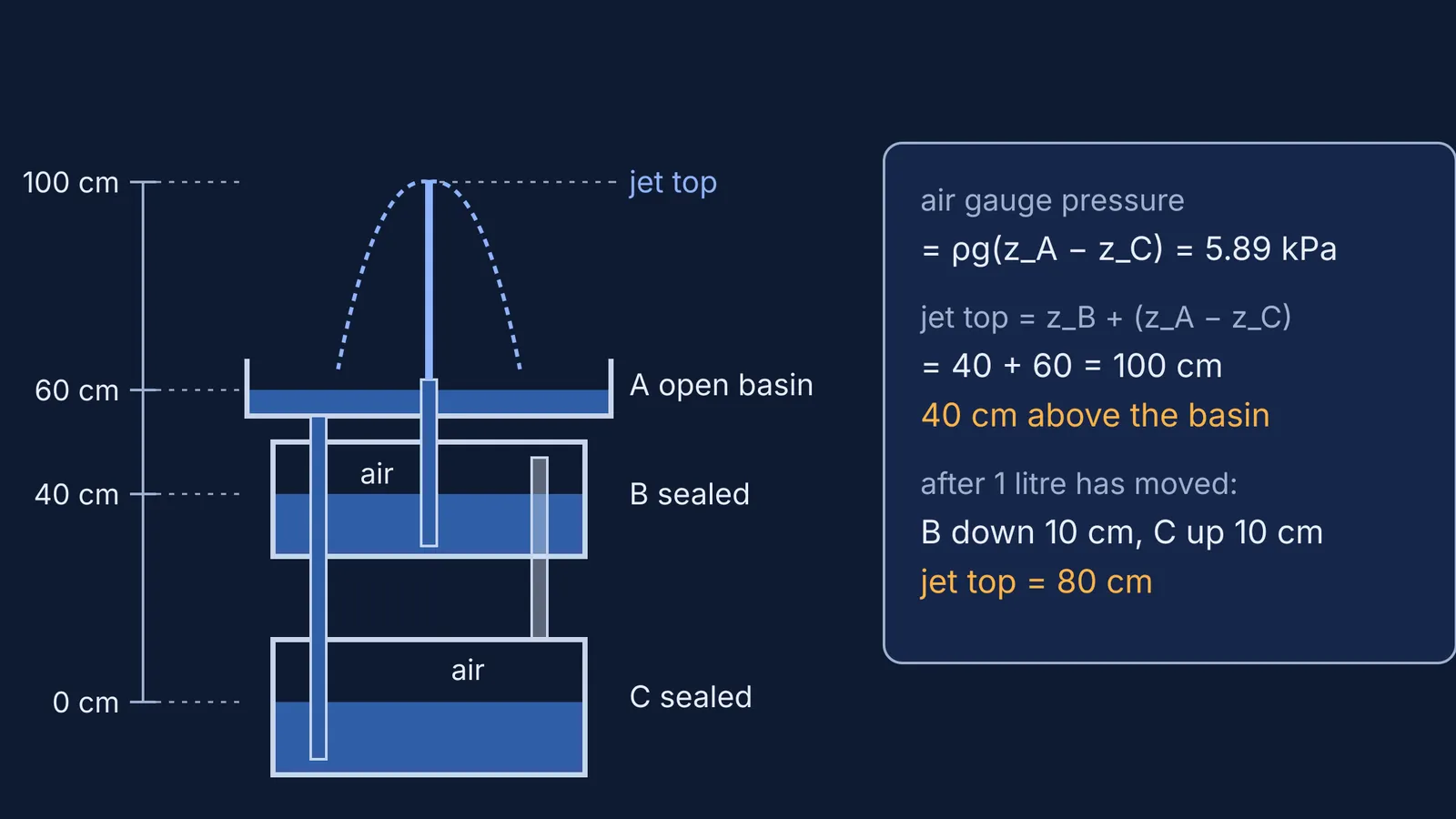
The fountain has three vessels, stacked one above the other:
A, an open basin at the top, which catches the jet.
B, a sealed middle chamber, full of water at the start, with air above the water.
C, a sealed bottom chamber, nearly empty of water at the start, mostly air.
A water tube runs from basin A down to the bottom of C. An air tube runs from the top of C into the air space of B. A jet tube rises from near the floor of B to a nozzle just above the water in A.
How does trapped air carry pressure from one chamber to another?
Call the heights of the three water surfaces z_A, z_B and z_C, measured from the same level.
Water falls from A to C. The water tube is full of water from basin A's surface down to the surface in C. So the pressure at C's water surface is atmospheric pressure plus ρg(z_A − z_C). The air in C sits on that surface, so it has the same pressure.
The air tube carries that pressure to B. Air weighs very little, so the air in B is at the same pressure as the air in C: gauge pressure ρg(z_A − z_C).
That air pushes water up the jet tube. Water in the jet tube can be held up a height ρg(z_A − z_C)/ρg = z_A − z_C above B's surface. So the top of the jet, with no friction, is at z_B + (z_A − z_C).
Compare that with basin A. The jet top minus z_A is z_B − z_C. So the jet rises above the basin by the height of B's water surface above C's. As long as B sits higher than C, the jet clears the basin.
Only vertical heights matter, not tube shapes or widths: the same "pressure depends only on depth" idea behind the hydrostatic paradox of differently shaped vessels.
Worked example: how high does the jet go?
Take a tabletop fountain with these illustrative dimensions:
Surface in C at z_C = 0, surface in B at z_B = 40 cm, surface in basin A at z_A = 60 cm.
Chambers B and C each 100 cm² in cross-section.
Nozzle 1.5 mm across, its tip at 62 cm. Water density 1000 kg/m³, g = 9.81 m/s².
Step 1: air pressure. Gauge pressure = ρg(z_A − z_C) = 1000 × 9.81 × 0.60 = 5886 Pa, about 5.89 kPa. That is only about 6% above atmospheric pressure.
Step 2: jet top. z_B + (z_A − z_C) = 40 + 60 = 100 cm. The basin is at 60 cm, so the jet tops out 40 cm above the basin, which equals z_B − z_C, as expected.
Step 3: exit speed. The water leaves the nozzle with the speed it would gain falling from the jet top to the nozzle: v = √(2g × 0.38 m) = 2.73 m/s.
Step 4: flow rate. Nozzle area = π × (0.75 × 10⁻³ m)² = 1.77 × 10⁻⁶ m². Flow = 1.77 × 10⁻⁶ × 2.73 = 4.8 × 10⁻⁶ m³/s, about 4.8 mL every second.
Where does the energy for the jet come from?
The jet does not get something for nothing. Follow 1 kg of water through one full loop in the ideal fountain:
It leaves B at 40 cm and is lifted to the jet top at 100 cm: it gains 9.81 × 0.60 = 5.89 J.
It lands in the basin and then falls from A at 60 cm to C at 0 cm: it loses 9.81 × 0.60 = 5.89 J.
The two match. The water falling from A to C pays for the water rising from B to the jet top. The air is only the go-between. The air volume barely changes: each litre entering C is matched by a litre leaving B.
Friction in the nozzle and tubes, and air drag, take some energy, so a real jet is lower than z_B + (z_A − z_C).
Why does the jet sink as the fountain runs?
Every litre that leaves B through the jet ends up, via the basin, in C. With 100 cm² chambers, 1 litre (1000 cm³) lowers B's surface by 10 cm and raises C's by 10 cm. The jet height above the basin, z_B − z_C, shrinks by twice that.
Start: z_B − z_C = 40 − 0 = 40 cm, jet top at 100 cm.
After 1 litre: z_B = 30 cm, z_C = 10 cm, so the jet top is 30 + (60 − 10) = 80 cm, only 20 cm above the basin.
Exit speed then: √(2 × 9.81 × 0.18) = 1.88 m/s, so the flow has dropped to about 3.3 mL/s.
Time taken: because the flow slows as the head falls, a step-by-step calculation gives about 4 minutes (246 s) for that first litre.
When it stops: the jet top reaches the nozzle at 62 cm once 1.9 litres have moved, unless chamber B runs dry first.
To restart it you refill B and empty C by hand, putting back the energy the water lost, so it is not a perpetual-motion machine. A siphon is the closest relative: how a siphon works and what limits its height covers a liquid moving between levels with no trapped air in between.
What mistakes do students make with Heron's fountain?
Using a vessel's depth instead of a height difference. The air pressure is set by z_A − z_C, not by the size of C.
Thinking the air supplies energy. It only transmits pressure, as in Pascal's law; falling water supplies the energy.
Adding atmospheric pressure twice. Use gauge pressure throughout; atmospheric pressure acts on the basin surface and on the jet, so it cancels.
To try variations such as a taller basin, the Fermi Problem Library has fluid statics problems with a step-by-step solver that explains the reasoning.
Quick checklist
Air gauge pressure = ρg(z_A − z_C), set by the falling column from basin A to chamber C.
Ideal jet top = z_B + (z_A − z_C); it clears the basin by z_B − z_C.
Worked example: 5.89 kPa, jet top 100 cm, 40 cm above the basin, 4.8 mL/s.
Energy in from water falling A to C equals energy out lifting water B to the top.
After each litre (100 cm² chambers), the jet top drops 20 cm.