

On this page
A large raindrop can weigh many times more than a mosquito and falls at several metres per second. Being hit by one sounds like being hit by a bus. Yet mosquitoes fly through heavy rain and survive direct hits. High-speed films made at Georgia Tech showed how, and the explanation is a chapter you already know: conservation of momentum. The mosquito survives not because the drop is soft, but because the mosquito is so light that it cannot take much momentum from the drop, and so cannot feel a large force.
What happens when a raindrop hits a flying mosquito?
Dickerson, Shankles, Madhavan and Hu, writing in PNAS in 2012, filmed mosquitoes being struck by drops and by jets of water at 9 m/s. Their mosquitoes had a body length of 3 mm and a mass of 2 mg. Raindrops, they note, have masses of about 4 to 100 mg, so 2 to 50 times the insect, and fall at terminal speeds of about 6 to 9 m/s.
What the films show:
The drop does not stop. It keeps falling at almost its original speed with the mosquito stuck to it.
The mosquito is pushed down for 5 to 20 body lengths while pinned to the drop.
It then slides off the side of the drop and flies on. Every mosquito struck by the jet survived the collision.
The mosquito accelerates at 100 to 300 g (g = 9.81 m/s²), which the authors suggest may be among the highest accelerations any animal survives.
The researchers also say it remains unknown whether flying insects can dodge raindrops. A mosquito flies at only about 1 m/s, far slower than the drops.
Why does momentum conservation protect the mosquito?
Treat the hit as a perfectly inelastic collision: drop and mosquito move together afterwards. Call the drop's mass m₁ and speed u, and the mosquito's mass m₂, roughly at rest. Momentum before equals momentum after:
m₁u = (m₁ + m₂)v, so v = m₁u/(m₁ + m₂)
If m₁ is much larger than m₂, v is almost equal to u. The drop barely slows down, so it loses very little momentum, and whatever momentum it loses is exactly what the mosquito gains: m₂v. That is small because m₂ is small.
The force on the mosquito is its own mass times its acceleration, F = m₂a. A light body cannot feel a large force without an enormous acceleration, and the insect's tough exoskeleton copes with that acceleration. The general rule for how much kinetic energy such a collision loses is worked in the fraction of kinetic energy lost in a perfectly inelastic collision.
Worked example: a 4 mm raindrop hits a 2 mg mosquito
Take a large drop 4 mm across falling at 9 m/s, the top of the range quoted in the study, and a 2 mg mosquito hovering in its path.
Mass of the drop. Radius R = 2 mm. m₁ = (4/3)πR³ρ = (4/3) × π × (2 × 10⁻³ m)³ × 1000 kg/m³ = 3.35 × 10⁻⁵ kg = 33.5 mg. That is 33.5 ÷ 2 = 16.8, about 17 times the mosquito's mass.
Shared speed. v = m₁u/(m₁ + m₂) = 33.5 × 9 ÷ 35.5 = 8.49 m/s. The drop loses only 0.51 m/s, about 6% of its speed.
Momentum the mosquito gains. Δp = m₂v = 2 × 10⁻⁶ kg × 8.49 m/s = 1.70 × 10⁻⁵ kg m/s.
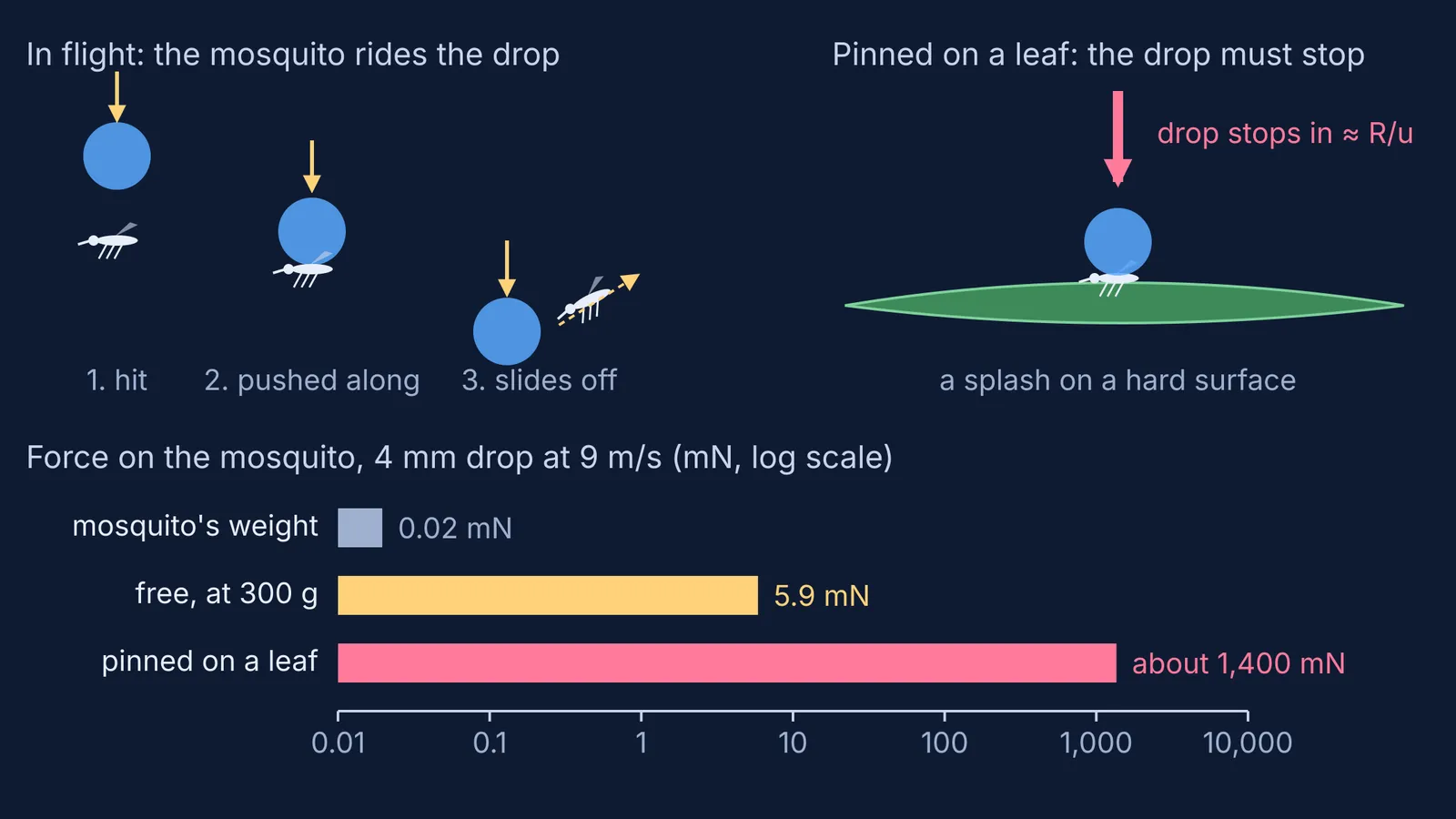
Force in flight. Use the measured upper acceleration of 300 g. F = m₂a = 2 × 10⁻⁶ × 300 × 9.81 = 5.9 × 10⁻³ N, about 6 mN. The study gives the same figure, 600 dyn. Compare the mosquito's weight, m₂g = 1.96 × 10⁻⁵ N: the force is 300 times its weight, but in absolute terms it is about the weight of a 0.6 g object.
How far it is carried. At 300 g it takes v/a = 8.49 ÷ 2943 = 2.9 ms to reach 8.49 m/s, covering ½vt = 12 mm, about 4 body lengths. At 100 g it takes 8.7 ms and 37 mm, about 12 body lengths. This fits the 5 to 20 body lengths seen in the films.
Kinetic energy lost. For a body hit while at rest, the fraction lost is m₂/(m₁ + m₂) = 2 ÷ 35.5 = 5.6%. The drop keeps almost all its energy.
Units check: kg × m/s² gives newtons, and all the masses were converted to kilograms first.
What if the mosquito is sitting on a leaf?
Now the mosquito cannot move, so the drop must stop. Its whole momentum, m₁u = 3.35 × 10⁻⁵ × 9 = 3.0 × 10⁻⁴ kg m/s, has to be removed. The study estimates the stopping time as the time to spread, τ ≈ R/u. For our drop, τ = 2 × 10⁻³ ÷ 9 = 0.22 ms.
F ≈ m₁u/τ = 3.0 × 10⁻⁴ ÷ 2.2 × 10⁻⁴ ≈ 1.4 N
That is an order-of-magnitude estimate, but it is about 70,000 times the mosquito's weight and about 230 times the force in flight. The study's smaller example drop gave 0.5 N, still 10,000 times the insect's weight. The same impulse idea, force equals change in momentum over time, is the one in impulse and force-time graphs for catches and airbags: stretch the time or reduce the momentum change and the force falls.
Why does flying low in rain put a mosquito at risk?
The drop carries the mosquito down several centimetres before it escapes. The authors point out that a mosquito flying too low may be driven into the ground at the drop's speed or into a puddle, and one mosquito in their tests that landed in water drowned, held by surface tension rather than hurt by the impact. In the heaviest rain they estimate a hovering mosquito is hit about once every 25 seconds, so hits are common and the low-mass trick matters.
Raindrops do not hurt people for a related reason: air drag caps their speed. That part, terminal speed and how it depends on drop size, is covered in why raindrops do not hurt when they fall from so high.
If momentum problems like this one trip you up, the Fermi Problem Library has a step-by-step solver that explains the reasoning.
Quick checklist
A drop hitting a hovering mosquito is a perfectly inelastic collision: v = m₁u/(m₁ + m₂).
A heavy drop barely slows; a 4 mm drop at 9 m/s keeps 94% of its speed.
The force on the mosquito is m₂a: about 6 mN at the measured 300 g.
Pinned on a hard surface, the drop must stop in about R/u, giving a force of order 1 N.
Light bodies cannot feel large forces in a free collision; that is the mosquito's protection.
The danger is flying low, where the ride ends on the ground or in water.


