

On this page
Look at almost any photo of a bright star taken through a big reflecting telescope and you see a sharp cross, or a star of six or eight points, around it. The spikes are added by the telescope, and the physics is single-slit diffraction turned inside out.
What causes diffraction spikes on stars?
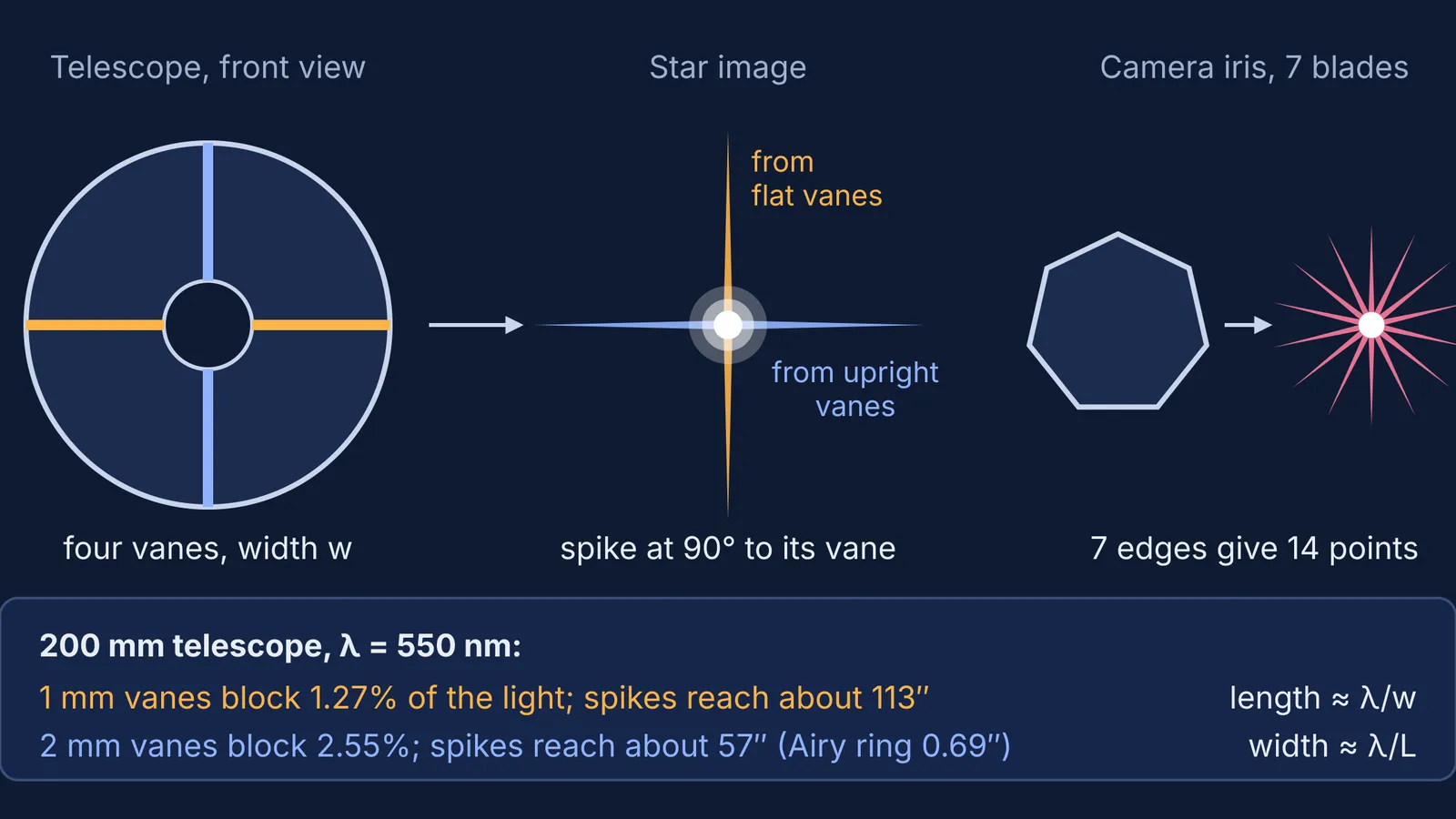
A reflecting telescope has a small secondary mirror in front of the main mirror. Thin metal strips called vanes (together, the "spider") hold it in place. Light passing each vane is diffracted by its straight edges.
NASA's description of the James Webb Space Telescope's star patterns says the same thing: in most reflecting telescopes the spikes appear when light meets the primary mirror's edges and the struts that hold the secondary mirror, and each strut makes a spike at right angles to itself (NASA and STScI, Webb diffraction spikes infographic). So the spikes are not in the sky, and they are not made by the air or your eye. A refractor with a clear round lens and no vanes shows no spikes.
The tool that makes the vane easy to handle is Babinet's principle: away from the centre of the image, an opaque strip diffracts light exactly like a slit of the same size. We used the same idea to measure a hair with a laser pointer, so here we only use the result.
Why is each spike at right angles to its vane?
Think of a vane as a slit that is very narrow one way (its thickness w, about a millimetre) and very long the other way (its length L, about 100 mm).
For a slit, the narrower the opening, the wider the light spreads. The first dark point of a single slit sits at an angle of about λ/a, which is the rule behind the width of the central maximum in single-slit diffraction. Apply it to both sizes of the vane:
Across the thin direction (w = 1 mm): the light spreads out to about λ/w. That is a long reach.
Along the long direction (L = 100 mm): the light spreads only about λ/L, a hundred times less.
So the light from one vane ends up in a long, thin streak. The streak runs across the vane, not along it. A vane lying flat makes an up-and-down spike, and an upright vane makes a sideways spike. Astronomers' Fourier-optics models give the same shape: a vane of width ε produces a spike whose brightness along its length follows a sinc(εk) curve, so its reach is set by the vane's thickness (Sivaramakrishnan and Lloyd, Astrophysical Journal, 2005).
A straight edge sends light to both sides equally, so one vane makes a pair of spikes pointing in opposite directions. Two vanes on one straight line, one on each side of the secondary mirror, make the same pair. That is why four vanes in a plus shape give four spikes, not eight. The Hubble Space Telescope's four-point stars come from exactly this layout (NASA infographic above).
How much light goes into the spikes? A worked example
Take an illustrative 200 mm telescope with four vanes running from the rim to the centre, each 100 mm long, in light of wavelength λ = 550 nm (green). We ignore the secondary mirror's own round shadow, which adds rings, not spikes.
Area of the opening. A = πR² = π × (100 mm)² = 31,416 mm².
Area covered by the vanes. 4 × w × L = 4 × 1 mm × 100 mm = 400 mm².
Fraction blocked. f = 400/31,416 = 0.0127, or 1.27%. This light is simply stopped by the metal.
Light sent into the spikes. By Babinet's principle, the spikes carry about as much light as a vane-shaped slit would let through, which is again about f, or roughly 1.3% of the starlight.
Effect on the star's peak. The centre of the image is the sum of all the light waves arriving in step, so its brightness scales as (1 − f)² = 0.975. The peak drops by about 2.5%: half lost on the metal, half moved into the spikes.
How far the spikes reach. θ ≈ λ/w = 550 × 10⁻⁹ / 1 × 10⁻³ = 5.5 × 10⁻⁴ rad. Multiply by 206,265 arcseconds per radian: about 113 arcseconds.
Compare with the star's own image. The first dark ring of the Airy pattern is at 1.22λ/D = 1.22 × 550 × 10⁻⁹ / 0.2 = 3.4 × 10⁻⁶ rad, or 0.69 arcseconds. The spike reaches about 160 times farther.
How wide the spike is. λ/L = 550 × 10⁻⁹ / 0.1 = 5.5 × 10⁻⁶ rad, about 1.1 arcseconds, comparable to the star's core. That is why the spike looks like a fine line.
Now make the vanes 2 mm thick. The blocked fraction doubles to 2.55%, and the spikes reach only λ/w = 57 arcseconds. Thicker vanes give brighter but shorter spikes. Studies of real telescopes show the vanes' effect on image quality depends on which measure you use, the peak brightness, the energy near the core or the contrast of fine detail (Harvey and Ftaclas, Applied Optics, 1995). How the Airy disc itself limits sharpness is in why f/16 softens a photo.
How many spikes does a camera iris make?
Streetlights in night photos turn into stars too. A stopped-down camera iris is a polygon, and each straight edge throws a pair of spikes at right angles to itself.
Even number of blades (6, 8): the polygon's edges come in parallel pairs, so the two spike pairs from opposite edges land on the same line. Six blades give 6 points, eight give 8.
Odd number of blades (5, 7, 9): no two edges are parallel, so no spikes overlap. Each edge adds two points: 5 blades give 10, 7 give 14, 9 give 18.
Webb shows how both rules mix. Its 18 hexagonal mirror segments have edges in three directions, which give six main spikes, and its three struts add more, partly overlapping, for an eight-point pattern (NASA infographic above). To watch a pattern change with the opening, try the diffraction models in the Simulation Lab.
Can a telescope get rid of diffraction spikes?
Yes, in three common ways.
No obstruction. A refractor, or a reflector with its mirrors tilted off-axis, has nothing across the opening, so there is nothing to diffract into a line.
Curved vanes. A curved vane has no single straight direction, so its light spreads around a circle instead of collecting in a sharp line. The total diffracted light is about the same; it is just not concentrated.
Thinner vanes. These send less light out of the core, though the spikes get longer.
None of these remove the Airy rings, which come from the round edge of the mirror itself.
Quick checklist
Spikes come from the instrument: vanes, strut edges and polygon apertures.
Babinet's principle: a thin vane diffracts like a slit of the same size.
Each straight edge makes a spike pair at right angles to itself.
Reach ≈ λ/w (vane thickness); width ≈ λ/L (vane length).
Light into the spikes ≈ fraction of the opening the vanes cover; 1 mm vanes in 200 mm give about 1.3%.
Even blade count N gives N points; odd N gives 2N.


