On this page
Photographers learn early that closing the aperture down, from f/2.8 to f/8 or f/16, gives more depth of field. Then they notice that a landscape shot at f/22 looks softer than the same shot at f/8, even with a perfect tripod. Nothing is out of focus. The blur comes from diffraction at the aperture, the same physics as the single-slit and circular-aperture patterns in Class 12 wave optics. This post works out how big that blur is, compares it with real pixel sizes, and shows why a phone camera with tiny pixels runs into the limit at almost any aperture.
What limits sharpness when you stop a lens down?
Light from one distant point arrives at the lens as a plane wave. The aperture is a circular hole of diameter D, so the wave diffracts. Instead of a point, the sensor receives an Airy pattern: a bright central disc surrounded by faint rings. The first dark ring sits at an angle θ = 1.22λ/D from the centre, the same result you use for the resolving power of a telescope.
The lens focuses that angle onto the sensor at a distance f, the focal length. So the radius of the central disc on the sensor is fθ = 1.22λf/D. The ratio f/D is the f-number N. That gives the key result:
Radius of the Airy disc (to the first dark ring) = 1.22λN
Diameter of the Airy disc = 2.44λN
Notice what is missing. The focal length and the lens diameter do not appear on their own; only their ratio does. A 24 mm lens at f/16 and a 200 mm lens at f/16 make the same size of Airy disc on the sensor. Why N also sets brightness and depth of field is covered in how camera aperture size affects brightness and blur, so it is not repeated here. The same 1.22λ factor, written with numerical aperture instead of f-number, sets the size of a focused laser spot, as worked in why a Blu-ray holds five DVDs.
How big is the Airy disc at f/2.8, f/8, f/16 and f/22?
Worked example. Take green light, λ = 550 nm = 0.55 µm, near the middle of the visible range.
Write the formula. d = 2.44λN, with λ in micrometres so that d comes out in micrometres.
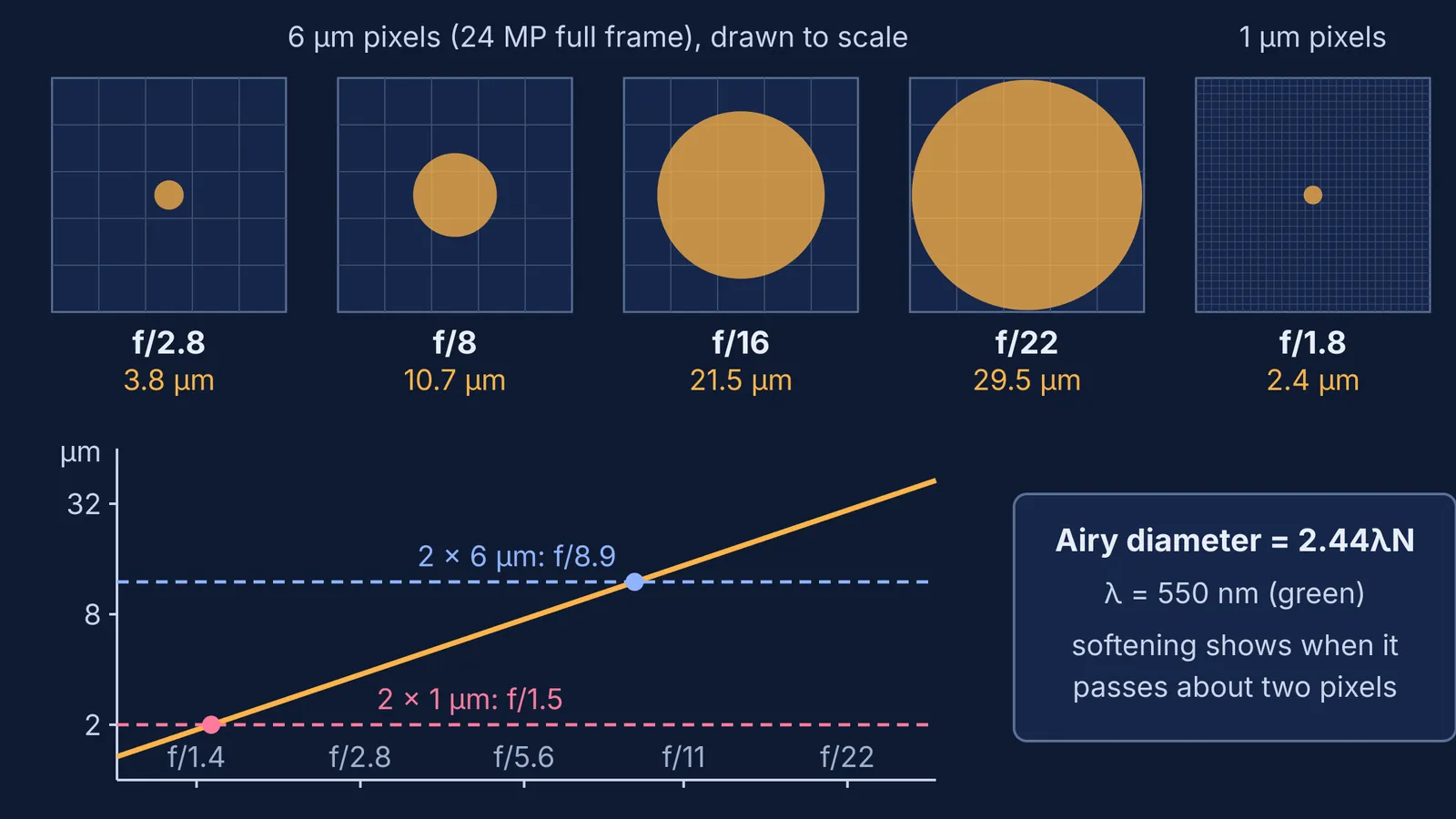
f/2.8. d = 2.44 × 0.55 × 2.8 = 3.76 µm, about 3.8 µm.
f/8. d = 2.44 × 0.55 × 8 = 10.7 µm.
f/16. d = 2.44 × 0.55 × 16 = 21.5 µm.
f/22. d = 2.44 × 0.55 × 22 = 29.5 µm.
Check the scaling. d is proportional to N. Going from f/2.8 to f/16 multiplies N by 16/2.8 = 5.7, and 21.5/3.76 = 5.7 as well.
Check the units. λ is a length and N is a pure number, so d is a length. Good.
For red light at 700 nm the disc at f/16 grows to 2.44 × 0.70 × 16 = 27.3 µm, so diffraction is a little worse at the red end of the spectrum.
The Rayleigh criterion says two points are just resolved when the centre of one disc falls on the first dark ring of the other, so the smallest separation you can resolve on the sensor is the radius, 1.22λN. At f/16 that is 10.7 µm.
When does the Airy disc become bigger than a pixel?
The pixel pitch is the sensor width divided by the number of pixels across it.
24 MP full frame. 36 mm across, 6,000 pixels: 36 mm / 6,000 = 6.0 µm.
24 MP APS-C. About 23.5 mm across, 6,000 pixels: 3.9 µm.
A 60 MP full frame. 36 mm across, 9,504 pixels: 3.8 µm.
There is no single f-number where diffraction "switches on". Softening grows gradually as N rises. A common rule of thumb is that it starts to show at 100% view once the Airy disc spans about two pixels. Treat that as one convention among several, not a law. Setting 2.44λN = 2p and solving for N gives N = 2p / (2.44λ):
6.0 µm pixels: N = 12 / 1.342 = 8.9
3.9 µm pixels: N = 7.8 / 1.342 = 5.8
3.8 µm pixels: N = 7.6 / 1.342 = 5.7
So a 24 MP full-frame camera stays crisp to about f/9, while a high-resolution body or a smaller sensor with the same pixel count begins to soften from about f/5.6. At f/16 on 6 µm pixels the disc is 21.5 / 6.0 = 3.6 pixels wide, which is why that f/16 landscape looks soft.
Why is a phone camera already diffraction-limited?
Phone sensors are tiny, so their pixels are tiny. Samsung lists its ISOCELL GN1 as a 50 MP sensor with 1.2 µm pixels, and its ISOCELL JN1 as a 50 MP sensor with 0.64 µm pixels. Take a round illustrative value of 1.0 µm, between the two.
Two-pixel threshold. 2p = 2.0 µm.
Solve for N. N = 2.0 / (2.44 × 0.55) = 1.49, so about f/1.5.
Compare a typical lens. Many phone main cameras sit around f/1.8 (an illustrative value; check your own phone). There d = 2.44 × 0.55 × 1.8 = 2.4 µm, already 2.4 pixels wide.
Smaller pixels. On 0.64 µm pixels the same f/1.8 disc covers 2.4 / 0.64 = 3.8 pixels.
Phone lenses have no adjustable aperture to blame: they are near the diffraction limit wide open. Adding more, smaller pixels behind the same lens therefore gives less extra detail than the pixel count suggests. Samsung's own JN1 page describes combining four 0.64 µm pixels into one 1.28 µm pixel in low light, which trades pixel count for signal.
So which f-number gives the sharpest photo?
Two effects pull in opposite directions. At wide apertures, lens aberrations usually dominate, because rays through the edge of a large lens do not meet at quite the same point. Closing the aperture cuts those edge rays and the image gets sharper. Keep closing it and the Airy disc grows until it dominates. The sharpest setting for most interchangeable lenses is therefore somewhere in between, and it is found by testing, not by the formula alone.
Two more cautions. Most sensors put a colour filter over each pixel and rebuild full colour from neighbours, so one pixel is not one fully independent sample. And the eye has its own diffraction limit, which decides whether you can even see the difference at normal viewing distance; that is worked in how many pixels your eye can see.
If circular-aperture diffraction still feels abstract, the Fermi Simulation Lab has interactive simulations for ideas that are easier to see than to read.
Quick checklist
Each point becomes an Airy disc of diameter 2.44λN on the sensor.
Only the f-number matters, not focal length or lens size alone.
At 550 nm: 3.8 µm at f/2.8, 10.7 µm at f/8, 21.5 µm at f/16, 29.5 µm at f/22.
Pixel pitch = sensor width / pixels across.
Rule of thumb: softening shows when the disc passes about two pixels, N ≈ 2p / (2.44λ).
Phone pixels near 1 µm reach that point at about f/1.5, so they are diffraction-limited wide open.
Softening is gradual, and aberrations make the widest aperture soft too.