

On this page
A flounder lies buried under a layer of sand. A shark swims over it, cannot see it, and still turns and bites in the right place. It finds the fish by feeling the faint electric field that every living body leaks into the water. The fields involved are a few billionths of a volt per centimetre, and you can work them out with the induction from your syllabus. This post does three calculations: the voltage across one sensing canal, the motional field a shark makes by swimming through Earth's magnetic field, and how far a prey fish's field reaches.
How does a shark sense an electric field?
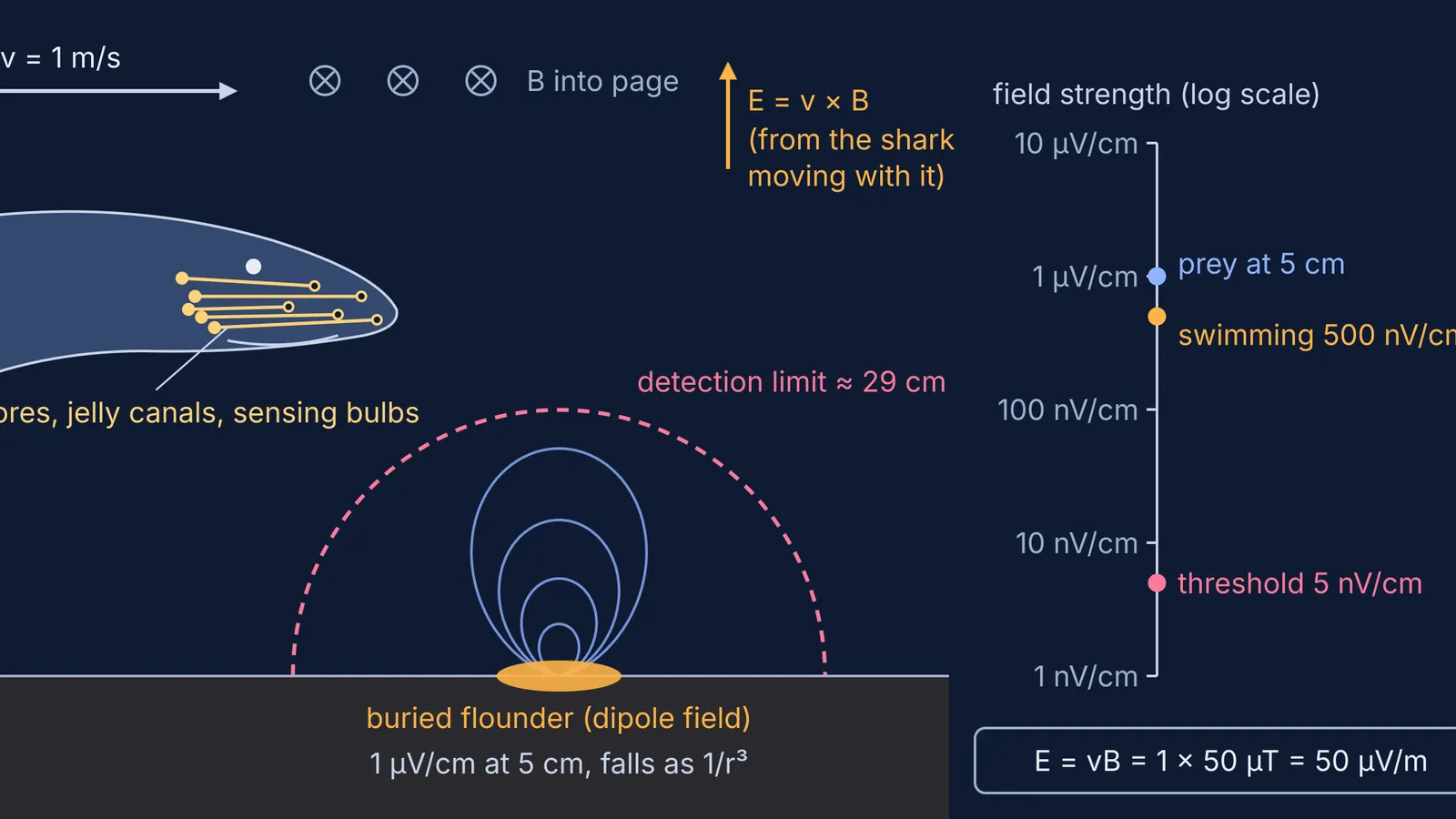
Sharks, skates and rays carry hundreds of small pores on the snout and head. Each pore opens into a canal filled with a jelly that conducts electricity well. The canal runs under the skin to a small bulb, the ampulla, lined with sensing cells. Together these are called the ampullae of Lorenzini.
Because the jelly is a good conductor and the canal wall is a good insulator, the potential at the pore is carried almost unchanged to the bulb. The sensing cells there compare that potential with the potential of the tissue around the bulb. So each canal works like a voltmeter with one probe at the skin pore and the other deep inside the head. A longer canal spans more of an external field, so it sees a larger voltage.
The ampullae sense electric fields. The lateral line, a row of pressure-sensing canals along the body, senses water movement. And a shark only senses electricity. Fish that make large voltages, such as the one in how an electric eel makes 600 volts with cells in series, are a different story.
How small is 5 nanovolts per centimetre?
In field and training experiments, Adrianus Kalmijn found that sharks and stingrays responded to electric fields as weak as about 5 nV/cm (Kalmijn, Science 1982). The exact threshold depends on the species and on how the experiment is done. A later study of sawfish and shovelnose rays found median response thresholds between about 5 and 80 nV/cm (Wueringer and others, PLoS ONE 2012). So treat 5 nV/cm as the sensitive end of the range, not a fixed constant.
Convert it to SI units first. 1 nV/cm = 10⁻⁹ V per 10⁻² m = 10⁻⁷ V/m. So 5 nV/cm = 5 × 10⁻⁷ V/m.
The potential difference across a canal of length L in a uniform field E is V = EL. For a 10 cm canal:
V = 5 × 10⁻⁷ V/m × 0.10 m = 5 × 10⁻⁸ V = 50 nV.
To picture it: a 1.5 V torch cell would make this field only if its two terminals were wired to plates 1.5 / (5 × 10⁻⁷) = 3 × 10⁶ m, or 3,000 km, apart.
What happens when a shark swims through Earth's magnetic field?
A conductor moving with velocity v through a magnetic field B feels a force qv × B on its charges. In the conductor's own frame this acts like an electric field of size E = vB, using only the part of B perpendicular to v. This is the same motional emf as in the EMF between aeroplane wing tips and the electrodynamic tether that makes kilovolts in orbit. A shark's body and the jelly in its canals are conductors, and the current loop can close through the surrounding seawater, which is not moving with the shark.
Earth's magnetic field is roughly 25,000 to 65,000 nT, that is 25 to 65 µT, depending on where you are (NOAA NCEI geomagnetism FAQ).
Worked example. A shark swims at 1 m/s through a 50 µT field. How does the motional field compare with its 5 nV/cm threshold?
Take the perpendicular part of B. For an upper estimate, assume the whole 50 µT is perpendicular to the shark's path.
Find E. E = vB = 1 m/s × 50 × 10⁻⁶ T = 5 × 10⁻⁵ V/m.
Check units. m/s × T = m/s × V·s/m² = V/m.
Convert. 5 × 10⁻⁵ V/m = 5 × 10⁻⁷ V/cm = 500 nV/cm.
Compare. 500 / 5 = 100. The motional field is 100 times the threshold.
A more modest case. If only 30 µT is perpendicular to the path, E = 3 × 10⁻⁵ V/m = 300 nV/cm, which is 60 times the threshold.
Across a 10 cm canal. V = 5 × 10⁻⁵ × 0.10 = 5 × 10⁻⁶ V = 5 µV.
Because E = v × B depends on direction, the signal changes with heading. Swim along the field lines and it vanishes; swim across them and it is largest. Kalmijn proposed that this could let sharks and rays sense their compass heading. The sense is sensitive enough in principle, but whether wild sharks actually navigate this way is debated.
Seawater also moves through Earth's field, so ocean currents make motional fields of their own. Kalmijn's rays were trained on uniform fields of that kind. The worked example above keeps to the shark's own motion through still water.
How far away can a shark detect a buried fish?
A fish leaks ions at its gills and mouth, so the water around it carries a weak field. Close to the fish, that field is roughly a dipole field, and a dipole's field falls as 1/r³, not 1/r² like a single charge.
Worked example. Suppose a flounder makes 1 µV/cm at 5 cm. This is an illustrative round value, not a measurement. How far away does the field fall to 5 nV/cm?
Ratio to lose. 1 µV/cm ÷ 5 nV/cm = 1000 / 5 = 200.
Use E ∝ 1/r³. The distance must grow so that r³ grows 200 times: r = 5 cm × 200^(1/3).
Cube root. 200^(1/3) ≈ 5.85, so r ≈ 29 cm.
Sensitivity check. A fish twice as strong reaches only 2^(1/3) ≈ 1.26 times further, about 37 cm.
Smell and hearing bring a shark close, sight helps at medium range, and the electric sense guides the last part of the strike, often when the prey is right under the snout and out of view.
If you want to practise turning a field formula into a range like this, the Fermi Problem Library has a step-by-step solver that explains the reasoning at each line.
What mistakes cost marks on questions like this?
Mixing V/cm and V/m. That is a factor of 100.
Using the whole of B in E = vB when only the component perpendicular to v counts.
Using 1/r² for a dipole. With 1/r² you would get 5 × √200 ≈ 71 cm, more than twice the dipole answer.
Calling the lateral line the electric sense. It senses water movement.
Writing that sharks navigate by Earth's field as if it were settled. It is a proposal.
Quick checklist
Ampullae of Lorenzini: pore, jelly-filled canal, sensing bulb; each canal reads the voltage between skin and body.
Threshold near 5 nV/cm = 5 × 10⁻⁷ V/m, varying with species.
10 cm canal at threshold: 50 nV.
Swimming at 1 m/s through 50 µT: E = vB = 500 nV/cm, 100 times threshold.
Prey dipole field falls as 1/r³, so 1 µV/cm at 5 cm drops to threshold at about 29 cm.


