On this page
Your hand never moves faster than a few tens of metres per second, yet a whip can make a sharp bang like a tiny explosion. That bang is a small sonic boom: some part of the whip is moving faster than sound, about 343 m/s in air at 20 °C. The question is how a slow flick becomes a supersonic tip. The answer is a Class 11 energy argument: the same energy squeezed into less and less moving mass.
Why does a whip crack at all?
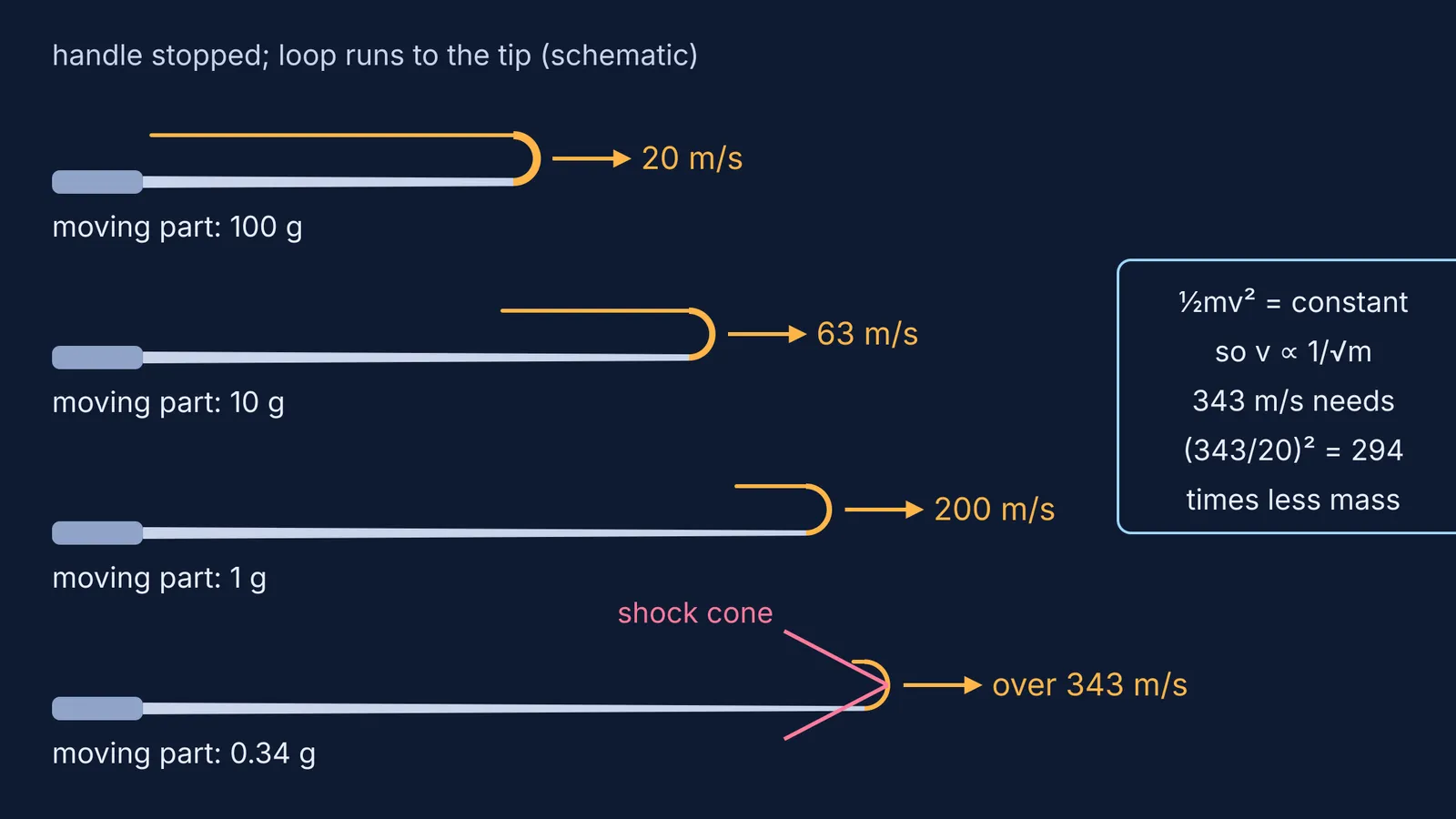
When you flick the handle forward and stop it, the whip does not move as one piece. A loop forms near the handle and runs along the whip towards the tip. Behind the loop, the whip has stopped. Ahead of the loop, the part that is folded back is still moving. As the loop travels, the stopped part grows and the moving part shrinks.
The crack is not the whip hitting itself, and it is not the air being slapped. It is a shock wave, the same thing as the boom from a supersonic jet, only much smaller. Why an object faster than sound leaves a cone-shaped shock behind it is explained in Mach number and the sonic boom, so here we only need the condition: something must exceed 343 m/s.
How does a slow flick become a supersonic tip?
Make one simple assumption: the kinetic energy you put into the moving part stays in the moving part as the loop runs along. Then
½mv² = constant, so v ∝ 1/√m.
If the moving mass falls 100 times, the speed rises 10 times. A whip is made thick at the handle and thin at the tip (it tapers), so the mass still in motion drops very fast as the loop nears the end. That taper is what turns a gentle flick into a fast tip.
You have seen two cousins of this idea. A string pulled through a hole in a table speeds up the particle on its end, which is worked in why a particle pulled through a hole speeds up, though there it is angular momentum that is kept. And on a thinner, lighter section of a string, a wave runs faster, since v = √(T/μ) grows as μ falls; see wave speed in a wire from stress and density. Goriely and McMillen's model of a cracking whip (Physical Review Letters, 2002) studies exactly how tension and taper make a pulse speed up as it travels along a whip.
How much must the moving mass shrink to reach 343 m/s? A worked example
These are illustrative round numbers, not measurements of a real whip.
Energy at the start. The loop sets 0.1 kg (100 g) of whip moving at 20 m/s. E = ½ × 0.1 × 20² = 20 J.
When only 10 g is moving. v = √(2E/m) = √(2 × 20 / 0.01) = 63 m/s.
When only 1 g is moving. v = √(40 / 0.001) = 200 m/s.
Mass needed for 343 m/s. m = 2E/v² = 40 / 343² = 3.4 × 10⁻⁴ kg = 0.34 g.
The ratio. 100 g / 0.34 g = 294. You get the same answer without the energy: m_end/m_start = (20/343)² = 1/294.
Check the units. E in J = kg m²/s², divided by kg gives m²/s², and the square root gives m/s.
A harder flick at 30 m/s puts in E = ½ × 0.1 × 30² = 45 J, so the mass need only fall to 2 × 45 / 343² = 0.76 g, a factor of 131. A faster flick needs much less taper to reach the same speed.
What do high-speed photographs show about the crack?
Peter Krehl, S. Engemann and D. Schwenkel filmed cracking whips at high speed and photographed the shock waves at the same time. Their paper, "The puzzle of whip cracking" in Shock Waves (1998), correlated the motion of the tip with the moment the shock appeared. As Science News reported, they recorded no shock until the tip was moving at about 744 m/s, more than twice the speed of sound (744/343 = 2.2). At that speed the shock cone's half-angle is sin⁻¹(343/744) = 27°.
That leaves a puzzle: the tip must pass 343 m/s first, so why no boom then? Goriely and McMillen's model gave one possible answer. In their picture, the front edge of the loop itself goes supersonic as it unrolls near the tip, and that loop makes the shock; the tip is still inside the loop's wake and cannot make its own. Krehl's team linked the shock to the turn-around of the cracker at the end of the lash.
The two accounts disagree about which part of the whip makes the boom. Both agree on the main point: a part of the whip goes supersonic, and the taper is what gets it there. Treat the detailed mechanism as still debated rather than settled.
Why is the simple 1/√m law only an estimate?
Air drag grows as v², so the fast, thin end loses energy fastest.
Bending the whip into a loop and unrolling it costs energy and turns some into heat.
Tension in the whip passes energy along, not just mass, so the motion is a travelling wave rather than a set of separate bits.
Your hand keeps working through the first part of the throw.
So the ideal law overestimates the tip speed for a given flick, and real whips need more taper or a harder throw than the sum suggests. If you want more problems that mix energy ratios and waves like this, the Fermi Problem Library has a step-by-step solver that explains the reasoning.
A safety note: a whip tip at these speeds can cut skin and damage eyes. Never crack one near people or animals.
Quick checklist
The crack is a small sonic boom, not the whip hitting itself.
A loop runs down the tapering whip; the moving mass shrinks behind it.
Same energy, less mass: ½mv² = constant gives v ∝ 1/√m.
From 20 m/s to 343 m/s needs (343/20)² = 294 times less moving mass.
Photographs put the shock near 744 m/s; loop versus tip as the source is still debated.
Drag and bending mean the ideal law overestimates the speed.