On this page
A fighter jet streaks over at twice the speed of sound, and for a few seconds you hear nothing. Then, well after it has passed, the boom arrives. Here is how they fit, with a worked example you can reuse in board exams and JEE Main.
What is Mach number?
NASA's Glenn Research Center describes Mach number as the ratio of an object's speed to the speed of sound in the gas around it (NASA, Mach number). In symbols, M = v / v_sound.
The same NASA page sorts flight into bands:
Subsonic: M less than 1
Transonic: M close to 1
Supersonic: M from 1 to 3, with high supersonic from 3 to 5
Hypersonic: M greater than 5
Mach number is a ratio, not a fixed speed, because the speed of sound depends on temperature. NASA gives it as a = √(γRT), about 761 mph (roughly 340 m/s) at standard sea-level conditions, and it changes with altitude as the air temperature changes (NASA, speed of sound). Our explainer on how temperature and humidity change the speed of sound goes through that dependence.
Why does a shock cone form, and what sets its angle?
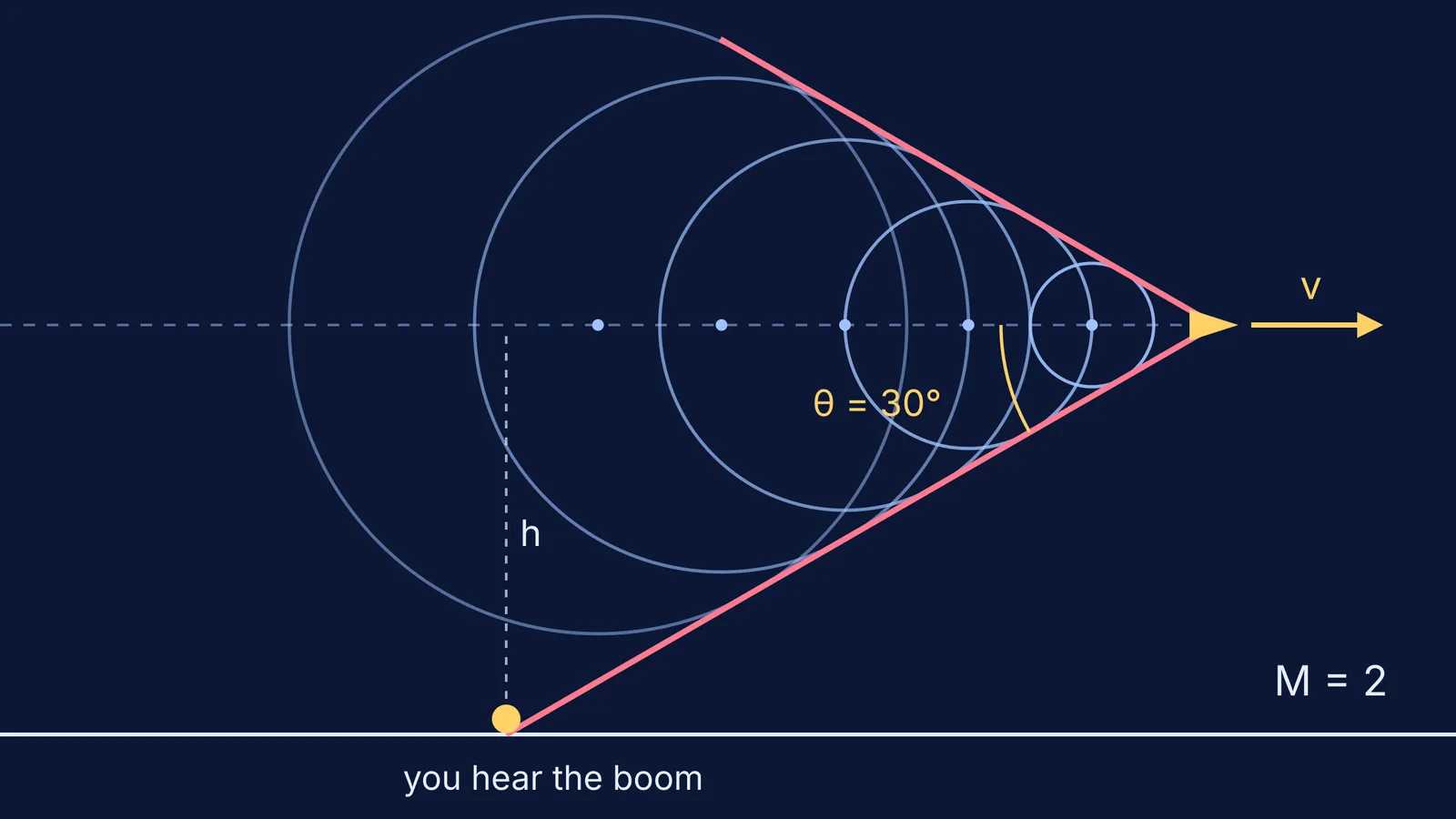
Every point on the jet's path sends out a sound wave that spreads as a sphere at v_sound. Below Mach 1, the jet stays inside its own waves. Above Mach 1, it outruns them, and the edges of all those spheres line up along a cone with the jet at the tip.
Take a wave sent out t seconds ago. Its radius is v_sound × t, and the jet has since moved v × t. The cone's edge just touches that sphere, so the right triangle gives sin θ = v_sound / v = 1 / M.
Here θ is the half-angle of the cone, measured from the flight path to the cone's edge. NASA's page on the Mach angle gives the same result, μ = asin(1/M), and notes that in supersonic flow small disturbances are confined inside this cone (NASA, Mach angle). At Mach 2, sin θ = 0.5, so θ = 30°. Faster jets make narrower cones. To watch the cone close up as speed rises, see our Mach cone shock wave simulation walkthrough.
When do you hear a sonic boom?
You hear the boom when the cone's surface sweeps over you, not at the moment the jet passes Mach 1. NASA's Dryden fact sheet says that as the cone spreads across the landscape along the flight path, it creates a continuous sonic boom along the full width of its base (NASA Facts: Sonic Booms). The same sheet notes that the nose and tail make two cones, usually heard as a single boom, and that the pressure change is only a few pounds per square foot, about what you feel riding a lift down two or three floors.
How long after a fighter jet passes do you hear the boom?
A fighter flies level at Mach 2, 6,000 m above you. Assume sound travels at 340 m/s all the way down. Real air is colder higher up, so this is an estimate.
Jet speed: v = 2 × 340 = 680 m/s.
Cone angle: sin θ = 1/2, so θ = 30°.
Where is the jet when the cone reaches you? The cone's edge meets the ground a horizontal distance x behind the jet, with tan θ = h / x. So x = 6,000 / tan 30° = 6,000 / 0.577 ≈ 10,400 m.
Time since the jet was overhead: t = x / v = 10,400 / 680 ≈ 15.3 s.
There is a neat shortcut. Since v = v_sound / sin θ, the steps collapse to t = (h / v_sound) × cos θ. With h / v_sound = 6,000 / 340 ≈ 17.6 s:
Mach 1.2: θ ≈ 56°, t ≈ 9.8 s
Mach 2: θ = 30°, t ≈ 15.3 s
Mach 3: θ ≈ 19.5°, t ≈ 16.6 s
The faster jet's boom arrives later, but never later than h / v_sound, the time sound would take to come straight down.
What mistakes do students make with Mach cone problems?
Writing sin θ = v / v_sound. A sine cannot exceed 1, so the smaller speed goes on top.
Treating θ as the full opening angle. The formula gives the half-angle; the full cone is 2θ.
Timing from when you see the jet rather than from when it is overhead.
Assuming the boom happens once, at Mach 1.
The Fermi Problem Library has worked problems with a step-by-step solver that explains the reasoning rather than printing an answer, so you can see which side of the triangle went wrong. If the wave picture itself feels shaky, the Fermi Concept Library gives each physics concept its own lesson.
For the scientist behind the number, read Ernst Mach, shock waves and the number on every fighter jet.