

On this page
When an aircraft travels through the air, it pushes against the molecules ahead of it, creating pressure disturbances that travel outward at the speed of sound. If the aircraft moves slower than sound, these waves ripple away ahead of the plane. But what happens when the aircraft outruns its own sound waves?
How does a Mach cone form?
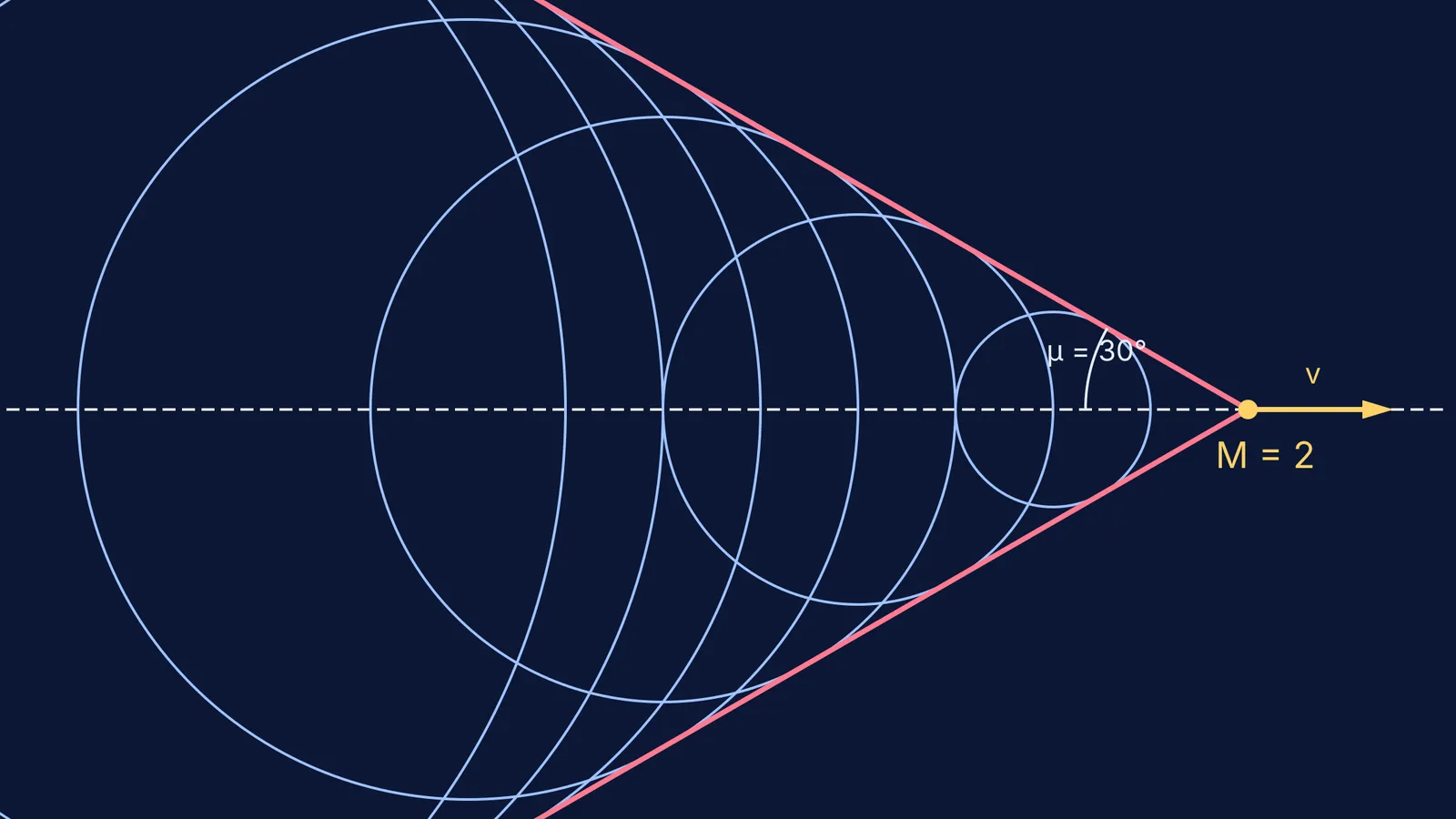
When an object travels at supersonic speeds (faster than the local speed of sound), the sound waves it emits cannot move forward fast enough to get out of its way. Instead of spreading out in all directions, these expanding spherical wavefronts merge and pile up, forming a single, massive pressure wave.
This boundary is called a shock wave. In three dimensions, this overlapping wave creates a conical shape trailing behind the aircraft, known as a Mach cone. The edge of this cone marks a sudden, intense change in pressure and temperature. If you were standing on the ground as this cone passed over you, you would experience this sudden pressure jump as a sonic boom.
Understanding how longitudinal waves propagate is key here; you can explore this further in our guide on Displacement and pressure waves in sound: the 90° phase shift.
What is the difference between the zone of action and zone of silence?
If you are standing ahead of a supersonic aircraft, you will not hear it approaching. This is because the aircraft is moving faster than the sound it generates. According to the principles of Mach waves, all of the pressure disturbances are confined within the Mach cone itself, creating a clear physical division in the atmosphere.
The area inside the cone, trailing behind the jet, is called the "zone of action." This is where the sound waves and pressure changes are actually felt. The area outside and ahead of the cone is called the "zone of silence." In this region, there is absolutely no upstream influence. The air remains completely undisturbed because the sound waves simply cannot travel fast enough to reach it. When the edge of the cone finally sweeps over your position on the ground, the sudden change in pressure hits your ear all at once.
How do you calculate the Mach angle?
The shape of the cone is not fixed, but changes depending on how fast the object is moving relative to the speed of sound. The half-angle at the tip of the cone is called the Mach angle (denoted by the Greek letter μ).
According to the geometry of a Mach wave, the Mach angle is defined by a simple trigonometric relationship between the speed of sound (a) and the velocity of the object (v):
sin(μ) = a / v
Because the Mach number (M) is defined as the object's velocity divided by the speed of sound (M = v / a), the formula is most commonly written as:
sin(μ) = 1 / M
This inverse relationship means that as the aircraft flies faster (increasing M), the Mach angle gets smaller, and the cone becomes narrower and more pointed. To review how to track moving objects geometrically in two dimensions, you can revise Motion in a plane from r(t): velocity and acceleration vectors.
What happens in a Mach cone shock wave simulation?
If you are studying for competitive exams like JEE or simply exploring physics, picturing these overlapping spheres in your head can be difficult. Running a Fermi Simulation Lab interactive model can make this geometric relationship instantly clear. Instead of just memorising the formula, you can change the aircraft's speed, watch the wavefronts interact, and see the zone of action form in real time.
Consider a worked example for an aircraft flying at Mach 2:
Identify the Mach number: M = 2.
Apply the formula: sin(μ) = 1 / 2.
Solve for the angle: μ = arcsin(0.5).
Result: The Mach angle is exactly 30°, which basic Mach wave principles confirm.
If you increase the speed to Mach 5 (hypersonic flight), the calculation becomes sin(μ) = 1 / 5 = 0.2. Taking the inverse sine gives an angle of approximately 11.5°, producing a much tighter, skinnier cone. Seeing these circles expand and perfectly align along a tangent line in a simulation proves exactly why the geometry works.
How do you solve Mach cone problems in exams?
In physics exams, Mach cone problems often require you to calculate the time delay between when an aircraft passes directly overhead and when you actually hear the sonic boom.
To solve these, you need to use the geometry of the Mach cone. If you know the altitude of the aircraft (h) and the Mach angle (μ), you can form a right-angled triangle.
Here is a step-by-step plan for tackling these questions:
Find the Mach number: If it is not given directly, calculate M = v / a.
Determine the Mach angle: Use the core formula sin(μ) = 1 / M.
Draw the triangle: Sketch the aircraft's altitude as the opposite side of a right-angled triangle, with the Mach angle located at the aircraft's position.
Calculate the time delay: Find the horizontal distance the plane has traveled since it was overhead using trigonometry (distance = h / tan(μ)), then divide that distance by the plane's velocity to find the time.
Whether you are tracing the edge of a shock wave or predicting the arrival of a sonic boom, visualizing the mathematics brings the physics to life. The next time you see a jet flying high in the sky, you will know exactly how to picture the invisible cone trailing behind it.


