

On this page
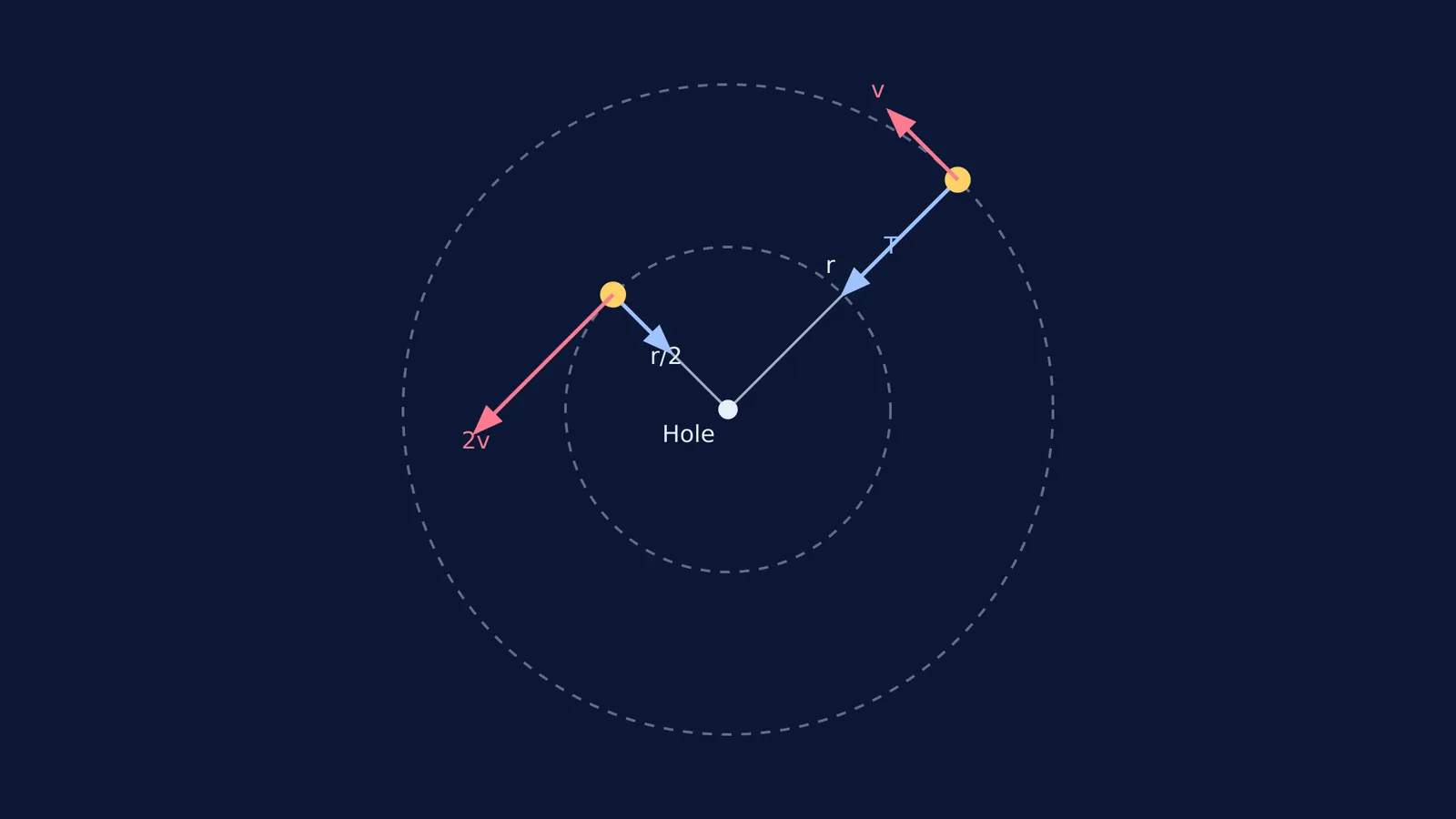
It is a classic mechanics problem you will almost certainly meet in JEE and NEET preparation: a particle tied to a string moves in a circle on a frictionless horizontal table. The string passes through a small hole in the centre. If you pull the string down, shortening the particle's path, the particle speeds up.
The physics behind this sudden acceleration comes down to two big ideas: the conservation of angular momentum and the work-energy theorem.
Why does the particle's speed increase?
The secret is in the forces. The only horizontal force acting on the spinning particle is the tension from the string. Because this tension always points directly towards the hole—the centre of rotation—it is defined as a central force.
A central force exerts zero net torque on an object. Torque requires a force applied at an angle to the radius, but here the force and the radius lie on the exact same line. With no external torque acting on the system, the total angular momentum remains constant throughout the entire motion.
Angular momentum is the product of mass, speed and radius (L = mvr). If the mass (m) and the angular momentum (L) do not change, then the speed (v) and the radius (r) must be inversely proportional. If you pull the string until the radius is halved, the particle's tangential speed must double to keep the angular momentum conserved.
Linear speed vs angular velocity
It is important to distinguish between the linear speed (v) and the angular velocity (ω) of the particle. While the linear speed describes how fast the particle is moving along the arc of the circle, the angular velocity describes how fast the angle is changing as the particle sweeps around the hole.
These two quantities are connected by the simple formula v = ωr. When we substitute this into our angular momentum equation (L = mvr), we get a new expression for angular momentum: L = mr²ω.
This reveals a crucial mathematical relationship. Because angular momentum is conserved, any change in the radius has a squared effect on the angular velocity. If you reduce the radius to half its original size, the linear speed merely doubles, but the angular velocity must increase by a factor of four to maintain the balance. This is the exact same mechanical principle that causes a spinning figure skater to rotate much faster when they pull their arms tightly against their body.
Where does the extra kinetic energy come from?
If the particle's speed increases, its kinetic energy (K = ½mv²) must also increase. Because kinetic energy goes up by the square of the speed, halving the radius does not just double the energy; it quadruples it.
Students sometimes assume energy should be conserved in this system, but it is not. The person pulling the string is doing work.
Even though the particle is moving in a circle, it is also being pulled inwards. The tension force and the inward displacement are in the same direction. According to the work-energy theorem, the net work done on a particle is equal to the change in its kinetic energy. The energy you expend pulling the string downwards is transferred directly into the particle, making it whirl faster.
A worked example of a string pulled through a table
Let us put some numbers to the rules. Suppose a 0.1 kg particle is moving at 2 m/s in a circle of radius 0.5 m.
First, you pull the string until the radius is 0.25 m. Because m v₁ r₁ = m v₂ r₂, the new speed v₂ is 2 × (0.5 / 0.25) = 4 m/s.
Next, calculate the kinetic energy. The initial kinetic energy is ½ × 0.1 × 2² = 0.2 J. The final kinetic energy is ½ × 0.1 × 4² = 0.8 J.
Finally, find the work done. According to the work-energy theorem, the change in kinetic energy is 0.8 − 0.2 = 0.6 J. Therefore, you did exactly 0.6 Joules of work by pulling the string.
Getting comfortable with rotational mechanics
Problems involving torque, tension and central forces often trip students up because it is hard to picture multiple changing variables at once. If you are struggling to set up equations for mechanics questions, the Concept Library holds every concept in physics, chemistry, biology, mathematics and computing, each with its own lesson and its place in the map.
When you get stuck on a specific question, Fermi's AI tutor works out what you already know, builds a plan for the session, and teaches through it — writing on a board, drawing the figure, running the simulation, and checking understanding as it goes.
Read more about mechanics and forces:


