

On this page
Stand on a bathroom scale in a plane cruising east, then in one cruising west at the same speed, and in perfectly smooth air the two readings would differ by about half a kilogram. Gravity has not changed. What changes is how fast you are going round Earth's axis, and so how much of your weight is used up keeping you on a circular path. This is the Eötvös effect, and it is a direct application of the circular motion and effective-g ideas in Class 11.
What is the Eötvös effect?
The Eötvös effect is the change in the apparent weight of a body when it moves east or west over the rotating Earth. Moving east, you weigh slightly less; moving west, slightly more.
You already know the version for a body at rest. Because the ground at latitude φ is carried round a circle of radius R cos φ, a little of g goes into the centripetal acceleration, which gives g′ = g − ω²R cos²φ. That is worked in effective g at a latitude due to Earth's rotation, so we start from it. The Eötvös effect asks what happens when you then move along that circle.
Why do you weigh less moving east?
Earth spins from west to east. At the equator the ground moves at ΩR = 7.292 × 10⁻⁵ rad/s × 6.378 × 10⁶ m = 465 m/s. At latitude φ it moves at 465 cos φ m/s.
If you travel east at speed v, you go round the axis faster, at u + v instead of u. A faster trip round the same circle needs more centripetal acceleration: (u + v)²/r instead of u²/r, where r = R cos φ. That extra pull towards the axis has to come from somewhere, and part of it is taken from the push of the floor. The scale pushes up less, so it reads less.
Travel west and you go round more slowly, at u − v. Less centripetal acceleration is needed, more of gravity presses you into the seat, and you read heavier.
Take the extra acceleration, (u + v)²/r − u²/r = (2uv + v²)/r, and its vertical part, which is cos φ times that. With u = ΩR cos φ and r = R cos φ:
Δg = 2Ωv cos φ + v²/R.
The first term is the Eötvös term. It is the vertical part of the Coriolis acceleration 2Ω × v; the sideways part is what bends the path of a ball in the rotating merry-go-round problem. The second term, v²/R, appears because any path over a curved Earth is itself a circle of radius about R, so it lowers your weight whichever way you go.
How big is it for a ship? A worked check
Take a ship sailing east at 10 m/s on the equator (φ = 0).
Eötvös term. 2Ωv = 2 × 7.292 × 10⁻⁵ × 10 = 1.46 × 10⁻³ m/s².
Curvature term. v²/R = 10² / 6.378 × 10⁶ = 1.6 × 10⁻⁵ m/s², a hundred times smaller.
Check without the formula. ((465.1 + 10)² − 465.1²) / 6.378 × 10⁶ = 1.47 × 10⁻³ m/s², the sum of the two terms. Same answer.
As a fraction of g. 1.47 × 10⁻³ / 9.8 = 0.015%.
That looks tiny, but gravity surveyors measure differences far smaller than this, which is why the effect was found on ships.
How much lighter is a passenger on an eastbound jet?
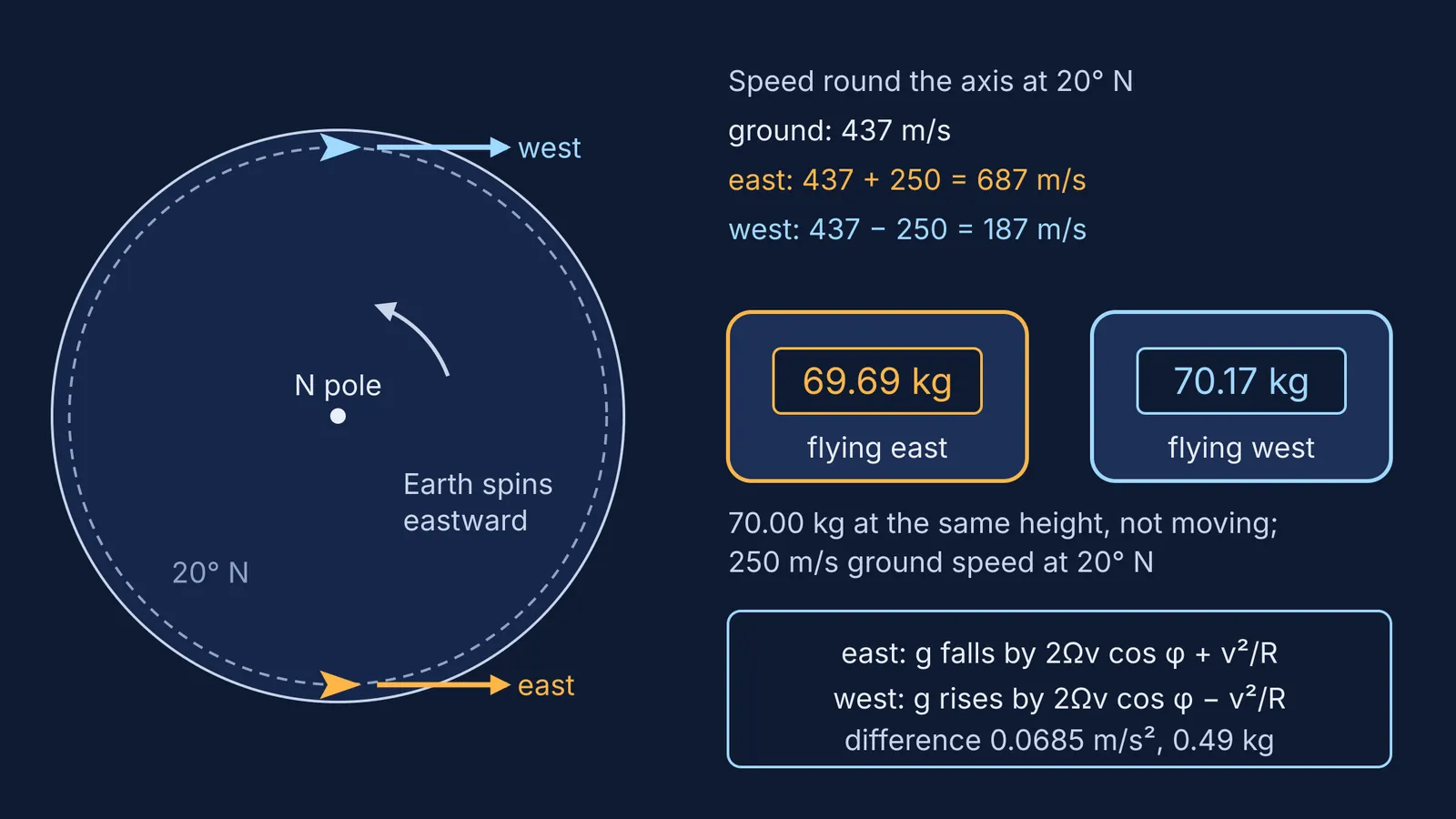
A jet at 900 km/h has v = 250 m/s. Take φ = 20° N, cos φ = 0.940, R = 6.371 × 10⁶ m and local g = 9.79 m/s².
Eötvös term. 2Ωv cos φ = 2 × 7.292 × 10⁻⁵ × 250 × 0.940 = 0.0343 m/s².
Curvature term. v²/R = 250² / 6.371 × 10⁶ = 0.0098 m/s².
Eastbound. g falls by 0.0343 + 0.0098 = 0.0441 m/s².
Westbound. The Eötvös term changes sign, the curvature term does not: g rises by 0.0343 − 0.0098 = 0.0245 m/s².
On the scale. A passenger who reads 70.00 kg at the same height but not moving reads 70 × (1 − 0.0441/9.79) = 69.69 kg flying east and 70 × (1 + 0.0245/9.79) = 70.17 kg flying west.
The difference. 70 × 2 × 0.0343 / 9.79 = 0.49 kg, about half a kilogram.
Height matters too: at 11 km, g is lower by roughly 2h/R, about 0.24 kg on 70 kg, but that is the same for both flights and cancels in the difference. A real scale on a plane would be swamped by turbulence, so the 0.49 kg is a clean-air calculation.
For an Indian example, a Rajdhani running east at 36 m/s near Delhi (28.6° N) loses 2Ωv cos φ + v²/R = 4.6 × 10⁻³ + 0.2 × 10⁻³ = 4.8 × 10⁻³ m/s², about 490 parts per million of g, or 34 g on a 70 kg passenger.
How was the Eötvös effect discovered?
Between 1901 and 1905, Oskar Hecker of the Potsdam observatory measured gravity at sea from ships. Loránd Eötvös saw that Hecker's values depended on which way the ship was sailing, and explained it as the vertical part of the Coriolis force. Hecker reworked his data, and new measurements on two ships moving in opposite directions, east and west, on the Black Sea gave consistent results. Eötvös later built a demonstration: a balance beam with equal weights on a rotating platform, so one weight moved east while the other moved west and the beam rocked. This history is set out in András Patkós's lecture on Eötvös (arXiv, 2020). His better-known torsion balance, which tested whether inertial and gravitational mass are equal, is a separate story told in how Eötvös showed gravitational and inertial mass are equal.
Why do gravity surveys correct for it?
Ships and aircraft measure gravity to map rocks, oil fields and the shape of the sea surface. A survey plane flying east reads low and the same plane flying west reads high, by tens of thousandths of a m/s² at airliner speeds, far more than the signals being sought. So every moving gravity survey subtracts an Eötvös correction built from the measured east and north velocities, as in the airborne survey of Bidel and colleagues (arXiv, 2022). If you want to revisit how centripetal and Coriolis terms combine, the Concept Library covers circular motion and rotating frames concept by concept.
Quick checklist
Moving east means going round the axis faster, so more centripetal pull is needed and you weigh less.
Δg = 2Ωv cos φ + v²/R for east; −2Ωv cos φ + v²/R for west.
The first term is the vertical part of the Coriolis term 2Ω × v.
It vanishes for due north or south travel and at the poles.
Ship at 10 m/s on the equator: 1.47 × 10⁻³ m/s².
Jet at 250 m/s at 20° N: about 0.49 kg difference east to west for 70 kg.


