

On this page
A parabolic flight gives you about 20 seconds of floating, but the aeroplane shakes and the pilot can only hold zero g to about a hundredth of g. A drop tower makes the opposite trade. You get less than 5 seconds, but the experiment is in almost perfect free fall. Class 11 kinematics plus one line of air drag explains both numbers, and why the tube is pumped almost empty before every drop.
What is a drop tower and why does it give weightlessness?
A drop tower is a tall shaft in which a sealed capsule carrying an experiment is released and allowed to fall. Nothing holds it up and nothing pushes on it, so the capsule and everything inside it accelerate downward at the same g. The experiment stops pressing on its supports, which is exactly what weightlessness means. Gravity has not been switched off. It is still 9.81 m/s² in the tube; the capsule is simply falling freely, just like the aeroplane in how a parabolic flight gives 22 seconds of weightlessness.
The most familiar example in Europe is the Bremen Drop Tower run by ZARM in Germany. Its payload user's guide lists a 146 m concrete tower, a 120 m drop tube 3.5 m wide, a free-fall distance of 110 m, a standard capsule of about 500 kg, and a tube pumped down to 10 Pa (0.1 mbar) before each drop. It quotes 4.7 s of weightlessness for a plain drop, 9.3 s with its catapult, and a microgravity quality of 10⁻⁶ g. ESA's drop tower page gives the capsule as 80 cm across and the drop time as 4.74 s.
How long does a 110 m free fall last? A worked example
Take g = 9.81 m/s² and start from rest.
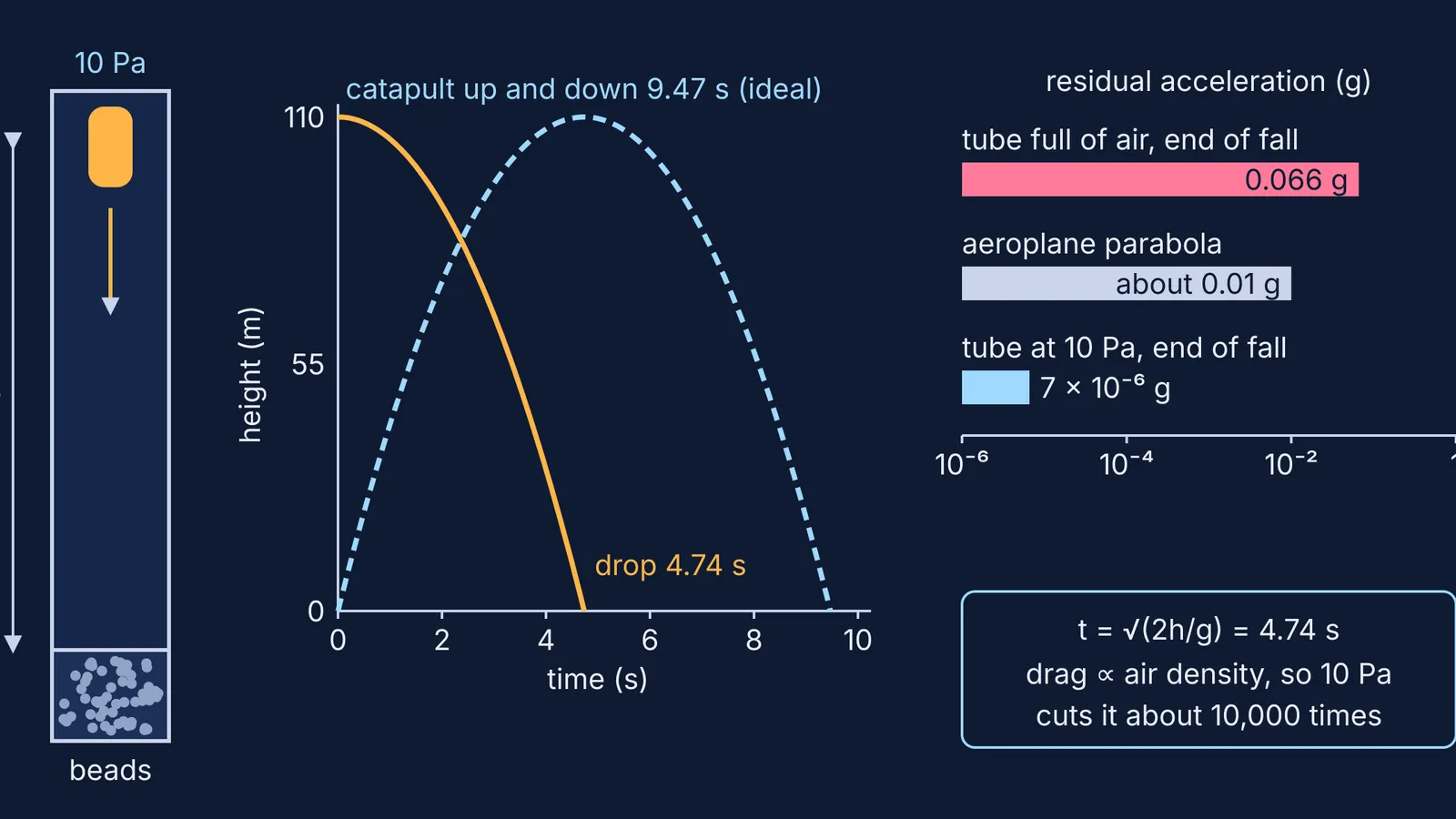
Time. From h = ½gt², t = √(2h/g) = √(2 × 110 / 9.81) = 4.74 s. That matches the facility's figure.
Speed at the bottom. v = gt = 9.81 × 4.74 = 46.5 m/s, about 167 km/h. ZARM quotes a maximum capsule speed of 168 km/h, so the numbers agree.
Why so short? Time grows only as the square root of height. To double the time you need four times the height. A straight 10 s drop would need h = ½ × 9.81 × 10² = 490 m of shaft, more than three times the whole tower.
The catapult trick. Instead of dropping the capsule from the top, fire it up from the bottom at the same 46.5 m/s. It rises, stops near the top and falls back, and it is in free fall the whole way up as well as down. The time is 2v/g = 2 × 46.5 / 9.81 = 9.47 s in the ideal case where it uses the full 110 m.
Check against reality. The real figure is 9.3 s. Working backwards, 9.3 s means a launch at 9.81 × 4.65 = 45.6 m/s and a peak about 106 m up. The capsule cannot use quite the whole tube, so it gets a little less than the ideal.
So doubling the path, not lengthening the tower, is what doubles the time. ZARM's guide describes the catapult as accelerating the capsule to 168 km/h in 0.25 s, with launch peaks of about 30 g.
Why must the drop tube be a vacuum?
At 46.5 m/s, air drag is not small. Use the quadratic drag force F = ½ρv²C_dA, which is worked through in linear and quadratic drag and terminal velocity. Take ρ = 1.2 kg/m³ for normal air, a capsule 0.8 m across so A = π × 0.4² = 0.503 m², and an assumed round drag coefficient C_d = 0.5.
In normal air: F = ½ × 1.2 × 46.5² × 0.5 × 0.503 = 325 N. On a 500 kg capsule that is a deceleration of 0.65 m/s², or 0.066 g.
At 10 Pa: air density scales with pressure, so ρ falls by 101,325 / 10, about 10,000 times, to about 1.2 × 10⁻⁴ kg/m³. The drag falls to 0.032 N and the deceleration to 6.5 × 10⁻⁵ m/s², about 7 × 10⁻⁶ g.
The 0.066 g matters because the capsule is slowed by the air but the experiment inside is not. Anything loose drifts towards the top of the capsule, and a candle flame or a cloud of dust feels a fake gravity of 0.066 g. That is worse than the aeroplane. With the air pumped out, drag drops to a few millionths of g, the same order as the 10⁻⁶ g ZARM quotes. Drag also grows as v², so it peaks at the end of the fall; averaged over the drop it is a third of the peak, about 2 × 10⁻⁶ g. A hyperloop tube is pumped out for a related reason, but to save energy rather than to protect an experiment.
How much cleaner is a drop tower than a zero-g aeroplane?
The aeroplane's weightlessness depends on the pilot cancelling every bump of turbulence by hand, and on the engines pushing exactly hard enough to cancel the air's drag. Novespace, which flies Europe's research parabolas, says in its science flights FAQ that equipment fixed to the aircraft sees residual gravity of about ±2 × 10⁻² g vertically and ±10⁻² g along the fuselage.
Compare that with 10⁻⁶ g in the tower: 10⁻² / 10⁻⁶ = 10,000. So the tower is about ten thousand times cleaner, but for 4.7 or 9.3 seconds instead of about 20. Slow experiments, or ones with people, go on the plane; quick, delicate ones such as a flame or a cloud of dust sticking together go in the tower.
If you want to see how the drop curve and the catapult arc compare, the Simulation Lab has interactive simulations for ideas that are easier to see than read.
How is the capsule stopped at the bottom?
The tube ends in a container of polystyrene pellets about 8.2 m deep, per ZARM's guide. The capsule plunges into them and is slowed by friction between the beads.
Suppose, as a round illustrative value, the capsule came to rest at a steady rate over 8 m. The average deceleration would be v²/2s = 46.5² / (2 × 8) = 135 m/s², about 13.7 g. The real deceleration is not steady. ZARM's guide asks every payload to survive peaks of about 50 g, which is why experiments are bolted down hard. The capsule is also kept at normal air pressure inside, so the experiment itself never sees the vacuum.
Quick checklist
A drop tower gives weightlessness by free fall, not by removing gravity.
110 m gives 4.74 s and 46.5 m/s at the bottom; 10 s would need 490 m.
A catapult launch doubles the path and the time; ideal 9.47 s, real 9.3 s.
Normal air would add 0.066 g of drag at the bottom; 10 Pa cuts it about 10,000 times.
The tower is about 10,000 times cleaner than a parabolic flight, but for seconds, not tens of seconds.
Average stopping deceleration from v²/2s is far below the real 50 g peaks.


