

On this page
A fast train spends much of its energy pushing air aside. A hyperloop removes most of that air. In December 2024 India got its first test track for the idea: a 410-metre hyperloop tube at IIT Madras' Discovery Campus in Thaiyur, built with Indian Railways, the student Avishkar Hyperloop team and the startup TuTr. Here is the physics, and why it is still hard.
How does hyperloop work?
Three ideas work together: thin air, no wheels touching at speed, and an electric push from the track.
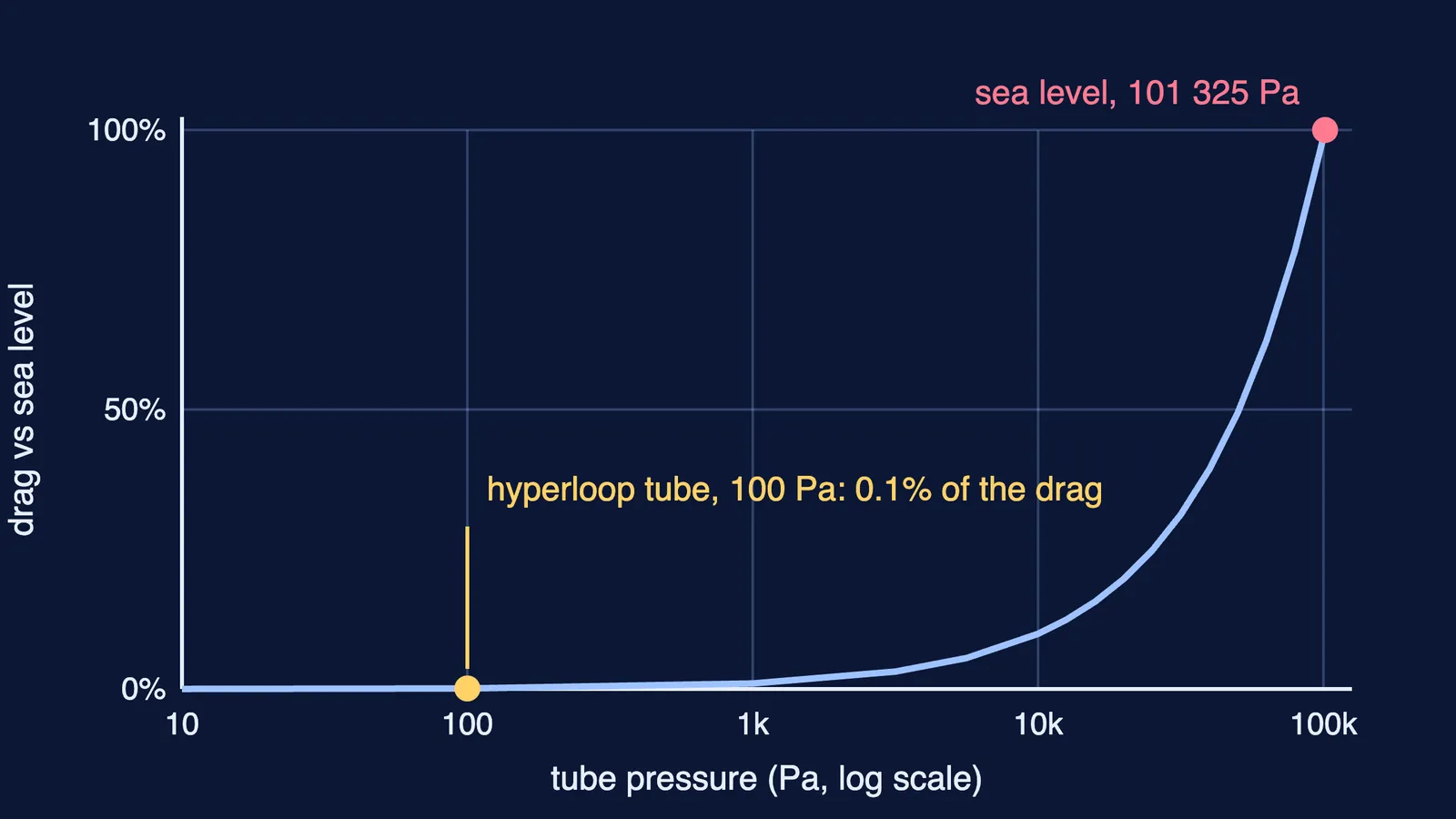
The best-known design is the Hyperloop Alpha paper, put together with engineers at SpaceX and Tesla. It sets the tube at an operating pressure of 100 pascals, which it says reduces the drag force of the air by 1,000 times relative to sea level. It avoids a hard vacuum, which it calls expensive and difficult to maintain.
In that design, linear electric motors covering as little as 1% of the tube's length push the pod to a cruise of 1,220 km/h, about Mach 0.91. A linear motor is an electric motor unrolled flat; compare how electric trains get their power from overhead lines.
Why does low pressure cut drag so much?
Air drag is F = ½ρv²C_dA, where ρ is the air's density, v the speed, C_d the shape factor and A the frontal area. At a fixed temperature, the ideal gas law makes density proportional to pressure. So drag falls in step with pressure.
Worked example. Standard sea-level pressure is 101,325 Pa, as fixed by the 1954 General Conference on Weights and Measures. Divide by the tube's 100 Pa and you get about 1,013, so the same pod at the same speed feels roughly a thousandth of the drag. That matches the paper's 1,000 times.
Now add speed. Compare the pod at 1,220 km/h with a fast train at 300 km/h, same shape and size. Drag grows with v², so the pod would face (1220 ÷ 300)² ≈ 16.5 times the train's drag in open air. In the tube that becomes 16.5 ÷ 1,013 ≈ 1/61 of the train's drag, while going four times faster. This is a best case: it ignores the squeezed air described below.
It is the same reason a feather and a coin fall together in a vacuum.
How does a hyperloop pod levitate?
Wheels struggle at these speeds, so the pod floats. Hyperloop Alpha proposed air-bearing skis, which it compares to an air hockey table: a thin cushion of pressurised air under the pod. The paper calls magnetic levitation a viable alternative but rejects it on cost.
One passive magnetic scheme is Inductrack, described in a Lawrence Livermore report on the Inductrack approach to magnetic levitation. Magnets on the vehicle sit in a Halbach array, which concentrates the field below and cancels it above. The track is a close-packed set of shorted circuits. Moving magnets induce currents in them whose fields repel the magnets: Lenz's law, a Class 12 topic.
The report gives levitating forces of order 40 tonnes per square metre of magnet array. Because the currents are induced, the vehicle must move faster than a few kilometres per hour to lift, so it needs wheels at rest. If the drive fails, the vehicle slows and settles onto those wheels.
What engineering problems are still unsolved?
Air trapped ahead of the pod. If the pod nearly fills the tube, the Hyperloop Alpha paper says, it "will behave like a syringe" and push the whole column of air. This ceiling, the Kantrowitz limit, forces you to go slowly or build a very wide tube. The paper's fix: a compressor fan on the nose that moves air from front to back.
A tube that changes length. Steel expands by about 10.8 to 12.5 millionths of its length per kelvin. For a 100 km tube and a 30 K day-night swing: ΔL = 12 × 10⁻⁶ × 100,000 m × 30 K = 36 m. The Alpha paper lets the tube slide on its pillars and puts slip joints at the stations to absorb it.
Keeping a long tube sealed, with joints flexing and a safe way out in an emergency.
Money. Hyperloop One announced it was shutting down in December 2023.
Like the space elevator, where the physics works but the cable is the problem, the hard part is engineering, not principle.
How can you use hyperloop to revise physics?
It makes a neat JEE Main revision set:
Ideal gas: why density falls with pressure.
Drag: rerun the 1/61 sum at your own speed.
Thermal expansion: change the length and the swing.
Induction: explain why Inductrack needs motion to lift.
If induced currents are hard to picture, the Fermi Simulation Lab has interactive simulations for ideas that are easier to see than read. If a step in the drag sum goes wrong, Fermi's AI tutor works through it with you on a board, checking your understanding as it goes.
Next time a headline promises a 30-minute city-to-city trip, ask: what pressure, what tested speed, and how many metres of track?


