

On this page
A space elevator is a cable from the equator up past geostationary orbit, so that vehicles could climb to space instead of riding rockets. The physics is sound; the missing piece is a cable material. Here is why it would stay up, where it pulls hardest, and a calculation you can check.
How would a space elevator work?
One detailed engineering design is the NIAC Phase II final report by Bradley C. Edwards, written in 2003 under a NASA Institute for Advanced Concepts grant. It traces the idea to a 1960 Russian paper by Artsutanov and describes a ribbon anchored to an ocean platform in the eastern equatorial Pacific, reaching about 62,000 miles (roughly 100,000 km) into space.
Geostationary orbit is 35,786 km above the equator, where one orbit takes 23 hours 56 minutes, the time Earth takes to turn once, according to ESA. We derived that height in why geostationary satellites sit 36,000 km high.
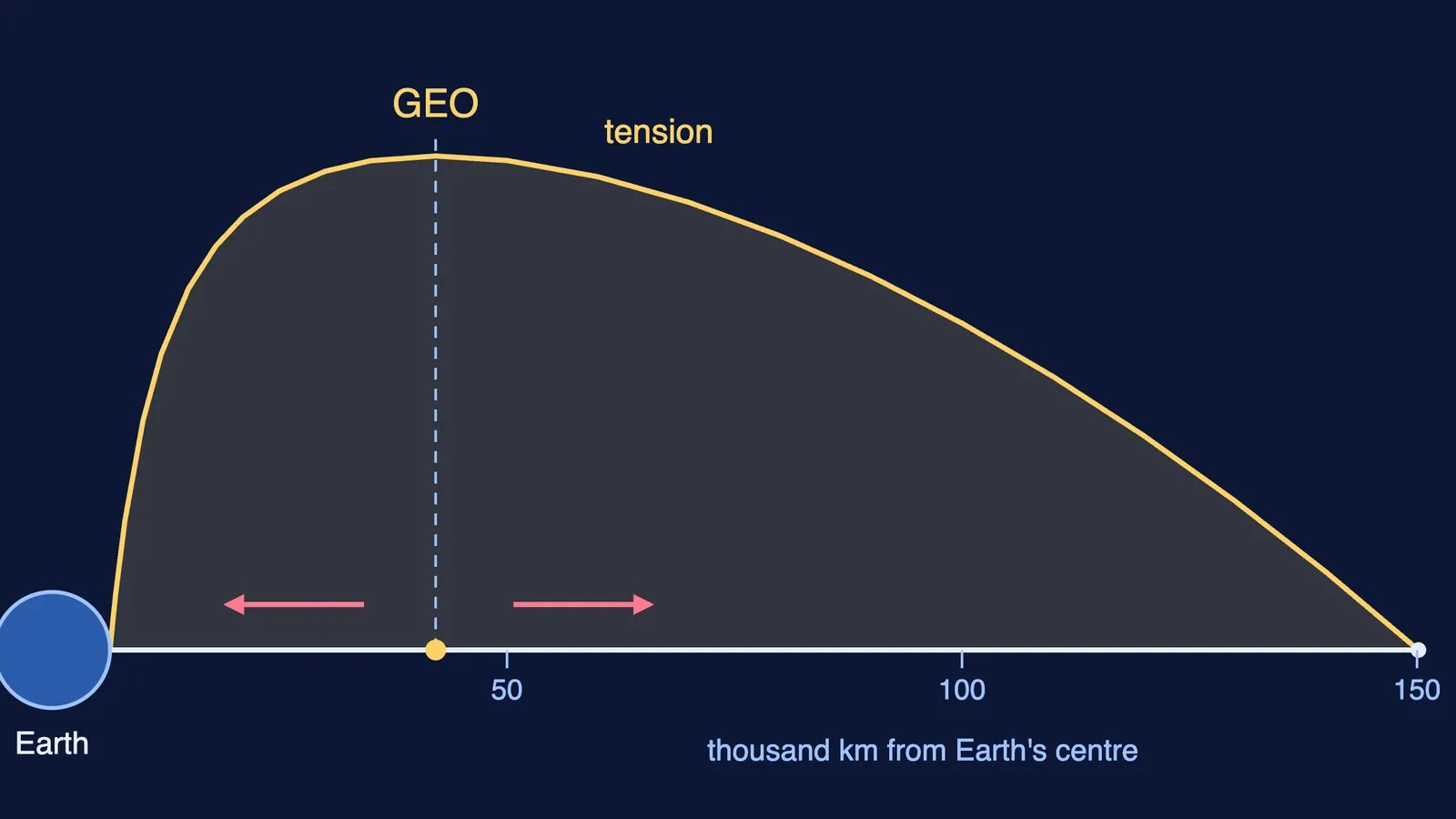
Picture the cable turning with Earth. Gravity pulls each kilogram inward with GM/r², while a once-a-day circle needs a centripetal force of ω²r. Below geostationary height gravity wins and the cable tends to fall; above it the cable tends to fly outward. The two halves pull against each other and keep the cable taut.
Where is the tension highest along the cable?
At geostationary height. Every piece below hangs from the pieces above; every piece beyond pulls outward. Tension rises from zero at the ground to a maximum at geostationary orbit, then falls further out. A heavy string is the classic case where tension changes along the same string; a space elevator is the biggest example you will meet.
How strong would the cable need to be?
Take Earth's values from the NASA Earth fact sheet: GM = 3.986 × 10^14 m³/s², equatorial radius R = 6,378 km, sidereal rotation 23.9345 hours, so ω = 7.292 × 10^-5 rad/s. Geostationary radius is r = 6,378 + 35,786 = 42,164 km.
For a cable of constant thickness, add up the net pull per kilogram from the ground to geostationary orbit: peak stress ÷ density = GM(1/R − 1/r) − ½ω²(r² − R²).
Put in the numbers: 6.25 × 10^7 − 0.95 × 10^7 − 0.46 × 10^7 ≈ 4.84 × 10^7 J/kg.
That is the strength-to-density ratio (σ/ρ) needed just to hold the cable up: like a rope 4,940 km long hanging in 9.81 m/s² gravity.
A cable that thickens towards the top needs less, but the thickening grows exponentially: area at the top ÷ area at the ground = e^(ρ × 4.84 × 10^7 ÷ σ).
Try Kevlar. The DuPont Kevlar technical guide lists a density of 1.44 g/cm³ and 3,600 MPa for resin-impregnated strands. With no safety margin, the exponent is about 19.4, so the cable would be about 260 million times wider at the top than at the bottom.
Run it backwards for a material as light as Kevlar:
taper of 1,000: about 10 GPa
taper of 100: about 15 GPa
taper of 10: about 30 GPa
taper of 2: about 100 GPa
Is any material strong enough for a space elevator?
Not in a form anyone can make by the kilometre. In 2008, Lee and colleagues reported in Science an intrinsic strength of 130 GPa for defect-free graphene, measured on microscopic membranes. Edwards's report says the design needs about 100 GPa, that steel, Kevlar, carbon fibre and spider silk fall short, and that lab tests had found carbon nanotubes at 63 GPa. It says the material was “expected to be available in 2 years”. That was 2003.
Long fibres are far weaker than perfect molecules, because one flaw anywhere can start a break. In 2020, Rice University reported carbon nanotube fibres with a tensile strength of 4.2 GPa, against 3.6 GPa for Kevlar: real progress, still well short of 30 to 100 GPa. To see strength and breaking in a lab test, read how to read the stress-strain curve of a wire.
How can you practise with this problem?
This one cable combines circular motion, gravitation, tension and stress:
Draw the forces on a short piece of cable at radius r, in the frame turning with Earth.
Find where the net pull is zero and check you get 42,164 km.
Add up the net pull from the ground to get the tension, and explain why it peaks there.
Make Earth spin faster and predict what happens to geostationary height and the taper.
If the rotating frame is hard to picture, the Fermi Simulation Lab has interactive simulations for ideas easier to see than to read. If step 3 trips you up, the Fermi Problem Library has a step-by-step solver that explains the reasoning, and Fermi's AI tutor can work out what you already know and build a plan for the session.


