On this page
You have probably read that geostationary satellites are "about 36,000 km up". ISRO says the same of its own GSAT-11, which it placed in geostationary orbit with an altitude of about 36000 km. It is the one height where the orbit's period equals Earth's spin, and you can find it yourself in ten minutes.
Why are geostationary satellites 36,000 km high?
In a circular orbit, gravity supplies the centripetal force, so GMm/r² = mv²/r, and the period follows: T² = 4π²r³/GM. That is Kepler's third law for a small body orbiting Earth, and our derivation of orbital velocity and time period walks through each line.
Because T grows as r to the power 3/2, each radius has exactly one period. NASA Earth Observatory puts it plainly: "The higher a satellite's orbit, the slower it moves." Low orbits are quick: NASA's Aqua satellite flies about 705 km up and takes about 99 minutes per orbit, according to the same NASA page. To hang over one spot, a satellite must take exactly as long as Earth takes to turn once, so only one radius works.
Which "once"? Earth's sidereal rotation period, one turn measured against the stars, is 23.9345 hours on the NASA Earth fact sheet. That is 23 h 56 min 4 s, about 4 minutes shorter than the 24-hour solar day; here is why a sidereal day is shorter than a solar day. The satellite has to match the sidereal day.
How do you find the height with a simulation?
Treat it as a search. Open an orbit simulation where you set the radius from Earth's centre and read the period, and halve the gap each time. The Fermi Simulation Lab has interactive simulations for ideas that are easier to see than to read. These are the periods you should see, computed from T = 2π√(r³/GM) with GM = 398,600 km³/s² from the NASA Earth fact sheet:
r = 10,000 km: 2.76 hours. Far too fast.
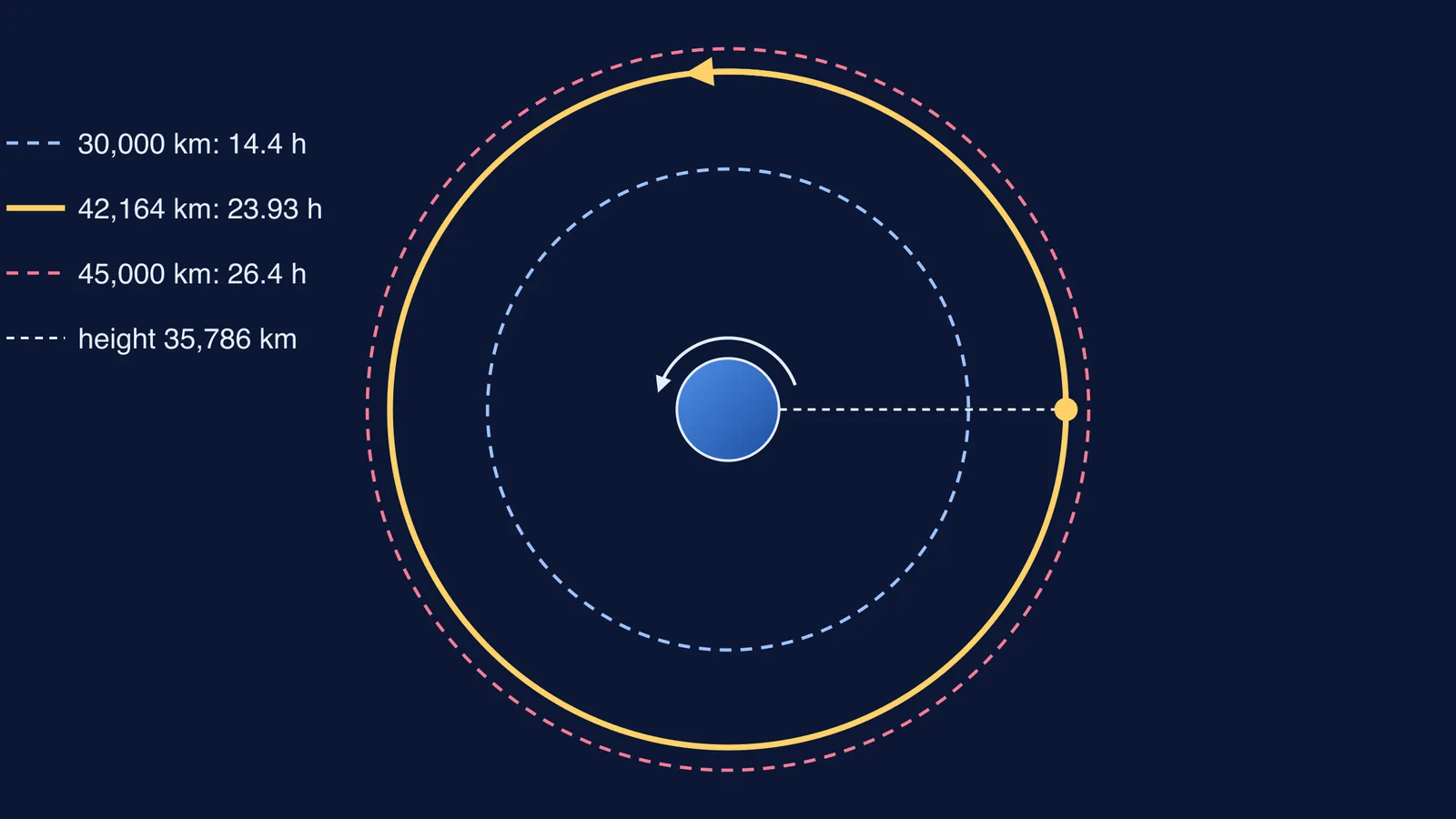
r = 30,000 km: 14.36 hours. Still too fast.
r = 45,000 km: 26.39 hours. Too slow, so the answer lies in between.
r = 40,000 km: 22.12 hours.
r = 42,000 km: 23.79 hours.
r = 42,200 km: 23.96 hours. Just past 23.93, so the answer is between 42,000 and 42,200 km.
A few more halvings close in on about 42,164 km. Notice steps 2 and 3: the radius grows by half, but the period grows by about 84 per cent. That is the 3/2 power at work.
How do you check it with Kepler's third law?
Now solve for r directly. Rearranged, r = (GMT²/4π²) to the power 1/3. Using the NASA Earth fact sheet values:
T = 23.9345 × 3600 = 86,164 s
GMT² = 398,600 × 86,164² ≈ 2.959 × 10¹⁵ km³
divide by 4π² ≈ 39.48 to get r³ ≈ 7.496 × 10¹³ km³
take the cube root: r ≈ 42,164 km
Subtract Earth's equatorial radius of 6,378 km, from the same fact sheet, and the height is 35,786 km. NASA Earth Observatory gives the same radius: "exactly 42,164 kilometers from the center of the Earth (about 36,000 kilometers from Earth's surface)".
A second check needs no G at all. In ratio form, Kepler's third law says (T₁/T₂)² = (r₁/r₂)³ for any two satellites of Earth. Take Aqua from the NASA orbit catalogue: r ≈ 6,378 + 705 = 7,083 km and T ≈ 99 minutes. The radius ratio is 42,164/7,083 ≈ 5.95, and 5.95 to the power 1.5 is about 14.52, so the period should be 99 × 14.52 ≈ 1,438 minutes, or 23.97 hours. That is within 3 minutes of the sidereal day. For more practice, try Kepler's third law: comparing orbital periods without G.
What if you use 24 hours instead?
Plug T = 86,400 s into the formula with the NASA fact sheet values and you get r ≈ 42,241 km, a height of about 35,863 km, roughly 77 km too high. A satellite there would move a little slower than Earth turns and drift slowly westward. Many textbook problems use 24 hours and accept "about 36,000 km", which is fine for an exam. Just know that the real orbit is set by the sidereal day.
A 10-minute plan for your next study session
Predict first: write down a guess for the radius.
Close in using the simulation and record each r and T as a pair.
Work out T²/r³ for three of your pairs. It should come out the same each time: 4π²/GM ≈ 9.90 × 10⁻⁵ s²/km³, using GM from the NASA Earth fact sheet.
Solve the formula by hand and compare it with your simulation answer.
Explain aloud why 24 hours gives a slightly wrong height.
If the algebra in step 4 stalls, the Fermi Problem Library has worked problems with a step-by-step solver that explains the reasoning rather than printing an answer.