

On this page
If you look up at a bright star tonight at 9:00 PM, when will it return to that exact same spot tomorrow? You might guess 9:00 PM. But if you actually measure it, you will find the star reaches that spot at 8:56 PM (OpenStax, Astronomy 2e).
This happens because there are two ways to define a day: by the stars, or by the Sun.
What is a sidereal day?
A sidereal day is the time it takes for Earth to complete one full 360-degree rotation on its axis relative to the distant stars. According to astronomy textbooks, a sidereal day lasts 23 hours, 56 minutes, and 4 seconds (OpenStax, Astronomy 2e).
Because the stars are incredibly far away, Earth's movement through space does not change our angle to them. Once our planet completes a 360-degree spin, you are facing the exact same distant star you were facing yesterday. This absolute rotation is the true spin of the planet.
Why is a sidereal day 4 minutes shorter?
A solar day—the 24-hour cycle we use for our clocks—is the time it takes for the Sun to return to the same position in the sky, such as from noon to noon (OpenStax, Astronomy 2e).
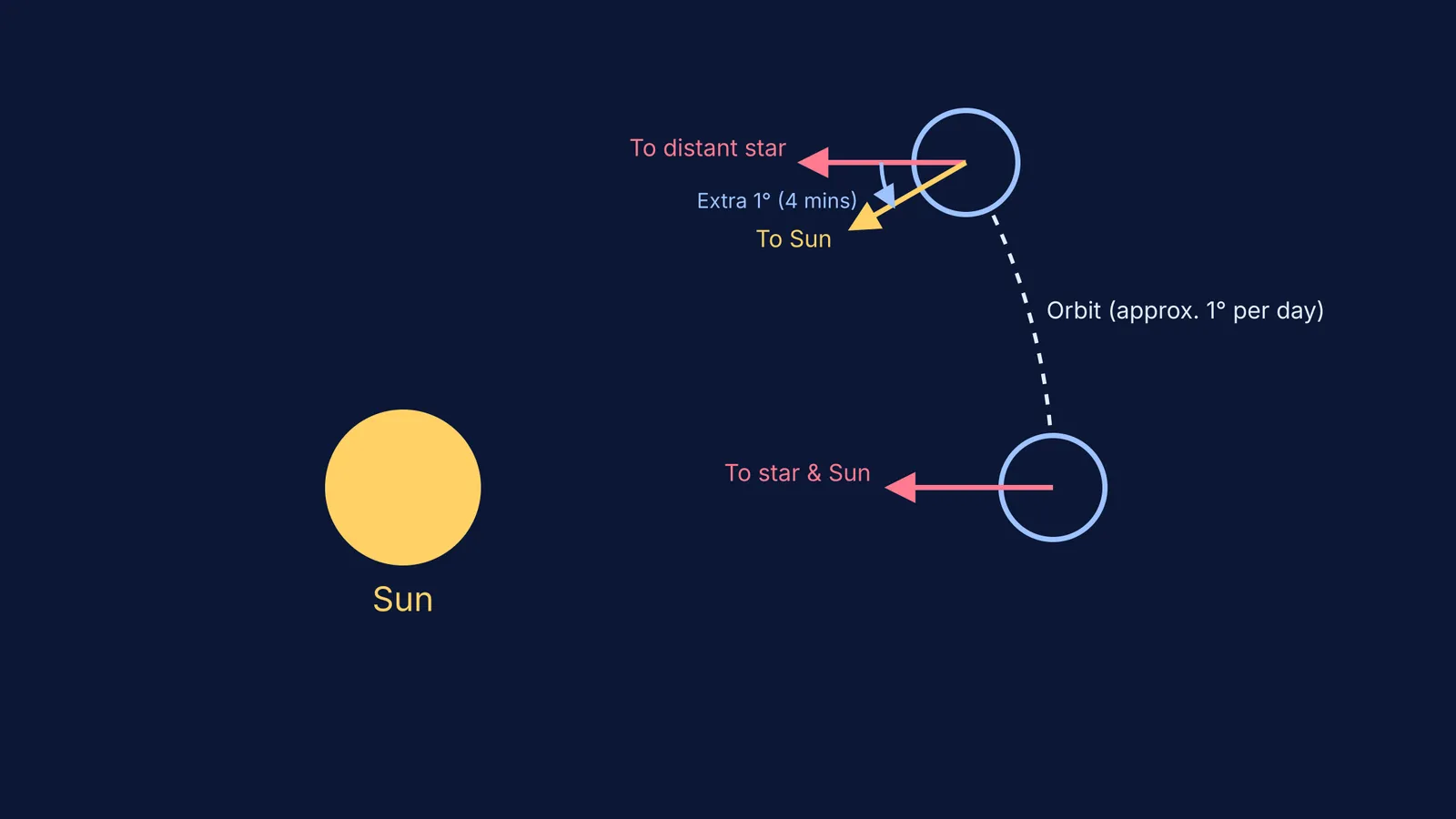
The four-minute difference exists because Earth is not standing still while it spins. Every day, Earth travels roughly 1 degree along its orbit around the Sun. (Since a full orbit is 360 degrees and takes roughly 365 days, the daily movement is just slightly less than 1 degree.)
By the time Earth has spun exactly 360 degrees (one sidereal day), it has moved forward in space. As a result, the side of the Earth that faced the Sun yesterday is now pointing slightly away from it. To bring the Sun back to the same spot overhead, Earth must rotate that extra 1 degree.
Because Earth completes a 360-degree rotation in about 1,440 minutes, a 1-degree rotation takes roughly 4 minutes. That extra catch-up spin is why our standard 24-hour solar day is longer than the true 360-degree rotation.
How do astronomers use sidereal time?
For anyone studying the night sky, a standard 24-hour clock is not very helpful. Because a solar day is based on the Sun, it hides the true rotation of the stars. Astronomers use sidereal clocks to keep track of where telescopes should point.
If an observatory wants to photograph a distant galaxy, the telescope must counteract Earth's rotation to stay locked on the target. The motors driving the telescope are calibrated to a sidereal day, spinning exactly 360 degrees in 23 hours, 56 minutes, and 4 seconds (OpenStax, Astronomy 2e). If they used a solar clock, the telescope would drift off target by four minutes every single day, and the resulting image would be a blurry streak.
Understanding this difference is a foundational step in astrophysics. It teaches students that the sky we see is a combination of two motions: our spin on an axis, and our journey around the Sun.
How can active learning help you see this?
Reading about orbits is helpful, but rotational geometry is famously difficult to picture in your head. When students are confused by orbital mechanics or Kepler's second law on areal velocity, memorising the math often fails when the exam changes the scenario. Often, a student will assume that a day is just a 360-degree spin, without considering how a planet's forward motion changes its angle to the central star.
Instead of showing a static diagram or simply stating the rule, prompt the student to predict the outcome. By asking the right questions, you can lead them to the answer. You can use this script to guide them:
"If Earth spins one full rotation, does it face the exact same direction in space?"
"Draw Earth yesterday and Earth today, slightly further along its orbit. Now draw an arrow pointing in the same direction on both."
"Does the second arrow point directly at the Sun?"
"What must Earth do to bring that arrow back to the Sun, and how long does that take?"
When students draw the arrows themselves and see the gap on the paper, they discover the catch-up time on their own. This moment of discovery builds a mental model that lasts much longer than rote memorisation. If you want to explore the mechanics of the solar system dynamically, the Fermi Simulation Lab has interactive simulations for ideas that are easier to see than to read.
A worked example: Predicting star times
Once you know the four-minute rule (derived from OpenStax), you can calculate the exact position of stars without a telescope. This is the same predictive astronomy that helped pioneers like Sandford Fleming map out standard time zones.
If you observe the star Sirius directly overhead at 10:00 PM on 1 January:
On 2 January, it will be overhead at 9:56 PM.
On 8 January (one week later), it will be overhead 28 minutes earlier, at 9:32 PM.
By 1 February (one month later), it will be overhead a full 2 hours earlier, at 8:00 PM.
By applying this simple subtraction, you are tracking the true rotation of the Earth.


