On this page
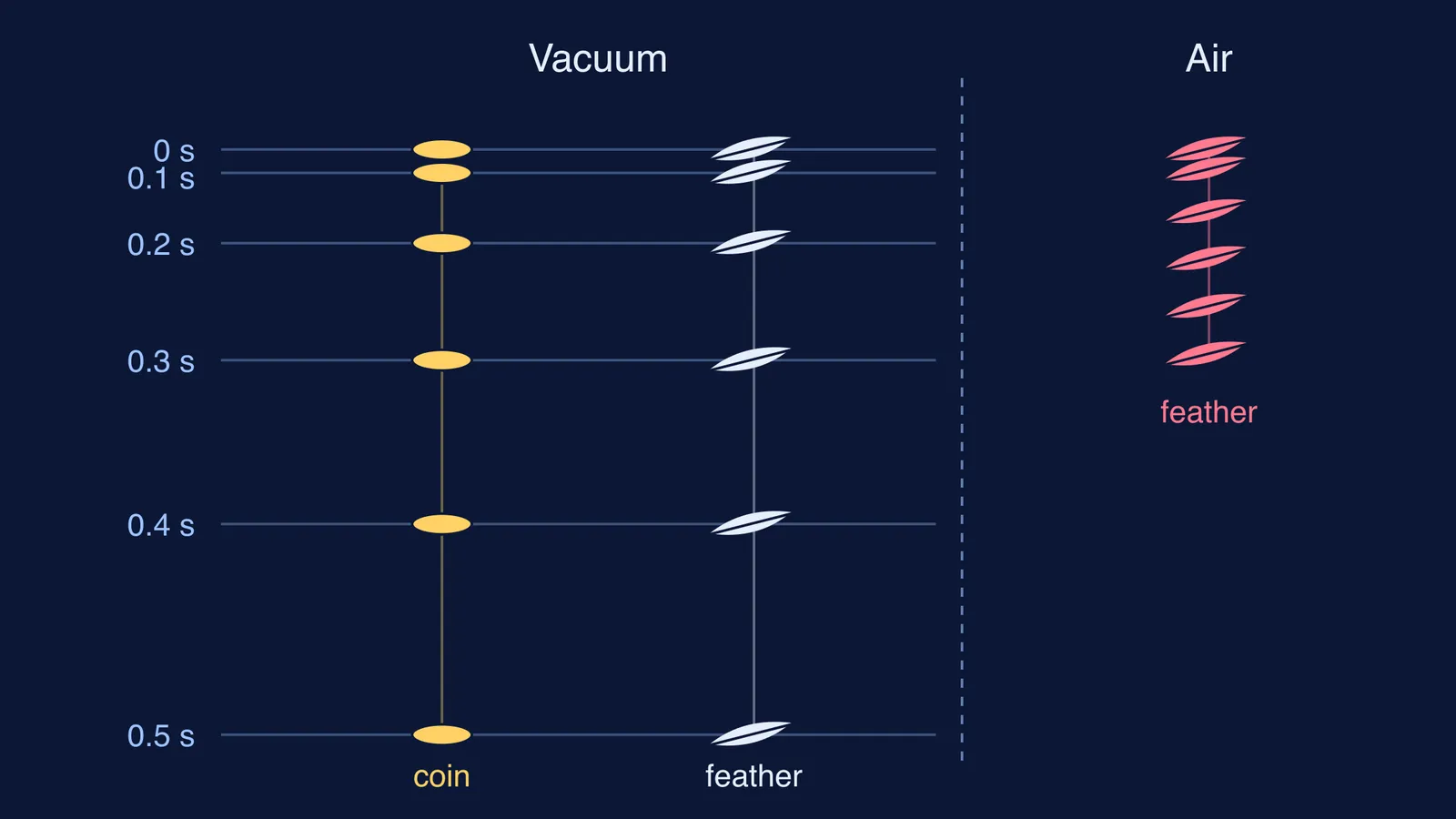
Drop a coin and a feather in your room and the coin wins. Pump the air out of a tube and they land together. The usual mistake is to blame gravity. Gravity treats both the same. The air does not.
Why do a feather and a coin fall together in a vacuum?
Start with Newton's second law, a = F/m. The pull of the Earth on an object of mass m is F = mg, as NCERT's Class 9 book Exploration, Chapter 6: How Forces Affect Motion writes it (Eq. 6.3).
Put the two together: a = mg/m = g. The mass cancels.
A coin with 10 times the feather's mass gets 10 times the pull, but it also has 10 times the inertia, so it is 10 times harder to speed up. The same NCERT chapter says it plainly in a margin note: the acceleration due to gravitational force by the Earth (g) does not depend on the mass of the object. The main text gives g = 9.8 m s⁻² near the Earth's surface.
A note for 2026-27: in the new book, Chapter 9 is Atomic Foundations of Matter, so guides citing "Chapter 9 Gravitation" describe the previous book.
What happened when Apollo 15 dropped a hammer and a feather?
On 2 August 1971, near the end of the third moonwalk, commander David Scott held a feather in one hand and a hammer in the other, according to NASA's history office. After both landed together he said: "How about that! Which proves that Mr. Galileo was correct in his findings."
NASA's description of the drop gives the details: a 1.32 kg aluminium geological hammer and a 0.03 kg falcon feather, released from about 1.6 m, were observed to undergo the same acceleration and strike the surface simultaneously. On those figures the hammer had about 44 times the feather's mass. NASA's lunar data archive notes typical feathers weigh only 0.3 to 3 g, so the real gap was probably larger.
The Moon works as a vacuum chamber. Its surface gravity is 1.62 m/s², and its night-time surface pressure is about 3 × 10⁻¹⁵ bar, according to NASA's Moon fact sheet, far too little air to slow a feather.
You can check the timing yourself with s = ½gt², so t = √(2s/g):
On the Moon: t = √(2 × 1.6 / 1.62) ≈ 1.4 s, for the hammer and the feather alike.
On Earth, with no air: t = √(2 × 1.6 / 9.8) ≈ 0.57 s, again for both. Mass never appears.
So why does a feather fall slower on Earth?
Because in air there are two forces, not one. NASA's Glenn Research Center describes a falling object as acted on by its weight W and by aerodynamic drag D, so its acceleration is a = (W − D)/m. Drag grows with the square of speed and with the object's area, D = Cd·ρ·V²·A/2.
An example with illustrative numbers: suppose a 5 g coin and a 0.5 g feather each feel the same drag of 0.002 N at some moment.
Coin: W = 0.005 × 9.8 = 0.049 N, so a = (0.049 − 0.002)/0.005 = 9.4 m/s².
Feather: W = 0.0005 × 9.8 = 0.0049 N, so a = (0.0049 − 0.002)/0.0005 = 5.8 m/s².
The same drag barely slows the coin but takes away about 40% of the feather's acceleration, because the feather has so little weight to push against it. A real feather, with its large area, feels far more drag than a coin, so it soon reaches terminal velocity: drag equals weight and it drifts down at a steady, slow speed.
To see how drag changes a fall over time, read our explainer on whether a ball takes longer to fall with air resistance.
How can you test this at home without a vacuum pump?
You need a ₹5 coin and a small square of paper cut slightly smaller than the coin.
Drop the coin and the flat paper side by side. The paper flutters and lands late.
Crumple the paper into a tight ball and repeat. The gap almost vanishes: same mass, much less drag.
Lay the flat paper on top of the coin and drop them together. The coin pushes the air aside, and the paper rides down with it without being stuck on. The paper's mass never changed; only its contact with the air did.
For a 3-mark answer, write it in this order: (i) in a vacuum the only force is weight, F = mg; (ii) a = F/m = g, independent of mass; (iii) in air, drag is large compared with the feather's small weight, so its net force and acceleration are smaller.
If the cancelling of mass still feels like a trick, the Fermi Simulation Lab has interactive simulations for ideas that are easier to see than to read. If mass versus weight is the confusing part, start with why you weigh less on the Moon but your mass stays the same, then try why two stones dropped one second apart drift further apart.