

On this page
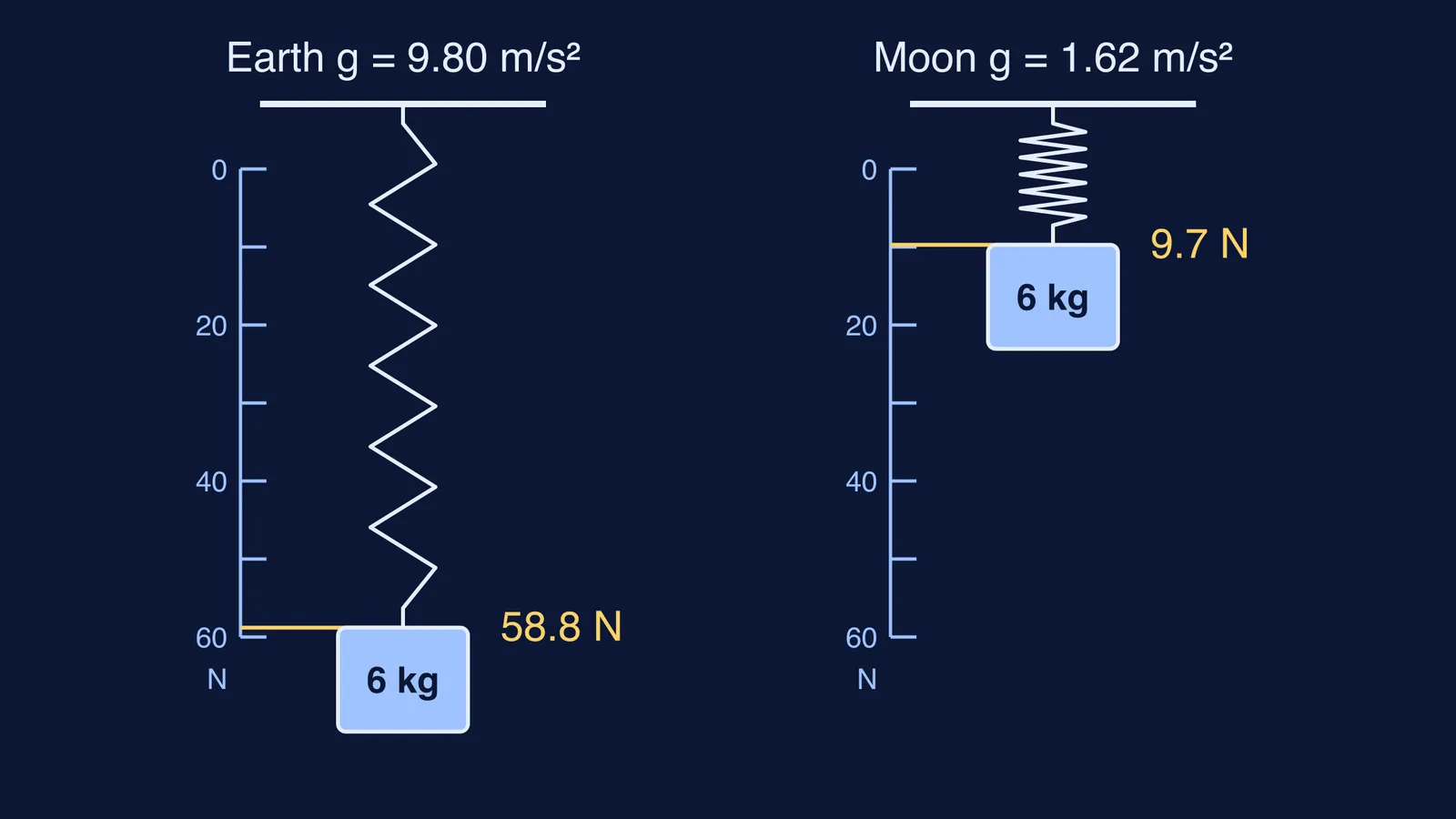
Picture a spring balance with a 6 kg bag of rice hanging from it. Carry the same balance and the same bag to the Moon, and the spring stretches far less, so the pointer stops much closer to zero. Nothing is broken. The balance is doing its job, which is measuring how hard gravity pulls. This idea first appears in middle-school science and comes back in Class 9 gravitation and in JEE Main mechanics, so it is worth getting straight once.
What is the difference between mass and weight?
Mass is the amount of matter in an object, and it does not depend on gravity, as NASA's Mass vs. Weight teaching guide puts it. Weight is the force with which a body is attracted to Earth or another celestial body, equal to its mass times the acceleration due to gravity, according to the same guide.
In symbols, W = mg, as NASA Glenn Research Center's weight equation page explains. Mass is measured in kilograms. Weight is a force, so it is measured in newtons (N).
The everyday habit of saying "I weigh 50 kg" is where most confusion starts. A bathroom scale is really sensing a force and then dividing by Earth's g for you. That shortcut only works on Earth.
Why do we weigh less on the Moon than on Earth?
The Moon's surface gravity is 1.62 m/s², compared with 9.80 m/s² on Earth, according to NASA's Moon fact sheet. That page gives the Moon-to-Earth ratio as 0.165, which is about one sixth.
The reason is the Moon's mass and size. The same NASA fact sheet lists the Moon's mass as 0.0123 of Earth's and its mean radius as 0.2727 of Earth's. Surface gravity depends on mass divided by radius squared, so you can check the ratio yourself:
Mass ratio: 0.0123
Radius ratio squared: 0.2727 × 0.2727 ≈ 0.0744
Gravity ratio: 0.0123 ÷ 0.0744 ≈ 0.165
The Moon has far less mass, which on its own would cut the pull to about 1/81 of Earth's (1 ÷ 0.0123). It is also smaller, so on its surface you stand closer to its centre, which on its own would make the pull about 13 times stronger (1 ÷ 0.0744). The small mass wins, and you are left with roughly one sixth of Earth's gravity.
What does a spring balance read on the Moon?
A spring stretches more when it is pulled harder. Less pull means less stretch and a lower reading. NASA's lesson plan on mass says that on the Moon "the spring balance will record a smaller weight", while a two-pan balance will not change, because the standard weights in the other pan also weigh only one sixth as much there.
That lesson adds a point many students miss: both instruments rely on gravity, so what each one measures is weight, not mass. The pan balance compares two weights that shrink together, which is why it still gives the right mass on the Moon.
Worked example: a school bag on the Moon
Your school bag has a mass of 6 kg. Use g = 9.80 m/s² for Earth and 1.62 m/s² for the Moon, the values in NASA's Moon fact sheet.
Mass on Earth: 6 kg. Mass on the Moon: still 6 kg.
Weight on Earth: W = 6 × 9.80 = 58.8 N.
Weight on the Moon: W = 6 × 1.62 = 9.72 N.
Check the ratio: 9.72 ÷ 58.8 ≈ 0.165, about one sixth.
A spring balance marked in kilograms for Earth would show about 6 × 0.165 ≈ 1 kg on the Moon. A pan balance would still show 6 kg.
That last step is the exam trap. The spring balance is not faulty; its kilogram markings simply assume Earth's g.
How do you avoid losing marks on mass and weight questions?
Run this check before you write your answer:
Is the question asking for mass or weight? Mass is in kg, weight is in N.
Did the mass change? It should not, unless matter was added or removed.
Which g applies? Use the value for the place in the question, or the value the question gives.
Which instrument? A spring balance reading changes with g; a pan or beam balance reading does not.
Is the answer sensible? Moon weight should be about one sixth of Earth weight, not six times bigger.
If you want more practice, the Fermi Problem Library has worked problems with a step-by-step solver that explains the reasoning rather than printing an answer, so you can see where a g value or a unit slipped. If weight as a force still feels shaky, the Fermi Concept Library gives each physics concept its own lesson and shows its place in the map.
For the next step, try these Class 9 mass and weight examples on the Moon, see how objects fall in our guide to free fall on Earth, the Moon and Jupiter, and find out why astronauts feel weightless in orbit.


