

On this page
When you travel to another planet or moon, some things about you change, and others stay exactly the same. The difference between mass and weight is a core idea in Class 9 physics, and it explains why astronauts can easily lift heavy rovers on the Moon. Understanding this concept is the foundation for solving gravitation numericals correctly.
What is the difference between mass and weight?
To understand what happens on the Moon, you first need to separate two ideas that we often mix up in everyday language:
Mass is the actual amount of matter in an object. It is a fundamental property that does not change when you move the object to a different location in the universe. We measure mass in kilograms (kg) using a beam balance. If you are made of a certain number of atoms on Earth, you have the exact same number of atoms in space.
Weight is the gravitational force pulling on that mass. Because it is a force, we measure weight in newtons (N) using a spring balance. Weight is directly proportional to the local gravitational pull.
You can calculate weight using the formula W = m × g, where m is the mass in kilograms and g is the acceleration due to gravity in m/s².
How is the gravity of a planet calculated?
To understand why the Moon's gravity differs from Earth's, you have to look at Newton's law of universal gravitation. The acceleration due to gravity on the surface of any planet or moon is calculated using the formula g = (G × M) / R², where G is the universal gravitational constant, M is the mass of the celestial body, and R is its radius.
According to the NASA Moon Fact Sheet, the Moon's mass is roughly 1.2% of Earth's mass, and its radius is roughly 27% of Earth's radius. When you plug these smaller values into the gravity formula, the result is a surface gravity that is a fraction of what we experience on Earth. This is why a person leaping on the lunar surface stays in the air longer and does not need as much force to overcome gravity.
Why is gravity weaker on the Moon?
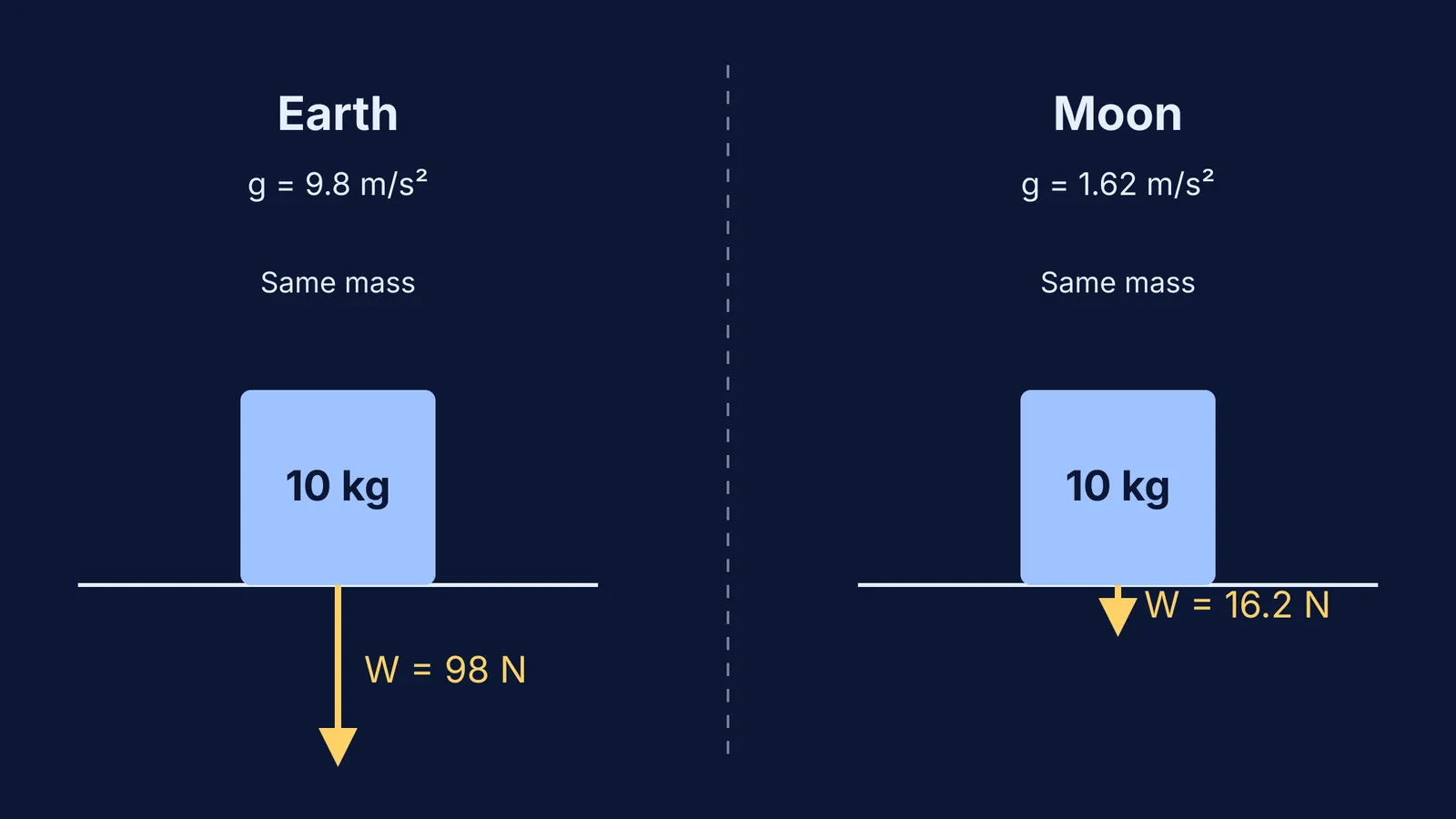
Your weight changes depending on where you stand because weight depends entirely on the local gravity of the celestial body.
As noted by the NASA Moon Fact Sheet, the acceleration due to gravity on the Moon is 1.62 m/s², while on Earth it is 9.8 m/s².
Because the Moon has a much smaller mass than Earth, its gravitational pull is much weaker. If you divide Earth's gravity by the Moon's gravity (9.8 ÷ 1.62), you get approximately 6. This means gravity on the Moon is roughly one-sixth of Earth's gravity. Consequently, any object will weigh only one-sixth as much on the Moon as it does on Earth, even though it retains all of its original mass.
Worked example: mass and weight of object on moon class 9
Here is how you tackle a standard Class 9 numerical problem on this topic. You will often be asked to find both values to test if you know the difference. We will use the gravity values from the NASA Moon Fact Sheet.
Question: An object has a mass of 60 kg on Earth. What is its mass and its weight on the Moon?
Step 1: Find the mass on the Moon. Since mass is the amount of matter, it does not change based on location. Mass on the Moon = 60 kg.
Step 2: State the formula for weight. Weight (W) = mass (m) × gravity (g).
Step 3: Calculate weight on the Moon. Use the Moon's gravity (g = 1.62 m/s²). W = 60 kg × 1.62 m/s² W = 97.2 N.
For comparison, let us calculate what that same object weighs on Earth. W = 60 kg × 9.8 m/s² = 588 N. The object feels much heavier on Earth, but its mass is 60 kg in both places.
How to avoid common Class 9 mistakes
When solving gravitation numericals in exams, watch out for these traps (using the constants from the NASA Moon Fact Sheet):
Writing weight in kg: In daily life, we say "I weigh 50 kg," but in physics, weight is a force. Always use newtons (N) for weight and kilograms (kg) for mass.
Changing the mass: If a question asks for the mass of an object on the Moon, write down the same mass it has on Earth. Do not divide the mass by six.
Using the wrong g: Always check whether the question asks for weight on Earth (use 9.8 m/s²) or weight on the Moon (use 1.62 m/s²).
If you find yourself confusing formulas or choosing the wrong units, the Fermi Problem Library has worked problems with a step-by-step solver that explains the reasoning rather than printing an answer. It can walk you through the steps to calculate forces, ensuring you understand why a unit is used before you move on to the next problem.
For more practice with gravity in different environments, try exploring Free fall on Earth, the Moon and Jupiter: a simulation guide or see how we Find the density of Earth from g and its radius. You can also learn Why the Moon Has No Atmosphere: RMS Speed vs Escape Velocity.


