

On this page
Switch a free fall simulation from Earth to the Moon to Jupiter and the same ball takes very different times to land. Make it ten times heavier with the air off, and nothing changes. One equation predicts both.
How long does an object take to fall on Earth, the Moon and Jupiter?
NASA's Planetary Fact Sheet lists surface gravity as 9.8 m/s² for Earth, 1.6 m/s² for the Moon and 23.1 m/s² for Jupiter. Jupiter has no surface you could stand on: the fact sheet notes say the gas giants' surfaces lie deep in the atmosphere and their gravity is given at the 1 bar pressure level, so a Jupiter drop is a thought experiment high in the atmosphere.
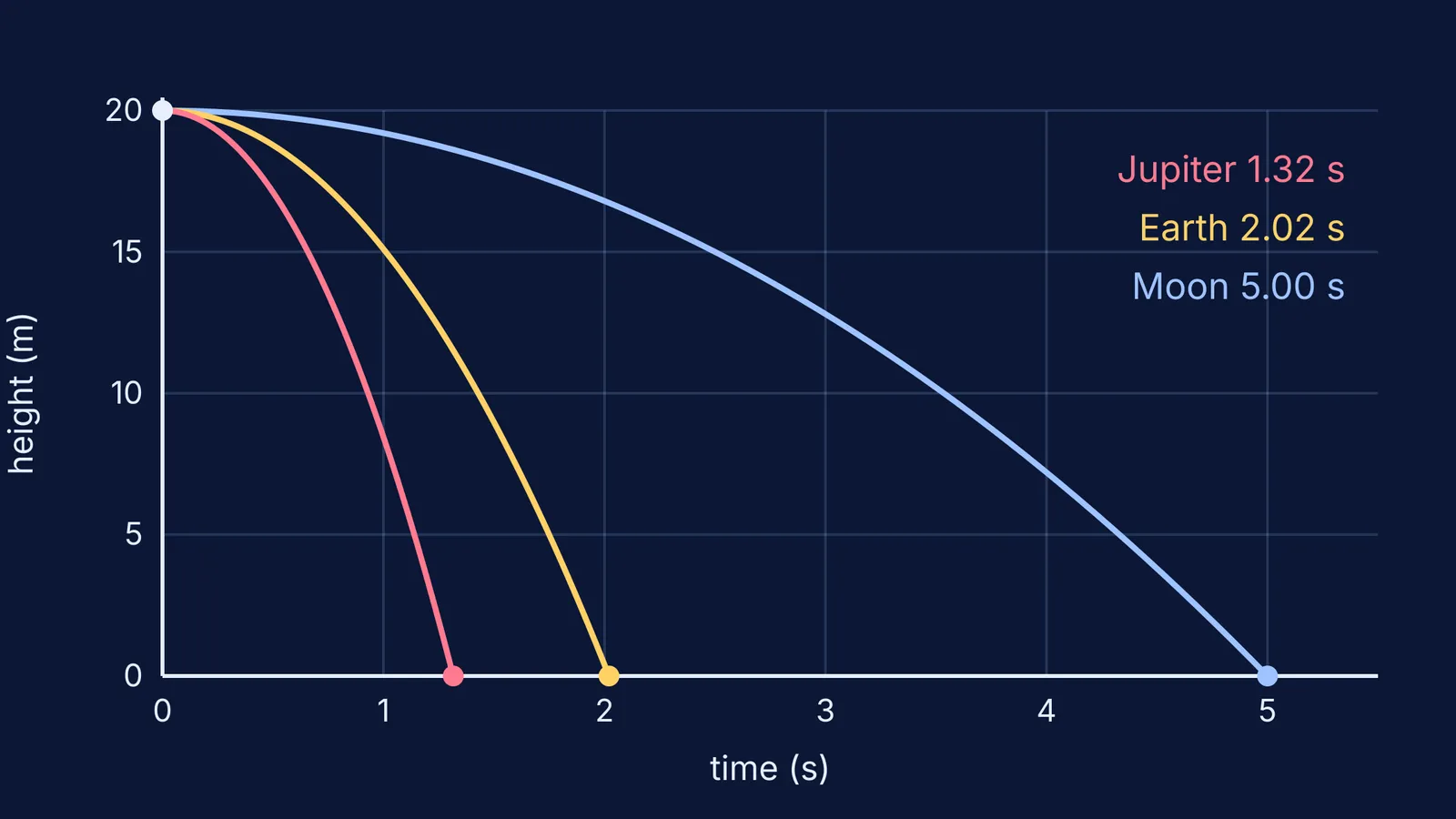
For an object released from rest with no air, the height fallen is h = ½gt². Rearranged, the fall time is t = √(2h/g) and the landing speed is v = √(2gh). Here is a worked example for a drop from 20 m:
Earth: t = √(40 ÷ 9.8) = √4.08 ≈ 2.02 s, landing at about 19.8 m/s.
Moon: t = √(40 ÷ 1.6) = √25 = 5.00 s, landing at 8.0 m/s.
Jupiter: t = √(40 ÷ 23.1) = √1.73 ≈ 1.32 s, landing at about 30.4 m/s.
Moon gravity is about 6.1 times weaker than Earth's (9.8 ÷ 1.6), but the fall takes only about 2.5 times longer, because time depends on 1/√g, not 1/g.
Why do heavy and light objects fall at the same rate?
The pull of gravity on a mass m is F = mg. Newton's second law says the acceleration is a = F/m. Put the two together and a = mg/m = g: the mass cancels. A heavier object is pulled harder, but it is also harder to speed up, by exactly the same factor.
The cleanest real test happened on the Moon. At the end of the last Apollo 15 moonwalk, Commander David Scott dropped a 1.32 kg aluminium geological hammer and a falcon feather together, as NASA's Apollo 15 hammer-feather drop page records. Mission Controller Joe Allen described the result in the Apollo 15 Preliminary Science Report, quoted on that page: "Within the accuracy of the simultaneous release, the objects were observed to undergo the same acceleration and strike the lunar surface simultaneously."
So with air resistance off, a simulation's mass slider should do nothing to the fall time.
How does air drag change who lands first?
On Earth, air pushes back. Drag grows with speed until it equals the weight; then the net force is zero and the object falls at a steady terminal velocity. NASA Glenn Research Center's terminal velocity page gives it as V = √(2W / (Cd ρ A)), where W is weight, Cd the drag coefficient, ρ the air density and A the cross-sectional area.
The NASA page draws two conclusions:
Same size and shape, different weight: the lighter object falls slower. From the formula, a sphere four times heavier than an identical-looking one has a terminal speed √4 = 2 times higher.
Same weight, different shape: a large flat plate falls slower than a small ball, because A is bigger.
NASA's page also states the limit plainly: "Galileo's principle only applies in a vacuum, where there is NO air resistance and drag is equal to zero." Mass only cancels when drag does.
What should you test in a free fall simulation?
Use this five-step routine. For each step, write your prediction first, then run it. The g values come from NASA's Planetary Fact Sheet.
Air off, Earth, 20 m. Change only the mass. Prediction: the time stays at about 2.02 s.
Air off, same object. Switch to the Moon, then Jupiter. Prediction: 5.00 s and 1.32 s.
Air off, Earth. Double the height to 40 m. Prediction: t = √(80 ÷ 9.8) ≈ 2.86 s, which is √2 times longer, not twice as long.
Air on, two balls of the same size, one four times heavier. Prediction: the heavy one lands first, and if the simulation shows terminal speed, it is about double.
Air on, same mass, larger area. Prediction: slower fall and lower terminal speed.
When a result surprises you, find which term in the equation you misjudged before moving on. For more practice, try the six predictions in our guide to learning projectile motion with a simulation, work through vertical motion under gravity problems, or read what studies found on simulations versus static diagrams.
The Fermi Simulation Lab has interactive simulations for ideas that are easier to see than to read, and you can bring the predict-then-run routine above to any of them. If you get stuck on why a result came out as it did, Fermi's AI tutor can run the simulation with you and check your understanding as it goes.
Pick one planet tonight, predict three fall times, and see how close you get.


