

On this page
You stand on a cliff, drop a stone, count one second and drop a second stone. Do they stay the same distance apart, drift apart faster and faster, or something in between? A common guess is "faster and faster". The real answer is simpler: the gap grows by the same amount every second.
How far apart are two stones dropped one second apart?
For a body dropped from rest with no air resistance, the distance fallen after time t is s = ½gt². This follows from the free-fall position equation y = y₀ + v₀t − ½gt² in OpenStax University Physics, section 3.5, with v₀ = 0. Standard gravity is defined as exactly 9.80665 m/s² in NIST's CODATA listing for standard acceleration of gravity; school problems round it to 9.8 or 10 m/s².
Call the first stone A and the second B, and let t be the time since B was released. A has been falling for (t + 1) seconds, B for t seconds. Subtract their distances:
gap = ½g(t + 1)² − ½gt² = ½g + gt
The t² terms cancel. With g = 9.8 m/s², the gap is:
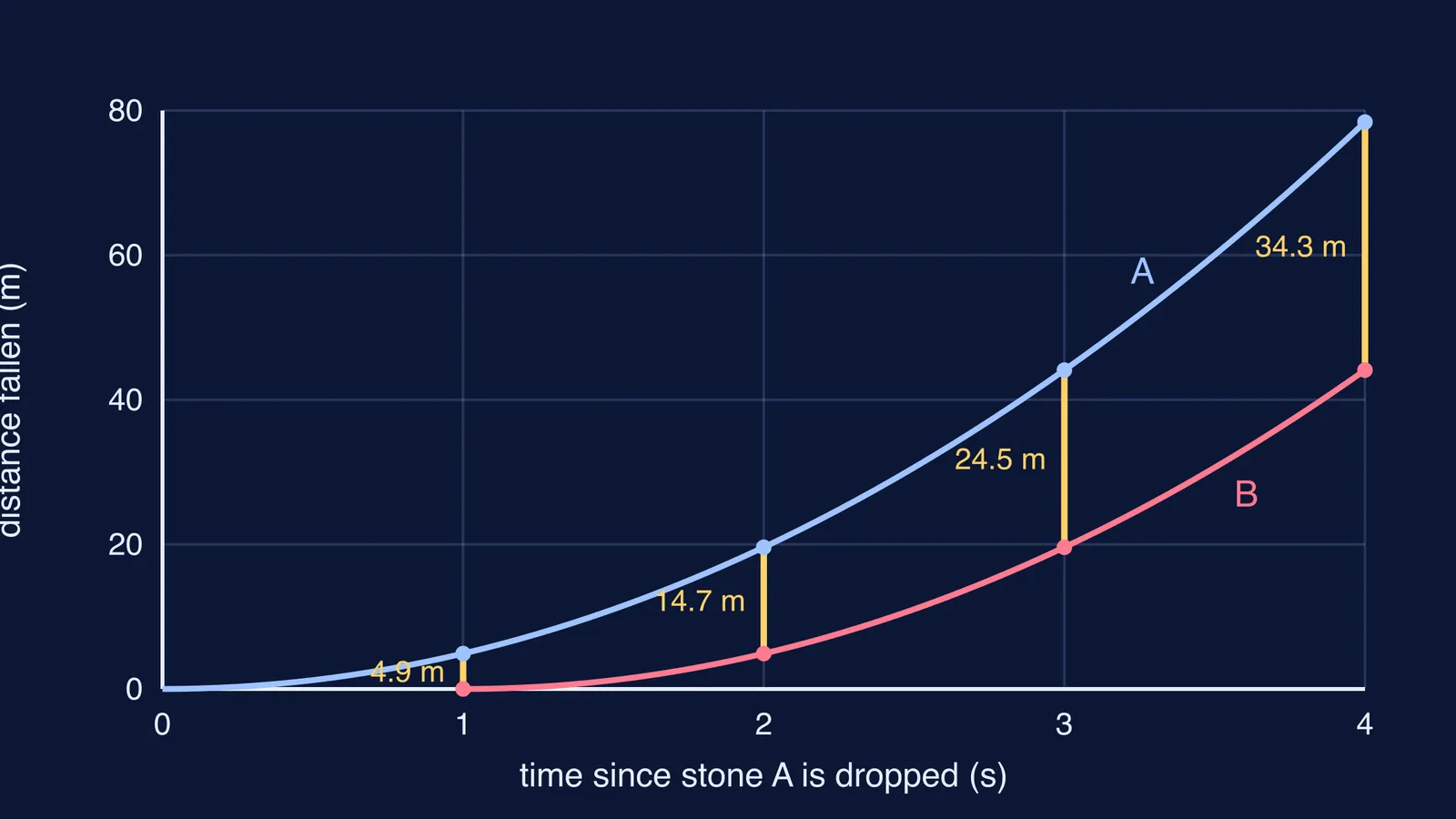
4.9 m at the moment B is released
14.7 m one second later
24.5 m two seconds later
34.3 m three seconds later
Each step is 9.8 m. That is a straight line on a gap-versus-time graph, not a curve.
Why does the gap grow linearly if both stones speed up?
Look at speeds instead of distances. From v = v₀ − gt in the same OpenStax free-fall section, a body dropped from rest has speed gt after t seconds. So A's speed is g(t + 1) and B's is gt. A is always faster by exactly g × 1 s, about 9.8 m/s.
Both stones gain speed at the same rate, so the difference in speed never changes, and a constant relative velocity means the gap changes at a constant rate.
We explain the general rule, that two freely falling bodies always have constant relative velocity, in why the relative velocity of two freely falling bodies stays constant.
Worked example: two stones from a 78.4 m cliff
Take g = 9.8 m/s², following the free-fall equations in OpenStax. The cliff is 78.4 m high, chosen so the numbers come out clean.
When does A land? Solve 78.4 = ½ × 9.8 × T². So T² = 16 and T = 4 s after A's release.
How far has B fallen by then? B has fallen for 3 s: ½ × 9.8 × 9 = 44.1 m.
The gap at that moment: 78.4 − 44.1 = 34.3 m. That matches the formula ½g + gt with t = 3 s: 4.9 + 29.4 = 34.3 m.
Speeds at that moment: A is at 9.8 × 4 = 39.2 m/s, B at 9.8 × 3 = 29.4 m/s. The difference is 9.8 m/s, the same as at every earlier moment.
B lands one second after A, 5 s after A's release, since both take the same 4 s to fall. Once A hits the ground, the gap formula stops applying.
What changes with g = 10, a different delay, or air resistance?
g = 10 m/s². Many exam papers round to this instead of the 9.8 m/s² used in OpenStax. The gaps become 5, 15, 25, 35 m, growing by 10 m each second.
A delay other than one second. If B is dropped τ seconds after A, the gap is ½gτ² + gτt. It still grows linearly, now at gτ per second. A two-second delay doubles the rate.
B thrown downward instead of dropped. B starts with a speed u, so the relative velocity is now g × delay − u. It is still constant, so the gap still changes linearly. It can even shrink, which is how "when does B catch A?" questions work.
Air resistance. Two identical real stones head towards the same top speed, so the speed difference shrinks and the gap levels off. See whether air resistance makes a ball take longer to fall.
A quick check before you answer
Use this when a question has two bodies released at different times, with the free-fall equations from OpenStax section 3.5:
Do both bodies have the same acceleration? If yes, relative acceleration is zero.
Find the relative velocity at the moment the second body starts. It stays that value.
Find the gap at that same moment. For a one-second drop delay it is ½g × 1², which is 4.9 m (or 5 m with g = 10).
Gap at any later time = starting gap + relative velocity × time.
Check that neither body has landed yet.
The distances A covers in each separate second follow the odd-number pattern Galileo found, explained in distance travelled in successive seconds of free fall.
For more two-body free-fall questions, the Fermi Problem Library has worked problems with a step-by-step solver that explains the reasoning rather than printing an answer.


