

On this page
When an object is dropped from rest, it does not cover the same distance in every second. As gravity pulls it downwards, it accelerates, meaning it travels further in each passing second than it did in the one before.
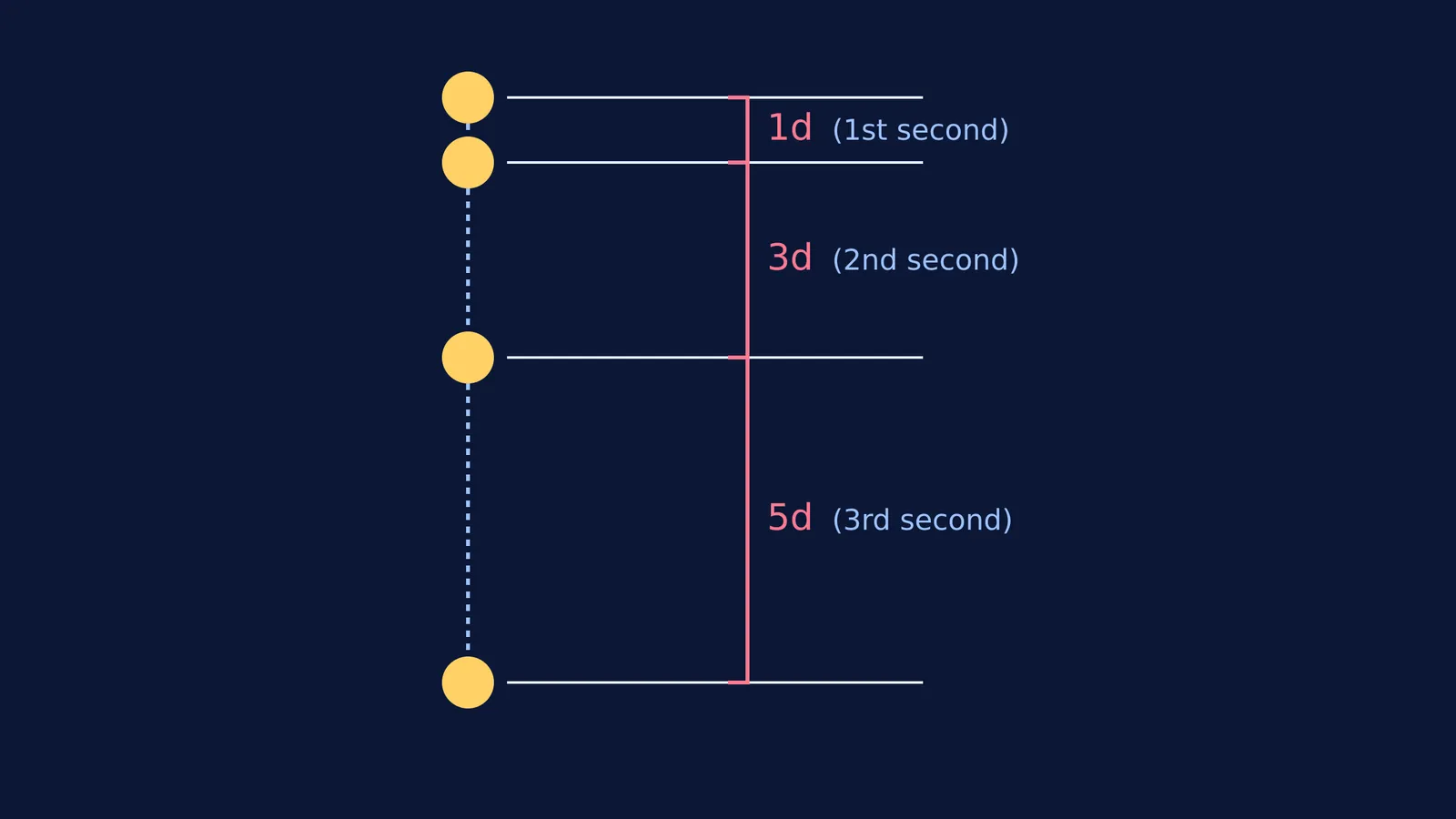
In 1638, the Italian astronomer Galileo Galilei published his law of odd numbers in his final book, *Discourses and Mathematical Demonstrations Relating to Two New Sciences*. He established that the distances covered by a falling object in successive equal time intervals are proportional to the odd numbers: 1, 3, 5, 7, and so on.
What is the distance travelled in successive seconds of free fall?
You can calculate exactly how far an object falls in any given second using the equations of motion. If you drop a ball, its initial velocity (u) is zero. The acceleration due to gravity (g) is roughly 9.8 m/s².
Because the object starts from rest, we can drop the initial velocity term and write the formula for the distance covered in the n-th second (sₙ) as:
sₙ = (g/2) × (2n - 1)
This shows that the distance depends entirely on the term (2n - 1), which generates the odd numbers.
A worked example of the 1:3:5 ratio
Let us predict the exact distances for the first three seconds of a ball's fall.
1st second (n = 1): s₁ = (9.8 / 2) × (2(1) - 1) = 4.9 × 1 = 4.9 metres.
2nd second (n = 2): s₂ = (9.8 / 2) × (2(2) - 1) = 4.9 × 3 = 14.7 metres.
3rd second (n = 3): s₃ = (9.8 / 2) × (2(3) - 1) = 4.9 × 5 = 24.5 metres.
The distances are 4.9 m, 14.7 m, and 24.5 m. If you divide each of these by 4.9, you get exactly 1, 3, and 5. This ratio holds true for any uniform acceleration, whether you are on Earth, on the Moon, or rolling a ball down an inclined plane.
Why do falling objects follow the 1:3:5 ratio?
The ratio emerges because of how total distance behaves over time. The total distance an object falls in t seconds is s = (1/2)gt².
After 1 second, the total distance is 0.5g × 1² = 0.5g.
After 2 seconds, the total distance is 0.5g × 2² = 2.0g.
After 3 seconds, the total distance is 0.5g × 3² = 4.5g.
To find the distance travelled *during* the 2nd second alone, you subtract the distance covered in the 1st second from the total distance at the end of the 2nd second: 2.0g - 0.5g = 1.5g. For the 3rd second alone, subtract the 2-second total from the 3-second total: 4.5g - 2.0g = 2.5g.
The sequence of distances for each second is 0.5g, 1.5g, and 2.5g. The ratio between them is 1:3:5. This pattern relies on the fact that finding the distance in the nth second requires subtracting two consecutive squares, and the difference between consecutive square numbers is always an odd number.
Does this work for objects thrown upwards?
Galileo's law applies to objects thrown straight up, but in reverse. If you throw a ball upwards, gravity slows it down by 9.8 m/s every second.
When a ball reaches the top of its flight, its velocity is momentarily zero, and then it falls back down exactly as if it had been dropped. Because of the symmetry of motion under uniform acceleration, the journey upwards is a mirror image of the journey downwards.
If a ball takes three seconds to reach its peak, the distance it travels in its final second of upward flight is exactly the same as the distance it will travel in its first second of downward flight. Therefore, in the last three seconds of its upward journey, the distances it covers will follow a 5:3:1 ratio.
If you find equations of motion tricky to apply in reverse, Fermi's AI tutor can help. It holds a line of reasoning across a whole session, notices where you are stuck, and teaches through it—drawing the figure and checking understanding as it goes.
Measuring the ratio yourself
Reading about a mathematical rule is one thing, but verifying it yourself helps cement the idea. If you want to see this happen in real time, you can set up a dropping ball in the Fermi Simulation Lab. Pause the simulation exactly at 1, 2, and 3 seconds, and measure the distance from the start. When you subtract the previous total to find the gap for each second, you will find it matches the 1:3:5 pattern perfectly.
This works just as well for a horizontal projectile from a cliff, because the vertical motion of a projectile is identical to an object dropped from rest. No matter how fast it moves sideways, its downward journey still follows the sequence of odd numbers.
You can also try this with a video of a falling object on your phone. Record a dropping ball at a high frame rate, and step through the frames to mark its position at equal time intervals. Even if those intervals are tenths of a second rather than full seconds, the ratio of the gaps between marks will still be 1:3:5:7.


