

On this page
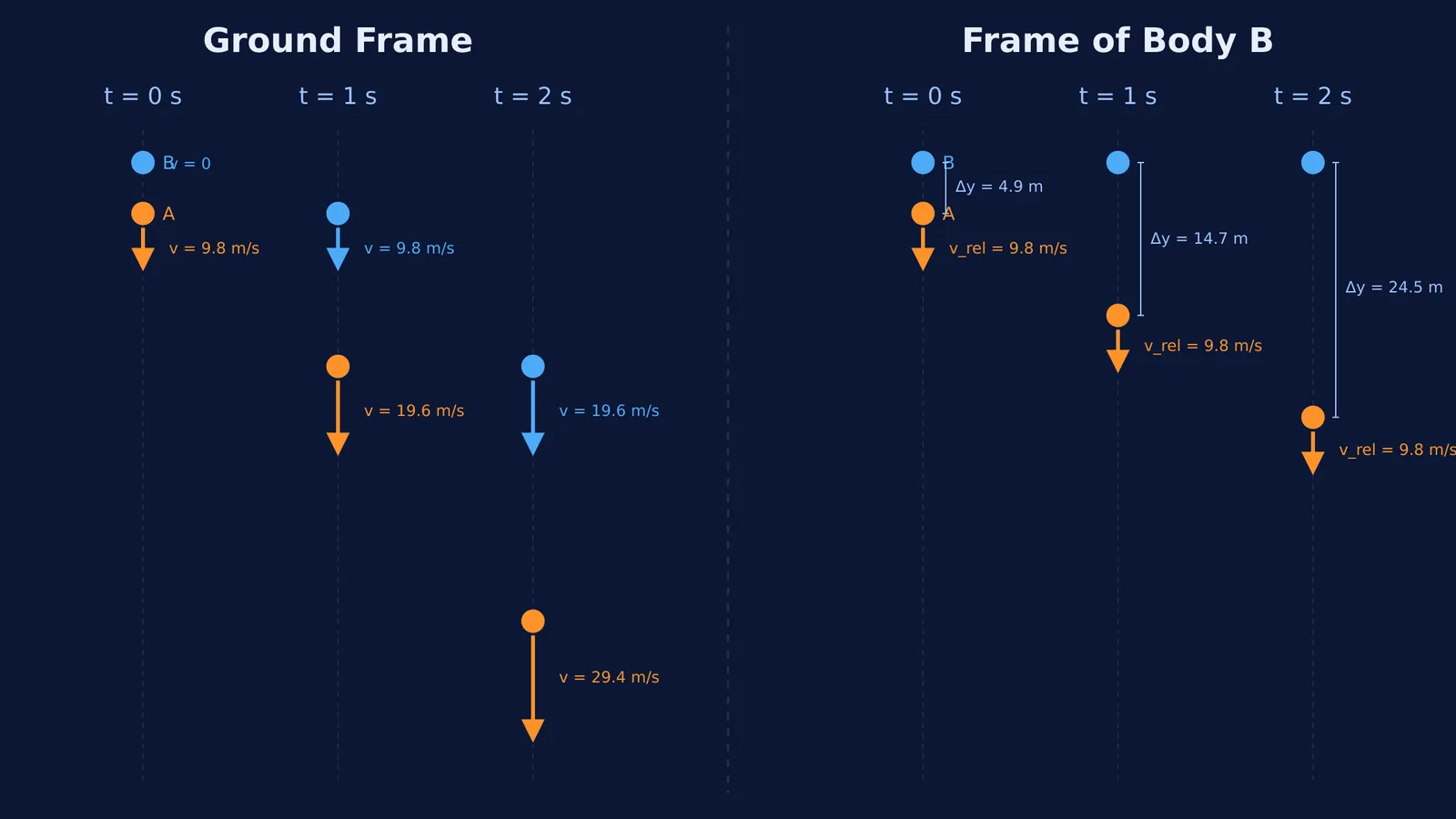
If you drop a stone from a bridge, and one second later drop another, they both speed up as they fall. Yet if you were falling alongside the second stone and looked at the first, it would not appear to be accelerating at all. Instead, it would seem to be moving steadily away from you in a straight line.
Why does this happen? The answer lies in how relative velocity works when two bodies share the exact same acceleration.
Why is relative acceleration zero?
In a uniform gravitational field where air resistance is negligible, all objects fall with the same constant downward acceleration of 9.8 m/s², regardless of their mass (OpenStax, 3.5 Free Fall). This is universally denoted as *g*.
Because both body A and body B are accelerating at *g*, we can calculate their relative acceleration by subtracting one from the other:
a_rel = a_A − a_B
a_rel = g − g = 0
From the perspective of either body, the other object has zero acceleration. It is not speeding up or slowing down relative to the observer.
Why does the relative velocity of two freely falling bodies stay constant?
An object's relative velocity is its velocity measured from a specific reference frame, found by subtracting the reference frame's velocity from the object's velocity (OpenStax, 4.5 Relative Motion).
If the relative acceleration between two objects is zero, it means their relative velocity cannot change. We can prove this mathematically using the kinematic equation for velocity, v = u + gt, where u is the initial velocity:
Velocity of body A: v_A = u_A + gt
Velocity of body B: v_B = u_B + gt
When we find the relative velocity v_AB (the velocity of A with respect to B), the *gt* terms cancel out:
v_AB = v_A − v_B = (u_A + gt) − (u_B + gt) = u_A − u_B
Because u_A and u_B are constants, the relative velocity v_AB remains entirely constant over time. If they are dropped at the exact same moment, u_A = u_B = 0, so their relative velocity is zero and they appear completely stationary to one another. If one is dropped later, it will always see the other moving at a fixed speed. This principle also forms the basis of the relative motion test for finding out if two projectiles will collide midair.
If you struggle to piece together reference frames and kinematic equations, the Fermi Concept Library covers every concept in physics, chemistry, biology, mathematics and computing, each with its own lesson and its place in the map. If you make wrong-method mistakes in the maths, the Fermi Problem Library offers worked problems with a step-by-step solver that explains the reasoning rather than printing an answer.
Why does the distance between them increase?
A common point of confusion is thinking that a constant relative velocity means the objects stay the same distance apart.
If body A is dropped one second before body B, body A will have already reached a velocity of 9.8 m/s by the time B is released (OpenStax, 3.5 Free Fall). Therefore, u_A = 9.8 m/s and u_B = 0 m/s. The relative velocity v_AB is 9.8 m/s.
Because body A is always moving 9.8 m/s faster than body B, the distance between them will increase by 9.8 metres every single second. Even though both are accelerating rapidly toward the ground, the gap between them widens completely linearly, much like calculating the distance in the nth second for an object under constant speed.
How far apart are the bodies over time?
We can track their exact positions to see this constant gap growth in action. Using the displacement equation for free fall, s = ut + ½gt², we can calculate how far each body has fallen (OpenStax, 3.5 Free Fall).
Let us assume body B is dropped at t = 0 seconds, while body A was dropped one second earlier. At t = 0, body A has already fallen for one second, so it is 4.9 metres below the drop point.
After one more second (t = 1):
Body B has fallen for 1 second: s_B = ½(9.8)(1)² = 4.9 metres.
Body A has fallen for 2 seconds: s_A = ½(9.8)(2)² = 19.6 metres.
The gap between them is 19.6 − 4.9 = 14.7 metres.
After another second (t = 2):
Body B has fallen for 2 seconds: s_B = ½(9.8)(2)² = 19.6 metres.
Body A has fallen for 3 seconds: s_A = ½(9.8)(3)² = 44.1 metres.
The gap between them is 44.1 − 19.6 = 24.5 metres.
From t = 0 to t = 1, the gap grew from 4.9 metres to 14.7 metres—an increase of exactly 9.8 metres. From t = 1 to t = 2, the gap grew from 14.7 metres to 24.5 metres—another increase of 9.8 metres. In the frame of either body, the other is simply moving away at a constant 9.8 m/s.


