On this page
Shine a laser pointer on a painted wall and look closely at the spot. It is not smooth. It is full of tiny bright and dark grains that seem to shimmer when you move your head. This is laser speckle. It is not dust, and it is not a fault in the laser. It is an interference pattern, and its grain size comes straight from the diffraction formula you already know. A 650 nm red pointer seen from 2 m with a 3 mm pupil gives grains about 1 mm across. Look through a 1 mm pinhole and the grains grow three times bigger.
Why does a laser spot on a wall look grainy?
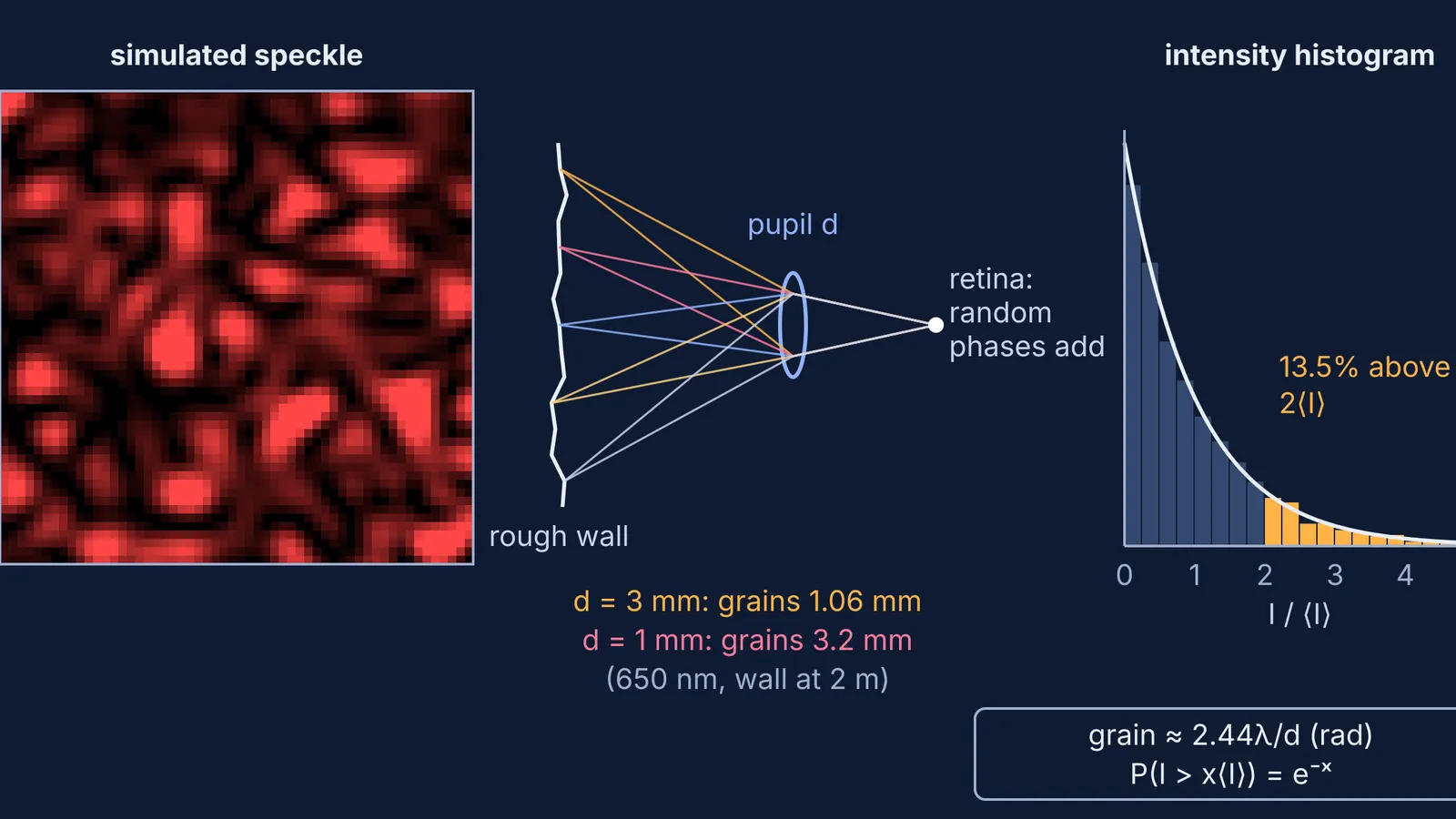
A painted wall looks smooth to you, but it is rough on the scale of a wavelength, which is less than a micrometre. Each tiny patch of the lit spot scatters light with a different path length to your eye, so each arrives with a different, effectively random phase.
With laser light, all those scattered wavelets are coherent: they keep fixed phase relations with each other. When they meet on your retina, they interfere. At some points they happen to add up and you see a bright grain. At others they nearly cancel and you see a dark one. The result is a random interference pattern.
A torch on the same wall shows no speckle. Its light is not coherent across the patch, so the phase relations change far faster than your eye can follow and the patterns average out to smooth brightness. This is the same reason two independent bulbs never give stable fringes, explained in why two independent light sources cannot produce interference.
What sets the size of a speckle grain?
Your eye cannot form a perfectly sharp image of a point. Because the pupil is a circular hole of diameter d, every point on the wall is imaged as a small Airy blur. The angular diameter of that blur's central disc is about 2.44λ/d. That is twice the Rayleigh angle 1.22λ/d, the same limit worked out for the pupil in how many pixels your eye can see.
Inside one blur spot, light from many rough points overlaps and adds with random phases. Neighbouring blur spots get independent random sums. So one speckle grain is about one blur spot across. The standard result for the smallest speckle size in an imaging system is 2.44λ(1 + M) × (f-number), where M is the magnification (Boas and Dunn, Journal of Biomedical Optics 2010). For your eye looking at a wall 2 m away, M is tiny and the f-number is focal length ÷ d, so the grain subtends an angle
θ ≈ 2.44λ/d
and on the wall it looks about θ × D across, where D is the viewing distance. Note what is missing: the roughness of the wall. Once the surface is rough compared with λ, the grain size depends only on the viewing aperture, the wavelength and the distance.
Worked example: how big are the grains at 2 m?
A red laser pointer has λ = 650 nm. You stand D = 2 m from the wall.
Normal pupil, d = 3 mm (a typical value in a lit room; real pupils range from about 2 to 8 mm).
Angle. θ = 2.44 × 650 × 10⁻⁹ m ÷ 3 × 10⁻³ m = 5.29 × 10⁻⁴ rad = 0.53 mrad.
Size on the wall. θD = 5.29 × 10⁻⁴ × 2 m = 1.06 × 10⁻³ m ≈ 1.06 mm.
Through a 1 mm pinhole. θ = 2.44 × 650 × 10⁻⁹ ÷ 1 × 10⁻³ = 1.59 × 10⁻³ rad = 1.59 mrad.
Size on the wall. 1.59 × 10⁻³ × 2 = 3.17 × 10⁻³ m ≈ 3.2 mm, three times bigger.
Check dimensions. λ/d is metres over metres, so θ is in radians, and θD is in metres.
Squinting narrows the opening in a rough, uneven way, but it works in the same direction: a smaller aperture means a bigger blur spot and coarser grains. That is the opposite of ordinary seeing, where a pinhole makes things look sharper, not grainier.
The same formula works for a camera. A phone camera at f/2 with a distant wall (M close to 0) gives grains about 2.44 × 0.65 µm × 2 ≈ 3.2 µm across on the sensor.
How bright are the bright grains?
When light from many random scatterers adds up, the intensity at a point follows a negative exponential distribution, as Boas and Dunn note for fully developed speckle (Boas and Dunn 2010). The chance that a point is brighter than x times the average intensity ⟨I⟩ is
P(I > x⟨I⟩) = e⁻ˣ
Put in numbers:
Brighter than twice the average: e⁻² ≈ 0.135, so 13.5% of the area.
Dimmer than a tenth of the average: 1 − e⁻⁰·¹ ≈ 0.095, so 9.5% of the area.
Dimmer than the average: 1 − e⁻¹ ≈ 0.632, so about 63%.
The most common intensity is zero: dark points are the most likely of all. That is why speckle looks so contrasty. The standard deviation of an exponential distribution equals its mean, so the speckle contrast (standard deviation ÷ mean) is 1.
Why is speckle useful?
Speckle is a nuisance in laser projectors and holograms, but doctors and researchers use it. If the scatterers move, such as red blood cells flowing under the skin, the speckle pattern flickers. A camera exposure then blurs it, and the contrast drops below 1. Mapping that drop across an image shows where blood flows fastest. This technique, laser speckle contrast imaging, is reviewed in the same paper by Boas and Dunn, with uses in neuroscience, dermatology and eye research.
A laser pointer's light also diffracts around small objects, which is the basis of measuring a hair with a laser pointer. Speckle is the many-scatterer version of the same wave behaviour.
Safety: never look into a laser beam, and never point one at anyone's eyes. Everything in this post is about looking at the spot on a wall, never at the laser itself.
If you want to see how aperture size changes a diffraction blur, try it in the Simulation Lab, which has interactive simulations for ideas that are easier to see than read.
Quick checklist
Speckle is interference of coherent light scattered from a surface rough on the scale of λ.
A torch gives none because its light is not coherent across the patch.
Grain angle ≈ 2.44λ/d; on a wall at distance D, size ≈ 2.44λD/d.
650 nm, 2 m: about 1.06 mm grains with a 3 mm pupil, 3.2 mm through a 1 mm hole.
Intensity is exponential: P(I > x⟨I⟩) = e⁻ˣ, so 13.5% of the area is above twice the average.
Never look into a laser beam.