On this page
A hair is only about seven divisions of a screw gauge wide, so the gauge reads it roughly. Shine a laser pointer past the same hair and a row of bright and dark patches spreads across a wall two metres away. You can measure that pattern with an ordinary ruler and work back to the hair's width to better than one per cent of the reading. This post shows why a hair diffracts like a slit, how to set up the measurement, and how to turn the dark spots into micrometres.
Safety first. Never look into a laser beam or along it, and never point it at anyone. Keep the beam at desk height and away from mirrors and shiny surfaces. Pointers are limited to 5 mW of visible light by US FDA rules, and university laser safety guidance says never to aim any beam at eyes, whatever its class. Even a legal pointer can hurt your eyes, as explained in why laser pointers are dangerous for eyes.
Why does a hair make the same pattern as a slit?
A slit is a gap of width a in an opaque sheet. A hair is the opposite: an opaque strip of width a in open space. Babinet's principle says that two such complementary screens produce diffracted waves that add up to the undisturbed beam. Wherever the undisturbed beam is dark, which on the wall means everywhere outside the small spot the laser would make on its own, the two patterns must have equal brightness.
So away from the centre, a hair of width a gives the same dark and bright fringes as a slit of width a. The only difference is the central spot, where the light that passes on both sides of the hair adds to the diffracted light. That is why you measure the dark fringes, not the middle.
The formula is the one you already know for a single slit. The n-th dark fringe sits at
y_n = nλD/a
where λ is the wavelength, D is the distance from the hair to the wall, and a is the hair's width. The slit derivation is in single-slit diffraction and Malus's law; here it is applied to an obstacle instead of a gap.
How do you set up the experiment at home or in the lab?
Tape one hair straight and tight across an empty slide frame or a hole cut in card.
Clamp the laser pointer so the beam hits the hair squarely. Do not hold it by hand.
Put the hair 2.00 m from a white wall or a sheet of paper and measure D with a tape.
Darken the room. The patches line up at right angles to the hair.
Mark the dark gaps with a pencil, counting outwards from the centre: 1, 2, 3, 4, 5 on the left and on the right.
Measure the distance between the two 5th dark gaps with a ruler.
Read the wavelength on the pointer's label; red pointers are often near 650 nm.
How do you get the hair's width from the pattern?
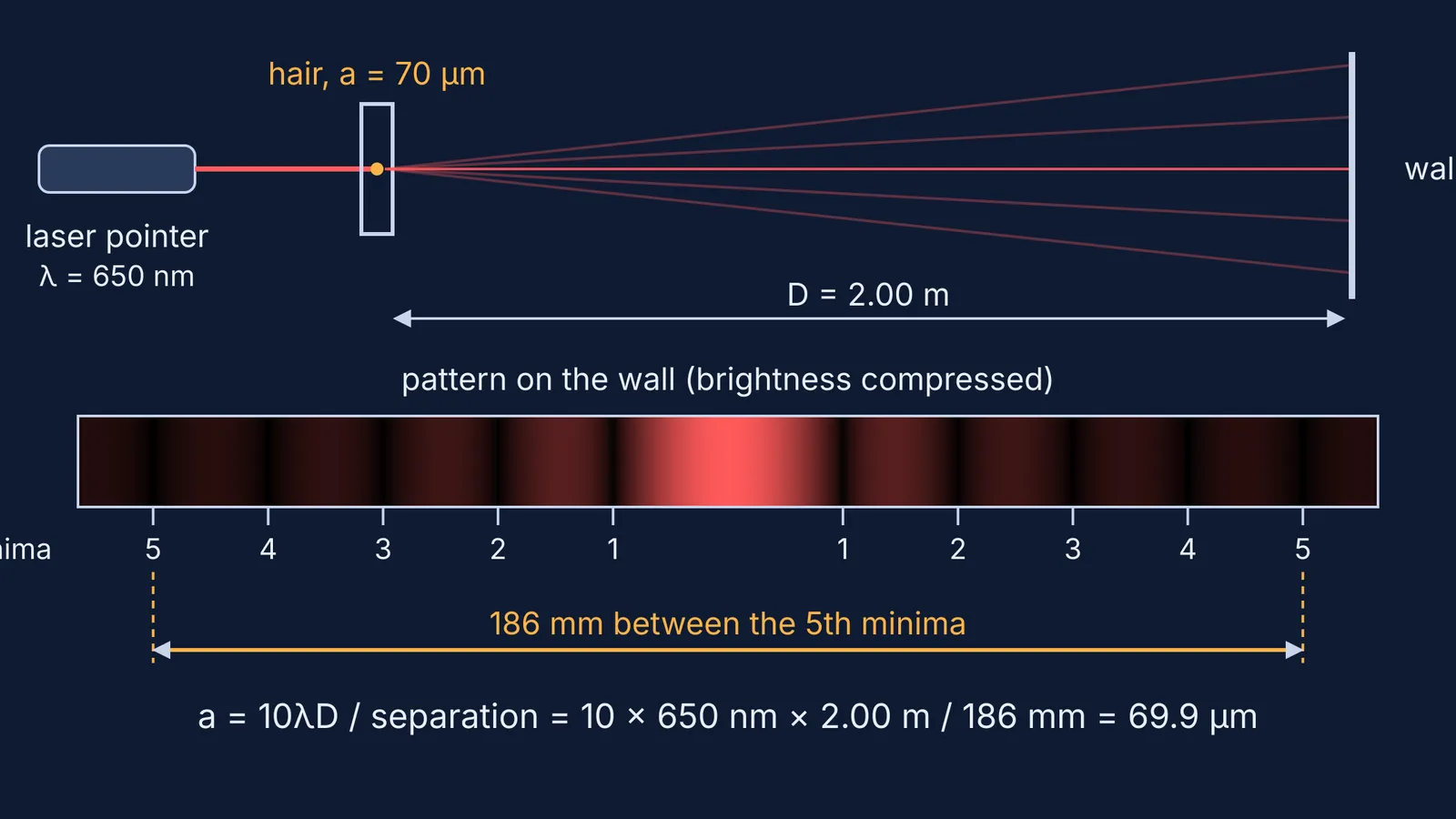
Here is a full worked example with a red pointer (λ = 650 nm), D = 2.00 m and a hair that turns out to be about 70 µm wide.
Predict the first dark fringe. y₁ = λD/a = (650 × 10⁻⁹ m × 2.00 m)/(70 × 10⁻⁶ m) = 0.0186 m = 18.6 mm from the centre.
Central band. It runs from the first dark fringe on one side to the first on the other: 2 × 18.6 = 37.1 mm wide.
The 5th dark fringes. y₅ = 5 × 18.6 = 92.9 mm from the centre on each side, so they are 2 × 92.9 = 186 mm apart.
Now invert. You measure 186 mm between the two 5th minima. That separation is 10λD/a, so a = 10λD/separation = 10 × 650 × 10⁻⁹ × 2.00/0.186 = 6.99 × 10⁻⁵ m = 69.9 µm.
Check the small-angle condition. The 5th minimum is at an angle of about 2.7°, so y ≪ D and the formula y = nλD/a holds well.
Check units. m × m ÷ m = m, as a width should be.
Two quick variations show how the pattern responds. A green pointer (532 nm) shrinks everything by the ratio of wavelengths: the central band becomes 30.4 mm. A thinner hair of 50 µm spreads the pattern out: its central band is 52.0 mm. Thinner objects give wider patterns. If you want to see that inverse relation move as you change the width, try the single-slit diffraction simulation.
Why is the laser method more precise than a screw gauge?
A screw gauge has a least count of 0.01 mm, which is 10 µm. A 70 µm hair is only seven divisions on the thimble, so an error of one division is about 14% of the reading. The spindle also squeezes a soft hair, and any zero error in the screw gauge matters a lot when the reading is this small.
Diffraction turns the 70 µm width into a 186 mm separation on the wall without touching the hair. A 1 mm ruler error in 186 mm is about 0.5% of the result, roughly 0.4 µm. That makes the reading uncertainty about 25 times smaller than the screw gauge's.
The catch is the wavelength. A label that says 650 nm when the real value is 640 nm or 660 nm puts about 1.5% straight into your answer, because a is proportional to λ. That is usually the largest error.
Why do different students get different answers?
Because hairs really are different. Published figures put human hair anywhere from roughly 20 to 180 µm across, with a commonly quoted range of 17 to 181 µm; the Harvard BioNumbers entry for hair diameter lists that range and notes that a better primary source is still needed. Treat it as rough. A hair is also not perfectly round, so turning it by 90° can change your result.
The spread of answers in a class is real data, not error.
To practise the inverse calculation with different wavelengths, distances and fringe numbers, the Fermi Problem Library has a step-by-step solver that explains the reasoning at each stage.
What mistakes spoil the measurement?
Measuring from the bright centre, which is changed by the unblocked beam. Use pairs of dark fringes.
Using y = nλD/a for bright fringes. That formula gives the dark ones.
Measuring D from the laser instead of from the hair.
Forgetting to convert nm and µm to metres before dividing.
Letting the hair sag or twist, which blurs the fringes.
Quick checklist
A hair diffracts like a slit of the same width (Babinet's principle), except at the bright centre.
Dark fringes: y_n = nλD/a, valid while y ≪ D.
Invert with a = 2nλD/(separation of the n-th minima).
Worked case: 650 nm, 2.00 m, 186 mm between 5th minima gives 69.9 µm.
Reading error about 0.5% against about 14% for a screw gauge; the wavelength label is usually the bigger uncertainty.
Never look into the beam or point it at anyone.