

On this page
A standard light bulb scatters light in all directions, so its power spreads out and diffuses rapidly before it reaches you. By the time the light crosses a room, only a tiny fraction of its original energy actually enters your pupil. A laser pointer is fundamentally different. It emits a coherent, collimated beam, meaning the light waves travel perfectly parallel to one another. Because the beam does not spread out as it travels, its power remains highly concentrated over long distances.
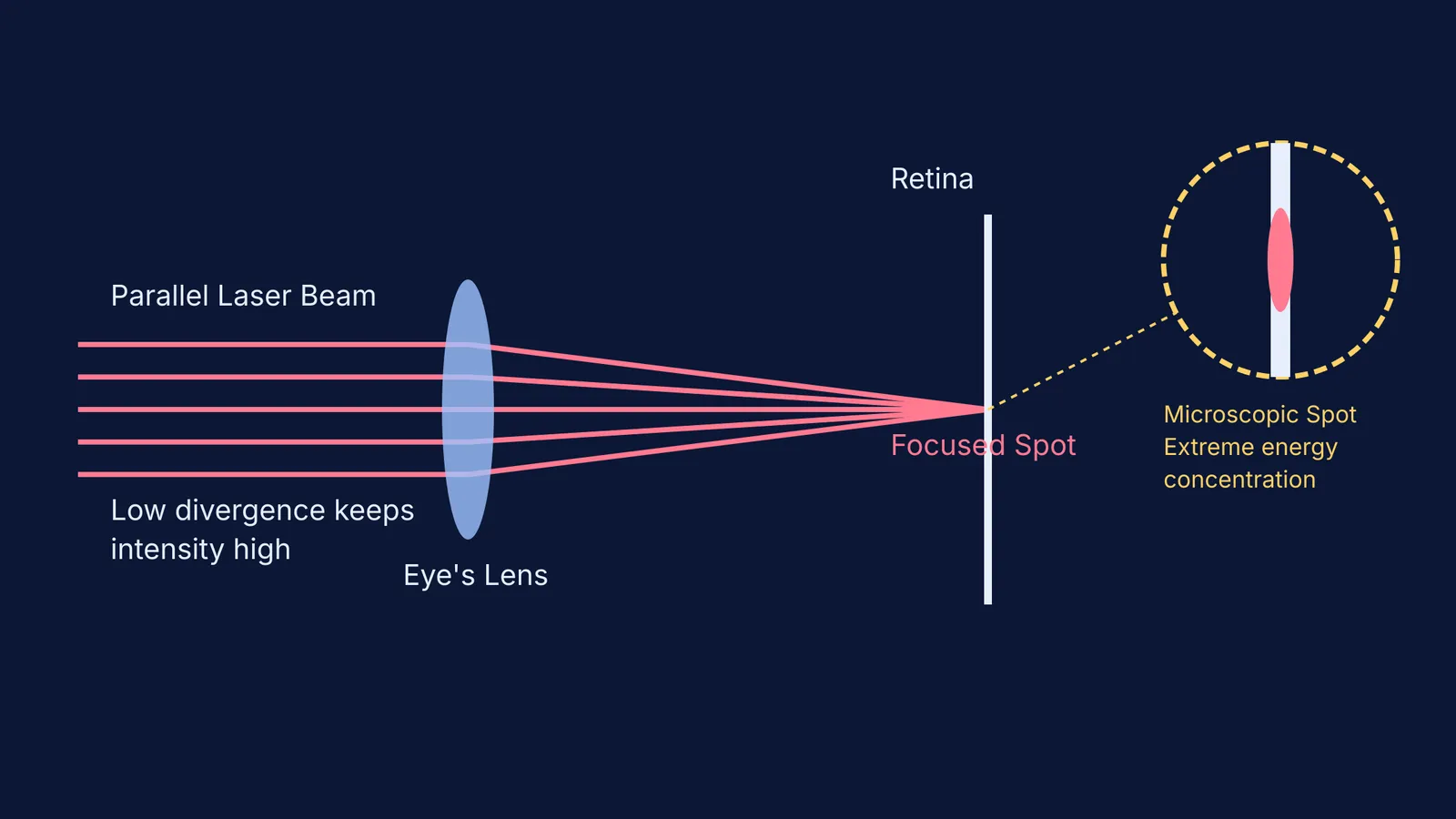
When you look at an ordinary light, your eye forms an image of a scattered, extended source spread over a wider area on the retina. But when a highly parallel laser beam enters the eye, the cornea and the crystalline lens act together to bend those parallel rays, forcing them to converge at a single, microscopic point.
How does the eye focus a laser beam?
Intensity in physics is defined as power divided by the area over which it is spread. The smaller the area, the higher the resulting intensity.
When a standard laser pointer beam hits the front of your eye, the beam itself might only be a few millimetres across. But the human eye acts as a highly efficient converging lens system, focusing that parallel beam down to a tiny spot on the retina. Because all of the laser's optical power is suddenly squeezed into such a microscopic area, the intensity of the light jumps dramatically.
According to the American Academy of Ophthalmology, this extreme focusing effect makes lasers incredibly dangerous, as even momentary exposure to a beam greater than 5 milliwatts (mW) can cause permanent damage.
If you want to understand how a lens bends parallel rays to a single point, you can explore it in the Fermi Simulation Lab. A separate post explains how spherical aberration and paraxial rays affect this kind of ideal focusing, and another discusses convex lens image formation.
Why are laser pointers dangerous for eyes?
The danger of this extreme intensity is what it does to the highly specialised, light-sensitive tissue lining the back of the eye. When a concentrated laser hits the retina, the energy is quickly absorbed by the retinal pigment epithelium and instantly converted into heat.
This rapid heating causes a photothermal burn. It effectively cooks the targeted cells, causing tissue death and creating a permanent blind spot in your vision, clinically known as a scotoma. The American Academy of Ophthalmology notes that these injuries can include full-thickness macular holes and hemorrhages in different retinal layers, which severely disrupt central vision.
Because the retina has no pain receptors, a person will not feel the burn as it happens. They may only notice a dark spot or blurred central vision hours later, by which time the damage is permanent and irreversible.
What happens to the blink reflex?
Our eyes have a natural defense mechanism against sudden, bright light: the blink reflex, or aversion response. According to the American Academy of Ophthalmology, this reflex is what protects us from standard pointers.
This reflex is the basis for most laser safety classifications. It protects the eye from lower-power lasers, which are legally limited to 5 mW of output. However, the Academy states that this protective mechanism is entirely ineffective against lasers with an output greater than 5 mW. High-powered lasers can inflict severe retinal damage in a fraction of a second, before the eye can even close. Furthermore, the human eye is inherently less sensitive to blue and violet light. This means the blink reflex may trigger even slower for these colours, drastically increasing the risk of injury from blue or violet lasers.
How can you check if a laser pointer is safe?
Many devices sold online are mislabeled and highly dangerous. According to the American Academy of Ophthalmology, testing shows that about 60 percent of sampled laser pointers emit far more power than their labels claim, sometimes reaching into the tens or hundreds of milliwatts. Here is a checklist to help ensure a laser pointer is safe for presentations or classroom use:
Inspect the batteries: Pointers that run on small button batteries are usually under the 5 mW limit and are generally safe for brief accidental exposure. Those taking AA, AAA, or lithium batteries are often designed for higher output and can be hazardous.
Beware of battery chargers: Pointers sold with battery chargers are likely to drain their batteries quickly because they are overpowered.
Be cautious with blue and violet lasers: The eye's blink reflex is slower for blue and violet light, which significantly increases the risk of injury from these lasers compared to red or green ones.
Never aim at vehicles: Never point a laser at an aircraft, moving car, or another person. Even when the beam spreads out over a distance, the resulting flash blindness can easily cause secondary accidents.
By understanding the physics of focused light, you can treat a laser pointer like a serious piece of optical equipment, ensuring its concentrated power stays safely away from the eye.


