On this page
Hold a 460 ppi phone at reading distance and you cannot pick out a single pixel. Sit 3 m from a 55-inch TV and you cannot tell 4K from Full HD. Both facts come from one number: a normal eye separates two points only if they are about 1 arcminute apart, 1/60 of a degree. Once you know that angle, you can work out the pixel density any screen needs, and the distance beyond which extra pixels stop showing.
What is the smallest detail the human eye can see?
The usual figure is 1 arcminute: 1′ = (1/60)° = 2.91 × 10⁻⁴ rad. This is the angle behind 6/6 vision, where each stroke of a letter on the test chart subtends 1′, as explained in how Herman Snellen built the eye chart. The International Telecommunication Union uses the same value for television design. Its Recommendation ITU-R BT.1845-1 says the typical minimum angular resolution of human vision is 1 arc-min, and defines the optimal viewing distance as the one at which two adjacent pixels subtend 1 arc-min at the eye.
Why about 1′ and not much less? Two limits meet near that value.
Diffraction at the pupil. The Rayleigh limit is θ = 1.22λ/D. For green light (λ = 550 nm) and a 3 mm pupil, θ = 1.22 × 550 × 10⁻⁹/(3 × 10⁻³) = 2.24 × 10⁻⁴ rad = 0.77′. The formula itself, for telescopes and microscopes, is covered in resolving power of microscope and telescope.
Spacing of the cones. At the centre of the retina, cones are roughly 2.5 µm apart, about 17 mm behind the eye's optical centre. Neighbouring cones are 2.5 × 10⁻⁶/17 × 10⁻³ = 1.47 × 10⁻⁴ rad = 0.51′ apart. To see a light line and a dark line as separate, you need at least two cones per light–dark cycle, which gives about 1.0′.
The eye's optics and its sensor are matched: neither wastes much on the other.
1′ is a typical value, not a hard wall. In a study of healthy eyes with logMAR charts, Elliott, Yang and Whitaker (1995) found mean acuity near 6/4.5 for ages 18 to 24, which is about 0.75′. Young eyes often do better than 6/6, and acuity also changes with contrast and brightness.
How many pixels per inch does a phone need?
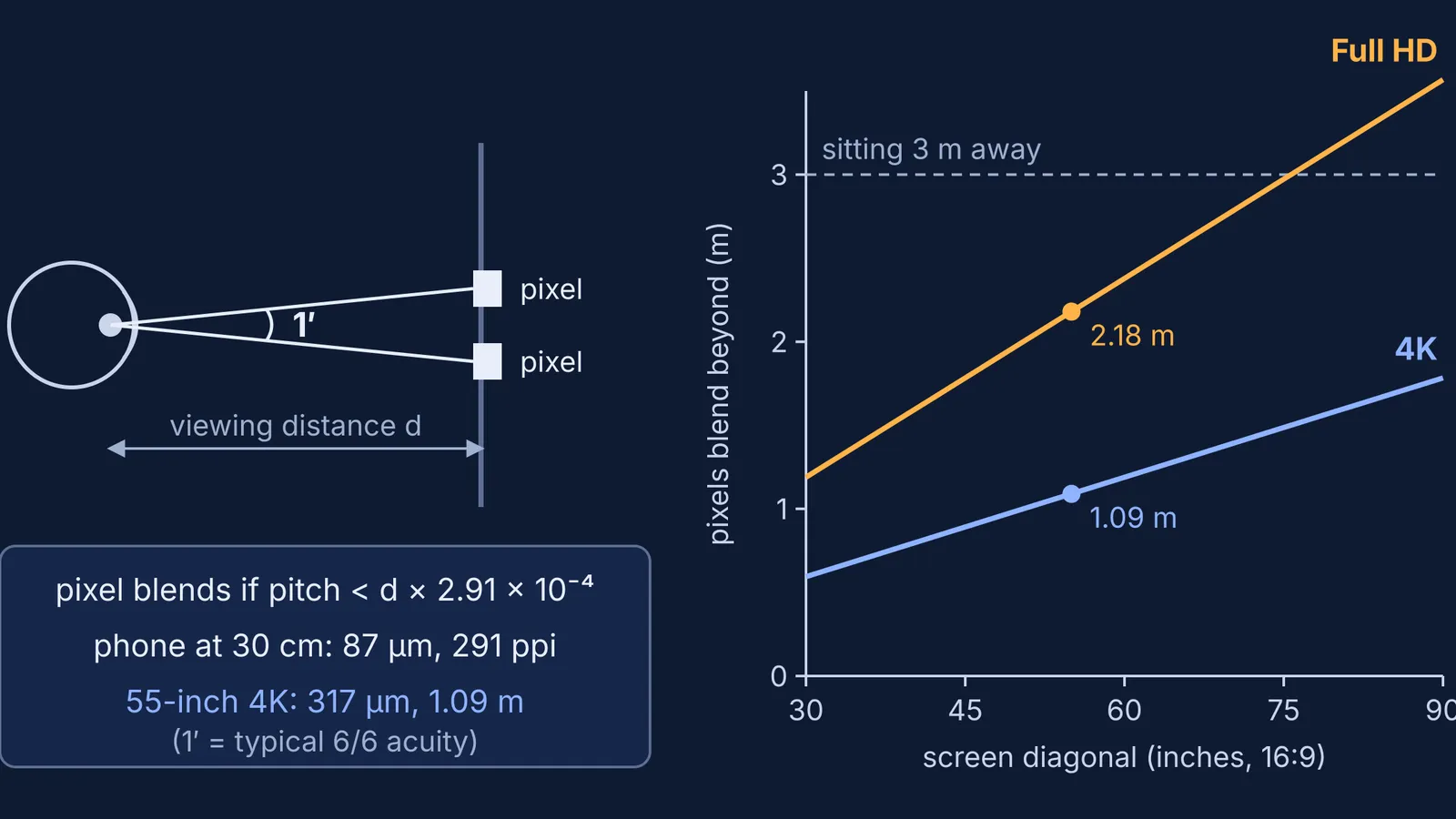
A pixel disappears into its neighbours when its pitch p (centre-to-centre spacing) subtends less than 1′. For small angles, p = d × 2.91 × 10⁻⁴, where d is the viewing distance.
Worked example: pixel density at reading distance
Phone at 25 cm. p = 0.25 × 2.91 × 10⁻⁴ = 7.27 × 10⁻⁵ m = 72.7 µm. One inch is 25.4 mm, so pixels per inch = 25.4 × 10⁻³/72.7 × 10⁻⁶ = 349 ppi.
Phone at 30 cm. p = 87.3 µm, which gives 291 ppi.
Tablet at 40 cm. p = 116 µm, which gives 218 ppi.
Check a real screen. A 460 ppi phone has p = 25.4 mm/460 = 55.2 µm. At 30 cm that subtends 55.2 × 10⁻⁶/0.30 = 1.84 × 10⁻⁴ rad = 0.63′, already finer than the eye resolves.
Check units. p is a length (metres × radians, and radians have no unit), and ppi is a count per length.
So roughly 300 ppi is enough at a normal reading distance for a 1′ eye. For a young 0.75′ eye at 30 cm the target rises to about 390 ppi, which is one reason phone makers often go higher. A maker's own "can't see the pixels" threshold is a design choice, not a law of optics.
At what distance do TV pixels disappear?
Turn the formula around: d = p/2.91 × 10⁻⁴. Beyond this distance, neighbouring pixels blend.
Worked example: a 55-inch TV in 4K and Full HD
Width of the screen. The diagonal is 55 × 0.0254 = 1.397 m. For a 16:9 screen, width = 1.397 × 16/√(16² + 9²) = 1.218 m and height = 0.685 m.
4K pitch. 4K has 3,840 pixels across, so p = 1.218/3,840 = 317 µm.
4K distance. d = 317 × 10⁻⁶/2.91 × 10⁻⁴ = 1.09 m.
Full HD. 1,920 pixels across, so p = 634 µm and d = 2.18 m.
In screen heights. 1.09/0.685 = 1.6 heights for 4K and 3.2 heights for Full HD. These match the optimal viewing distances listed in ITU-R BT.1845-1, which is a good check on the arithmetic.
The distance scales with screen size. For a 43-inch set it is 0.85 m in 4K and 1.70 m in Full HD; for a 75-inch set, 1.49 m and 2.97 m.
Is a 4K TV worth it if you sit 3 m away?
At 3 m, a Full HD pixel on a 55-inch screen subtends 634 × 10⁻⁶/3 = 2.11 × 10⁻⁴ rad = 0.73′. That is already below 1′, so a typical eye sees a smooth picture. A 4K pixel subtends 0.36′. The extra detail is there on the panel, but it is finer than a 1′ eye can resolve from that seat.
To see what 4K adds on that screen, a 1′ viewer would sit closer than about 2.2 m, and to see all of it, about 1.1 m. At that distance the screen fills about 58° of your view, the optimal horizontal viewing angle the ITU lists for 4K. A larger screen pushes these distances out.
This is about resolution only. A 4K set may still look different because of brightness, contrast, colour or how it processes the signal, and real pictures are not test patterns. Sitting close is also not harmful, as does sitting close to the TV damage eyesight explains.
Why do screens look dotted under a magnifying glass?
Each pixel is made of red, green and blue subpixels, each about a third of the pixel's width on a striped panel. A lens makes them subtend more than 1′, so you see them. Without a lens they merge, which is the colour mixing described in why screens show tiny red, green and blue dots up close.
To practise angular-size and resolving-power numericals step by step, the Fermi Problem Library has a solver that explains the reasoning at each stage.
Quick checklist
Typical eye limit: 1′ = 2.91 × 10⁻⁴ rad, the angle of 6/6 vision.
It is set by both pupil diffraction (about 0.77′ for a 3 mm pupil) and cone spacing (about 1′ for two cones per cycle).
Pixels blend when pitch is less than d × 2.91 × 10⁻⁴.
About 291 ppi at 30 cm and 349 ppi at 25 cm for a 1′ eye.
A 55-inch TV: 4K pixels blend beyond 1.09 m, Full HD beyond 2.18 m.
ppi is pixels per inch of length, not per square inch.
1′ is typical; young eyes are often sharper.