

On this page
If you have ever looked really closely at your phone screen or laptop monitor—perhaps through a magnifying glass or a droplet of water—you might have noticed something strange. Instead of seeing the smooth images and crisp text you are used to, the display breaks down into a rigid grid of tiny red, green and blue glowing dots.
Why does a screen use these three specific colours, even when it is showing you a vibrant yellow school bus, a bright purple flower, or a pure white webpage? The answer lies not just in the engineering of the device in your hand, but in the biology of your own eyes.
Why do screens show tiny red green blue dots up close?
These tiny dots are called subpixels. In modern digital displays, every single pixel you see is actually made up of a cluster of these three microscopic light sources: red, green and blue (RGB).
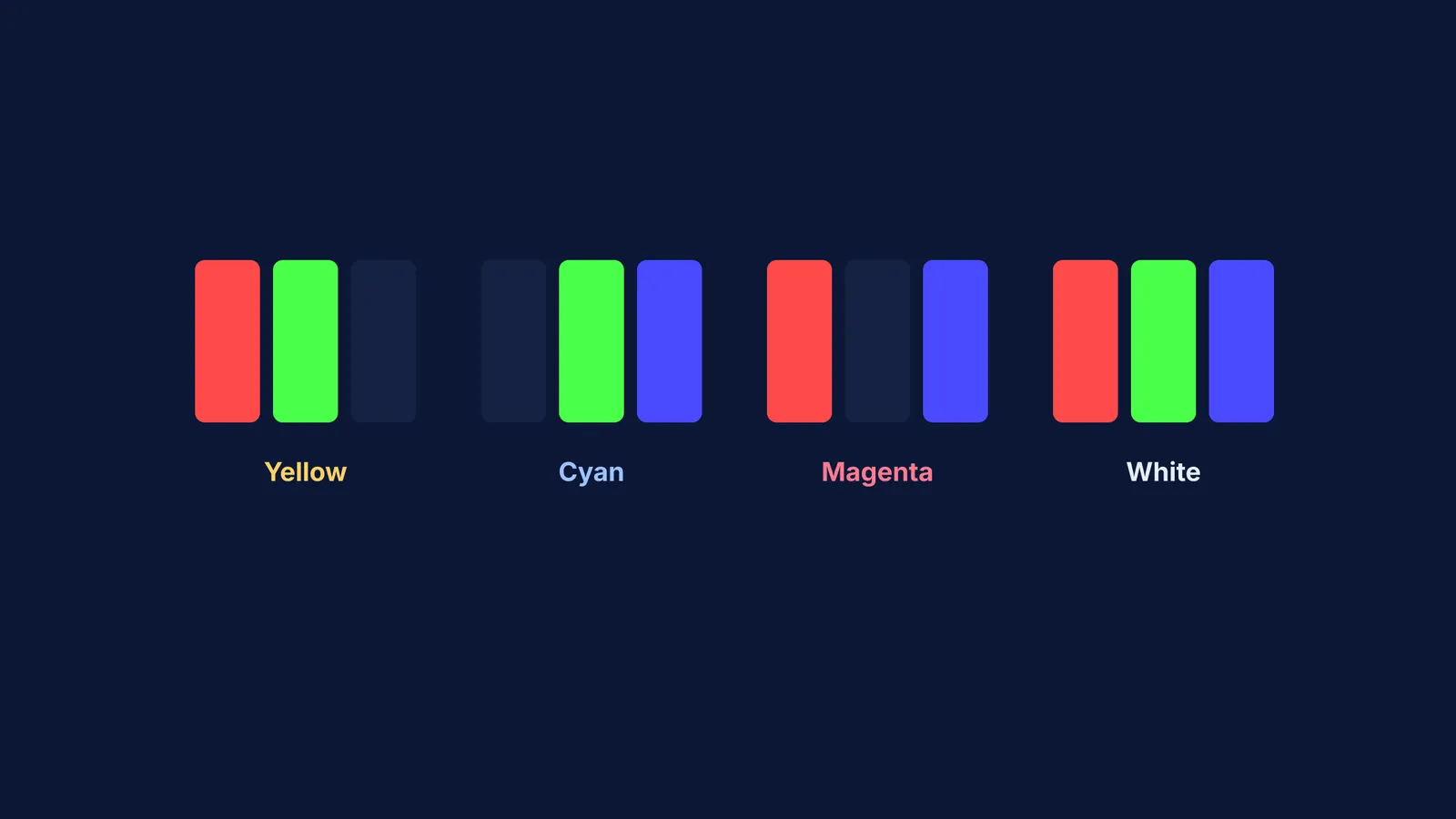
Screens rely on a physics principle called additive colour mixing. If you grew up mixing paints in art class, you are familiar with subtractive colour mixing. In that system, adding more pigments together absorbs (or subtracts) more light, eventually creating a dark, muddy brown. But screens do not use paint; they use light. Mixing coloured light works by adding energy. According to the standard model of additive colour, when you combine red, green and blue light at their maximum intensities, they form pure white (Wikipedia: Additive color).
By adjusting the brightness of each individual subpixel independently, a screen can blend these three primary colours in varying proportions to recreate almost any shade you can imagine.
How do your eyes see colour?
The reason engineers chose red, green and blue for displays has everything to do with how human vision works. The retina at the back of your eye contains light-sensitive cells. The rod cells handle low-light vision, but the cells responsible for colour vision are called cones.
According to the biological principles of trichromacy, you have three distinct types of cone cells:
S-cones: Most sensitive to short wavelengths of light, peaking around 420–440 nm (which we perceive as blue).
M-cones: Most sensitive to medium wavelengths, peaking around 534–555 nm (green).
L-cones: Most sensitive to long wavelengths, peaking around 564–580 nm (red) (Wikipedia: Color vision).
When light enters your eye, your brain does not measure the exact, objective wavelength of a photon. Instead, it simply measures the relative signals coming from these three types of cones and compares them.
How do screens trick your brain?
Screens exploit this biological quirk through a process called metamerism. When a display needs to show you a yellow image, it does not actually emit a single wavelength of yellow light. Instead, it turns on its red and green subpixels right next to each other.
Because the subpixels are so microscopic and packed so tightly together, your eye cannot resolve the individual dots—a physical limitation similar to the resolving power calculated by Ernst Abbe and the numerical aperture of the microscope. The red light hits your L-cones, and the green light hits your M-cones simultaneously. Your brain reads that combination, adds the signals together, and concludes that you are looking at yellow.
If you want to explore ideas that are easier to see than to read, the Fermi Simulation Lab has interactive simulations where you can adjust light intensities yourself and watch how additive colour mixing happens in real time.
Can you see the dots at home?
You can prove this optical illusion to yourself using nothing but your phone and a tiny drop of water.
Display a plain white image or open a blank webpage on your phone.
Carefully place a single, small drop of water on the screen (the water drop acts as a tiny magnifying lens, bending the light much like the dispersion of white light by a glass prism).
Look closely through the water drop: you will see the white background disappear, revealing the individual red, green and blue stripes glowing at full brightness.
Wipe the screen gently when you are done!
Your brain is constantly smoothing over these gaps. The next time you watch a vibrant film or play a video game, remember that you are not actually seeing millions of colours on the glass—you are just seeing three, mixed perfectly to trick the cones in your eyes.


