On this page
The black sand on beaches near Kollam in Kerala and Manavalakurichi in Tamil Nadu is rich in heavy minerals: ilmenite and rutile, which are titanium ores, and zircon, sillimanite, garnet and monazite. Mineral plants separate them with magnetic, gravity and electrostatic stages. In the electrostatic stage the sand is poured onto a spinning earthed drum under a high-voltage wire. Some grains fly off. Others stay stuck to the drum and are brushed off further round. The physics behind it is Class 12 electrostatics: charging, image charges and how fast charge leaks away.
Which beach-sand minerals conduct and which do not?
Researchers at Indian Rare Earths Ltd (IREL) in Kollam and Chavara describe the split directly: ilmenite, rutile and leucoxene behave as conducting minerals, while zircon, sillimanite, garnet and monazite behave as non-conducting minerals when a high potential difference is applied (Raghu Kumar and co-workers, Proceedings of the International Seminar on Mineral Processing Technology, 2006). The same paper notes that the feed must be dry and closely sized, and that humidity changes the corona.
"Conducting" is relative: ilmenite is no metal, but it conducts far better than zircon. The machine that uses it is the high-tension roll separator. One manufacturer, Mineral Technologies, lists rolls 270 mm in diameter and 1,800 mm long for separating titanium mineral sands. Sorting by conductivity with a magnetic rotor is a different machine, covered in the eddy-current separator that throws aluminium cans off a belt.
How does a high-tension roll separator work?
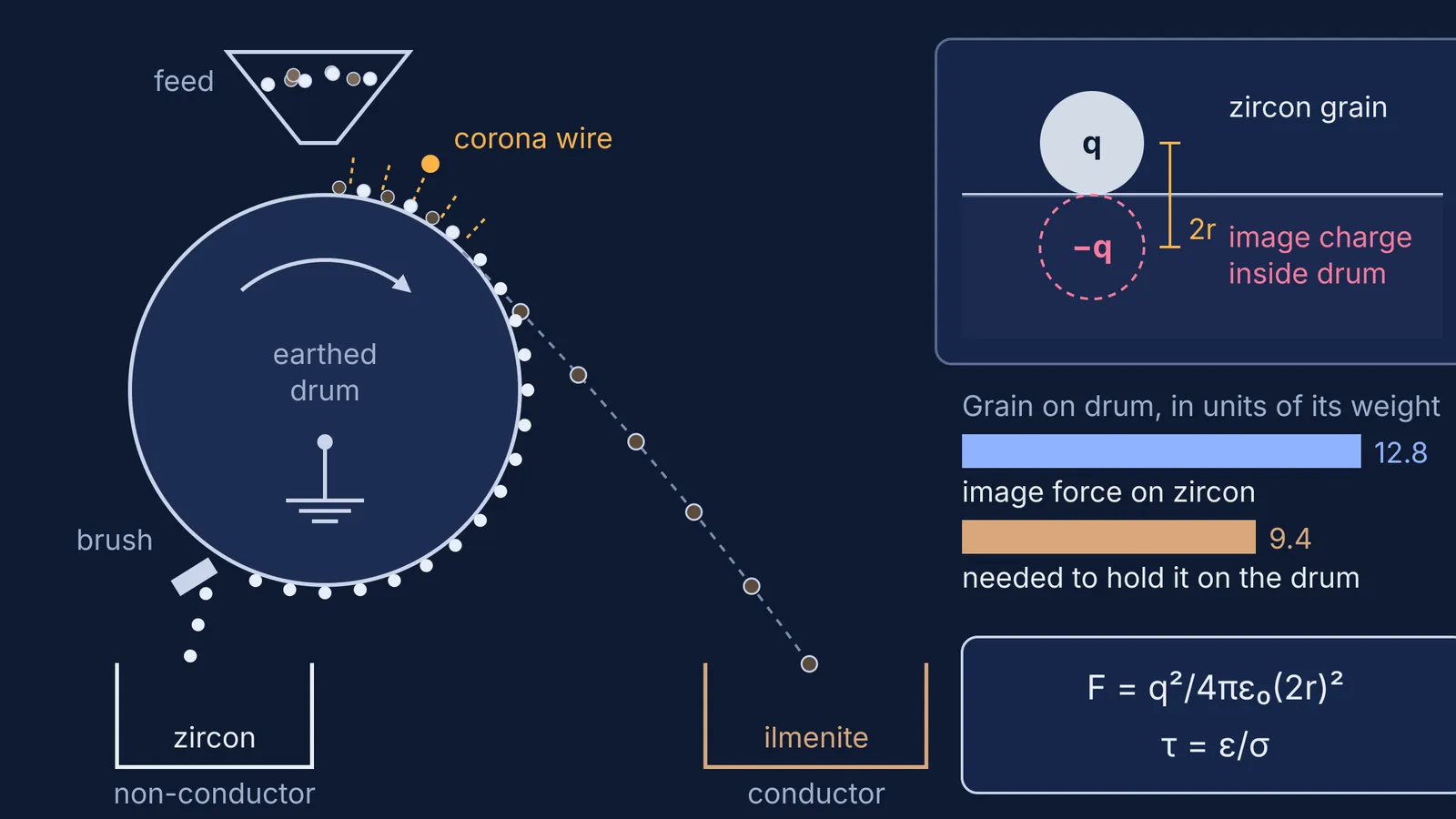
Feed. Dry sand falls in a thin layer onto the top of an earthed metal drum that is turning.
Charge. The drum carries the grains past a thin wire at tens of kilovolts. The air near the wire breaks down into a corona, and ions from it land on every grain. Corona charging of particles is the same process used in electrostatic precipitators that clean smoke with charged plates.
Conductors lose their charge. A conducting grain touching the earthed drum hands its charge to the drum almost at once. Nothing holds it, so the spinning drum throws it off into the conductor bin.
Non-conductors keep it. A zircon grain cannot pass its charge to the drum in the time it is there. Its own charge attracts it to the metal surface, and it is carried round until a brush sweeps it into the non-conductor bin.
Real plants repeat this over several cleaning stages.
Why does a charged grain stick to an earthed drum?
A charge q near a large earthed conductor induces an opposite charge on the conductor's surface. The field outside is the same as if a charge −q sat at the mirror point inside the metal. This is the method of images, which is also how the field of a power line over the ground is found in why 765 kV lines use bundles of wires.
For a small grain touching the drum, treat the drum surface as flat (its radius is far larger than the grain). Put the grain's charge at its centre, a distance r above the surface. The image is r below the surface, so the two are 2r apart, and the attraction is
F = q² / [4πε₀ (2r)²]
This is an approximation. Treating the charge as a point at the centre of a sphere that touches a plane is the simple textbook model, not an exact result.
Worked example: how hard is a zircon grain held?
These are illustrative round numbers, not plant measurements. Real grain charge depends on size, humidity, temperature and the machine's settings.
Take a zircon grain 150 µm across (r = 75 µm), relative permittivity about 12 (approximate), density 4,650 kg/m³, charged in a field of 1 MV/m until it is saturated.
Saturation charge. A sphere in a corona keeps collecting ions until its own field turns them away. The standard result (the Pauthenier limit) is q = 4πε₀ r² E × 3ε_r/(ε_r + 2). With ε_r = 12 the factor 3ε_r/(ε_r + 2) = 36/14 = 2.57. So q = 4π × 8.854 × 10⁻¹² × (75 × 10⁻⁶)² × 10⁶ × 2.57 = 1.61 × 10⁻¹² C = 1.61 pC.
Check. The field at the grain's surface is q/(4πε₀r²) = 2.6 MV/m, a little below the roughly 3 MV/m at which air breaks down. The charge is plausible.
Image force. F = q²/[4πε₀(2r)²] = 9.0 × 10⁹ × (1.61 × 10⁻¹²)² / (1.5 × 10⁻⁴)² = 1.03 × 10⁻⁶ N.
Weight. m = ρ × (4/3)πr³ = 4,650 × (4/3)π × (75 × 10⁻⁶)³ = 8.2 × 10⁻⁹ kg. W = mg = 8.1 × 10⁻⁸ N.
Ratio. F/W = 1.03 × 10⁻⁶ / 8.1 × 10⁻⁸ = 12.8. The grain is pulled onto the drum with about 13 times its own weight.
What the drum asks for. A drum 270 mm across (R = 0.135 m) at 250 rpm (an illustrative speed) has ω = 250 × 2π/60 = 26.2 rad/s. To move in a circle with the drum, a grain needs a centripetal acceleration ω²R = 26.2² × 0.135 = 92.5 m/s², which is 9.4 g.
Verdict. An uncharged ilmenite grain has only gravity (1 g at most) pulling it towards the drum, far less than the 9.4 g needed, so it leaves. The zircon grain has 12.8 g of electric pull. Even underneath the drum, where gravity pulls it away, it needs 9.4 + 1 = 10.4 g and has 12.8 g, so it stays on until the brush.
Why does ilmenite lose its charge and zircon keep it?
Charge placed on a material leaks away in a time set by the charge-relaxation time, τ = ε/σ, where ε = ε_r ε₀ is its permittivity and σ its conductivity. Check the unit: (F/m)/(S/m) = F/S = (C/V)/(A/V) = s.
For a zircon-like grain with ε_r = 12 and an illustrative σ = 10⁻¹² S/m, τ = 12 × 8.854 × 10⁻¹² / 10⁻¹² = 106 s.
A grain stays on the drum for about half a turn. At 250 rpm that is 60/250/2 = 0.12 s, about 900 times shorter than τ. The charge barely moves.
For a grain with an illustrative σ of 1 S/m, typical of a poor semiconductor, τ = 1.06 × 10⁻¹⁰ s. The charge is gone before the grain has moved a fraction of a millimetre.
These conductivities are round numbers to show the scale, not measured values for these minerals. The point is that τ differs by many powers of ten between the two kinds of grain, which is why a simple drum can separate them.
If you want to practise image-charge and relaxation-time problems step by step, the Fermi Problem Library has a step-by-step solver that explains the reasoning.
Quick checklist
Ilmenite, rutile and leucoxene act as conductors; zircon, sillimanite, garnet and monazite act as non-conductors.
Corona from a high-voltage wire charges every grain on an earthed drum.
Conductors hand their charge to the drum and are thrown off; non-conductors stay.
Image force on a grain touching a plane: F = q²/[4πε₀(2r)²].
Illustrative zircon grain: 1.61 pC, 1.03 µN, 12.8 times its weight, against the 9.4 g needed to keep it turning with the drum.
Charge-relaxation time τ = ε/σ decides who keeps charge.
Monazite is radioactive and its handling is regulated. This is an industrial process, not something to try at home.