On this page
Every day, weather stations in India and around the world let go of a balloon carrying a small instrument box called a radiosonde. The balloon is about 1.5 m across when it leaves the ground. Near 30 km up it is about 6 m across, and then it bursts. Nothing heats it, and nobody lets more gas in. The balloon grows only because the air outside thins out. With the combined gas law and a table of the atmosphere, you can work out where it will pop.
How big is a weather balloon at launch and at burst?
According to the US National Weather Service radiosonde fact sheet, a sounding balloon is about 1.5 m in diameter at launch, rises at about 300 m per minute (5 m/s) and bursts when it reaches 6 to 8 m across. The radiosonde then falls back under a small parachute.
India's upper-air network does the same job. How IMD forecasts the weather describes where the radiosonde network fits into forecasting. At the National Atmospheric Research Laboratory in Gadanki, near Tirupati, Venkat Ratnam and colleagues reported in Atmospheric Measurement Techniques that their 600 g Totex balloons usually burst at about 32 to 35 km. Burst height depends on the balloon's mass, how much gas it carries and the payload, so these are typical figures, not fixed ones.
Why does a weather balloon expand as it rises?
A latex balloon is soft. Its thin rubber can only push back weakly, so the gas inside stays at nearly the same pressure as the air outside. If the outside pressure halves, the gas expands until its own pressure has roughly halved too.
The amount of gas does not change, so the combined gas law applies:
p₁V₁/T₁ = p₂V₂/T₂
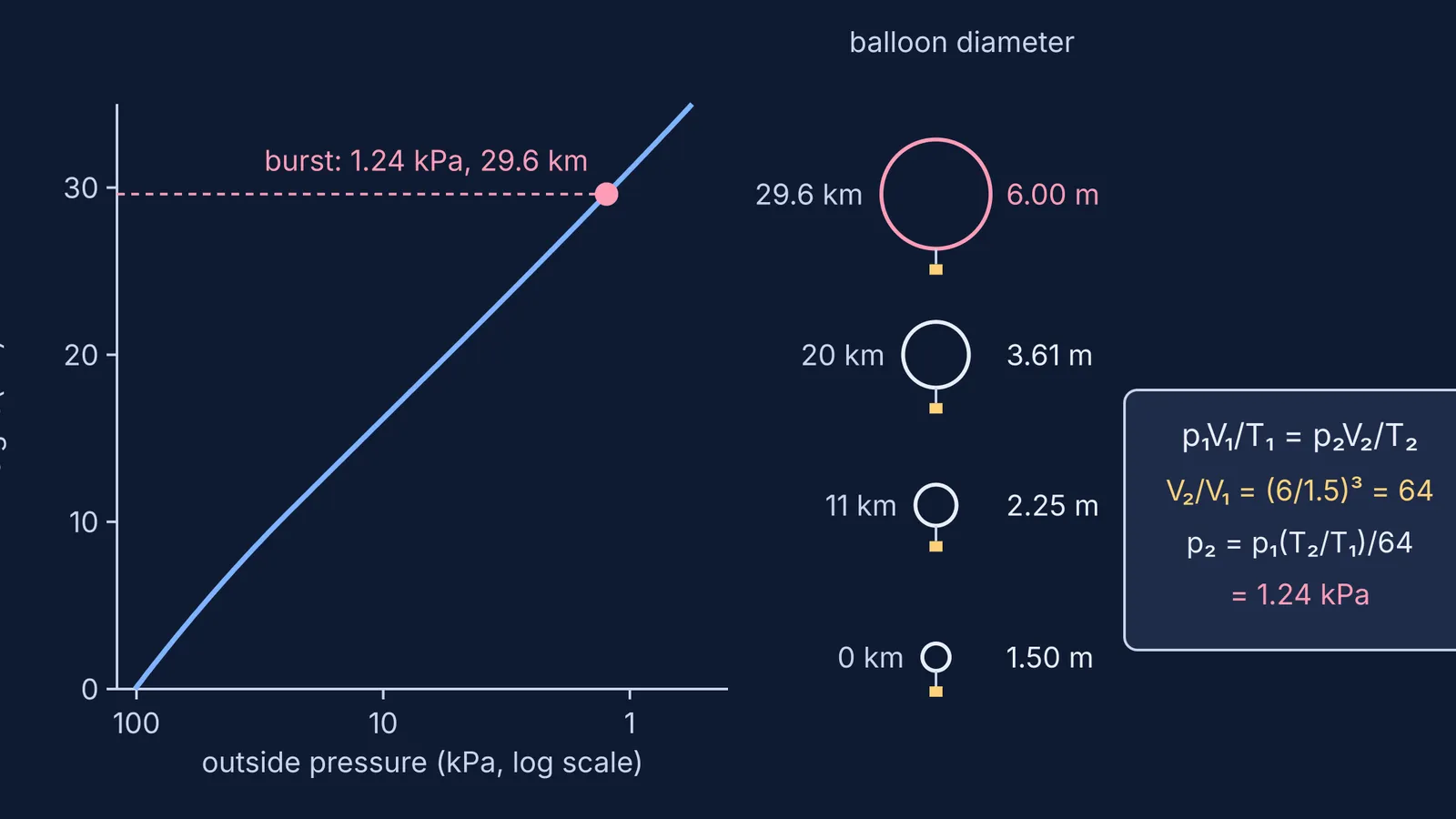
Outside pressure falls steeply with height. The reasons are covered in why atmospheric pressure decreases with height. In the US Standard Atmosphere 1976 model (NASA technical report) the pressure is 101.3 kPa at sea level, 22.6 kPa at 11 km, 5.47 kPa at 20 km and 1.17 kPa at 30 km.
Temperature also matters, and here is a common wrong idea. The gas does not heat up and swell. It cools as it rises, roughly following the air around it from about 288 K at the ground to near 217 K above 11 km. Cooling on its own would shrink the balloon. The falling pressure wins by a large margin.
How do you calculate the height where a weather balloon bursts? (worked example)
Use the fact-sheet sizes: 1.5 m across at launch, bursting at 6.0 m (the low end of the 6 to 8 m range). Launch conditions: 101,325 Pa and 288 K. Take the gas temperature at burst to equal the outside air temperature there.
Volume ratio. Volume goes as diameter cubed: V₂/V₁ = (6.0/1.5)³ = 4³ = 64.
Rearrange the gas law. p₂ = p₁ × (T₂/T₁) × (V₁/V₂).
Guess the temperature. Between 20 and 32 km the standard atmosphere warms by 1 K per km from 216.65 K. Near 30 km it is about 226 K.
Burst pressure. p₂ = 101,325 × (226.3/288.15) × (1/64) = 1,243 Pa, or 1.24 kPa.
Find the height. The standard atmosphere reaches 1.24 kPa at about 29.6 km, where the temperature is indeed about 226 K, so the guess in step 3 was consistent.
Time to get there. At 5 m/s, 29,600 m takes 5,920 s, about 99 minutes.
Check the units: T₂/T₁ and V₁/V₂ are pure numbers, so p₂ comes out in pascals. Check the sense: a balloon that grows 64 times must reach a pressure about 64 times lower, adjusted for the cooling.
What if you ignore the cooling? Then p₂ = 101,325/64 = 1,583 Pa, which the model reaches at about 28.0 km. Ignoring temperature puts the burst about 1.6 km too low. Repeat the sum for an 8 m burst diameter and the ratio is 152, the pressure about 550 Pa and the height about 35 km, matching the top of the Gadanki range.
Where does most of the swelling happen?
Turn the sum around and find the size at each height. At 11 km the volume is only 3.4 times the launch volume, so the diameter is about 2.25 m. At 20 km it is 13.9 times (about 3.6 m). Between 20 km and 29.6 km the volume more than quadruples, from 13.9 to 64 times.
The reason is that pressure falls roughly exponentially with height. Each extra few kilometres divides the pressure by roughly the same factor, so the volume multiplies by roughly the same factor. Ratios that look small near the ground become large once the balloon is high up.
The same idea goes back to the early gas balloons, described in Jacques Charles, hydrogen balloons and the volume of a gas.
Why does the balloon keep rising at a steady speed?
As it swells, the balloon pushes aside more air, but that air is thinner. If the gas inside is at the same pressure and temperature as the air outside, the mass of air displaced stays fixed: it equals the mass of the gas times the ratio of their molar masses. So the buoyant force stays roughly the same all the way up, which is why the climb rate stays near 5 m/s.
The balloon stops only when the rubber can stretch no further and tears.
To see the gas laws at work, try the Simulation Lab, which has interactive simulations for ideas that are easier to see than to read.
What are the limits of this calculation?
The standard atmosphere is a mid-latitude average. Over India the tropopause is higher and colder, so real profiles differ by a few kilometres in places.
The rubber does add a small pressure above the outside value, so the gas is close to, not exactly at, outside pressure.
The gas may run a little warmer or cooler than the air because of sunlight and the time it takes to exchange heat.
The burst diameter changes from balloon to balloon, which is why the 6 to 8 m range gives roughly 30 to 35 km.
Quick checklist
The gas stays near outside pressure, so falling outside pressure makes it swell.
The gas cools on the way up; it does not swell because it is heated.
Volume ratio = (diameter ratio)³.
p₂ = p₁ × (T₂/T₁) × (V₁/V₂), with temperatures in kelvin.
1.5 m to 6 m means 64 times the volume and a burst near 1.24 kPa, about 30 km.
Most of the swelling happens above 20 km.
The instrument comes down by parachute and burst heights vary with the balloon.