

On this page
Astronauts train for weightlessness without leaving the atmosphere. They fly in an ordinary-looking jet that climbs steeply, then follows the same curved path a thrown ball would take. For about 20 seconds everyone inside floats. Then the floor presses up hard, at almost twice normal weight, and the cycle repeats about 30 times a flight. All of it is projectile motion and apparent weight, two chapters you already know, joined in one aeroplane.
Why do people float inside a parabolic flight aeroplane?
You feel your weight through the push of the floor, not through gravity itself. The floor pushes on your feet, your feet push on your legs, and that chain of contact forces is what "heavy" feels like. In a lift, the scale reads N = m(g − a) when the lift accelerates downwards with a; see how a weighing scale reading changes in an accelerating lift. Set a = g and the scale reads zero.
That is the whole trick. If the aeroplane accelerates downwards at exactly g, it falls at the same rate as everything inside it. The floor has no reason to push on you, so N = 0 and you float. Gravity has not switched off. At 7 to 8 km altitude, g is still about 99.8% of its surface value, because g falls only as 1/r² and 8 km is tiny next to Earth's 6,371 km radius. Astronauts in orbit float for the same reason: they are falling too, as explained in why astronauts feel weightless in orbit.
What does the aeroplane actually do during a parabola?
Each parabola has three phases. ESA's description of the Airbus A310 Zero-G, flown by the French company Novespace, gives the numbers (ESA Academy: parabolic flights):
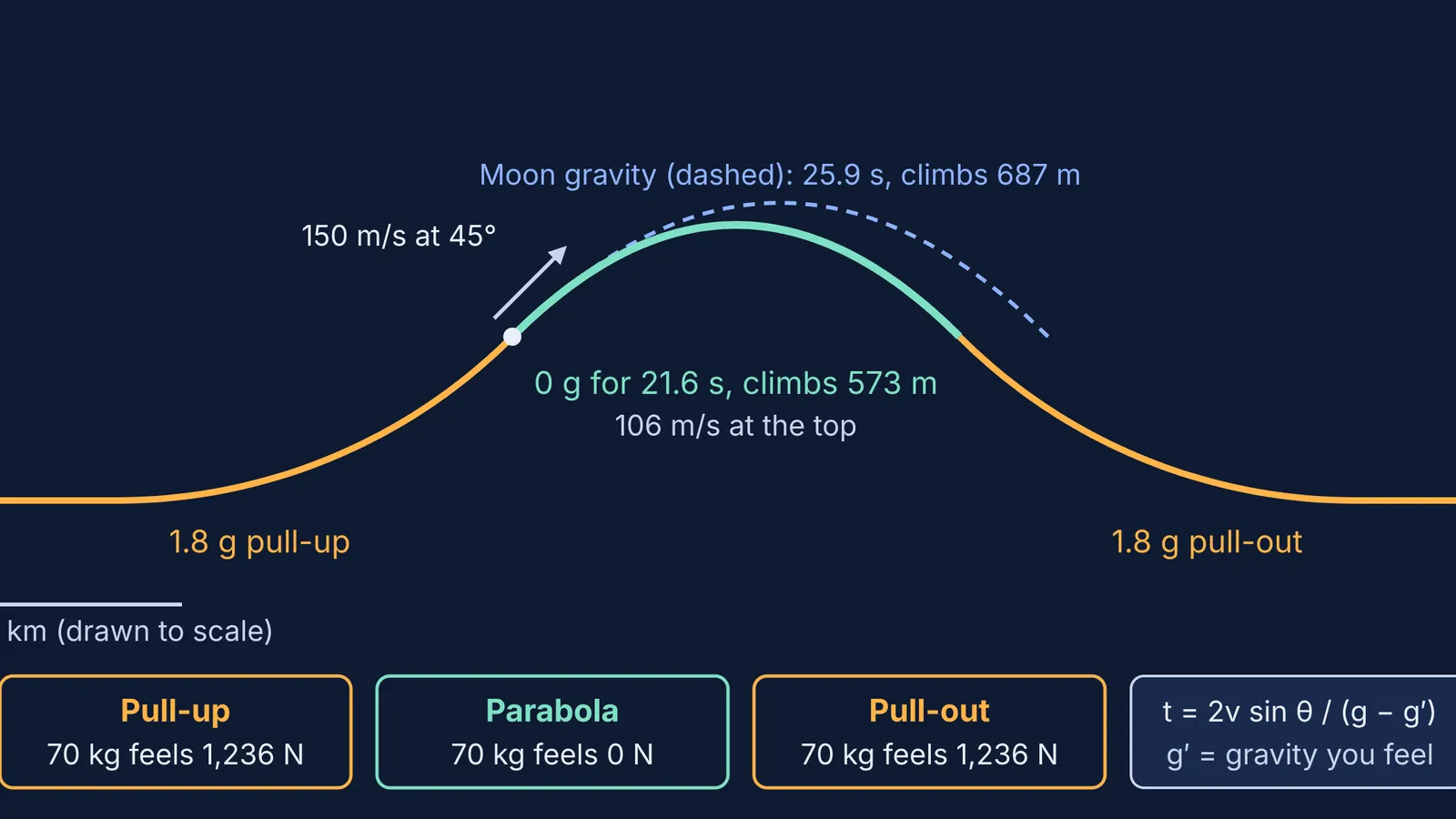
Pull-up. From level flight the pilots pitch the nose up to about 50°. The cabin feels almost 1.8 g.
Injection and parabola. At about 50° the pilots cut the thrust back just enough to cancel air drag. With drag cancelled and lift brought to zero, the only unbalanced force is gravity, so the jet becomes a projectile. ESA quotes about 22 seconds of weightlessness.
Pull-out. As the nose falls to about 50° below the horizon, the pilots pull back to level flight, and the cabin again feels about 1.8 g.
ESA says each flight gives about 30 parabolas, roughly 10 minutes of weightlessness in total. NASA describes the same manoeuvre with a 45° climb, about 1.8 g and about 20 seconds of free fall (NASA: parabolic flight). The exact angle and duration differ by aircraft and operator.
The engines are not switched off during the parabola. They keep running so that thrust cancels drag. Without them, drag would slow the jet a little faster than gravity alone, and loose objects would drift towards the front of the cabin.
How long does the weightless part last? A worked example
Take round illustrative numbers: the jet enters the parabola at 150 m/s, climbing at 45°. Use g = 9.81 m/s².
Split the velocity. Vertical: 150 × sin 45° = 106.1 m/s. Horizontal: 150 × cos 45° = 106.1 m/s.
Time of flight. The vertical speed falls to zero and returns to 106.1 m/s downwards, so t = 2v sin θ/g = 2 × 106.1/9.81 = 21.6 s. This is the formula from projectile motion on level ground, here with the jet as the projectile.
Height gained. H = (v sin θ)²/2g = 106.1²/(2 × 9.81) = 573 m above the injection point.
Speed at the top. Only the horizontal part is left: 106.1 m/s, about 382 km/h. The jet is still flying fast, just not climbing.
Horizontal distance. 106.1 × 21.6 = 2.29 km.
So a 150 m/s entry at 45° gives about 22 seconds, close to the figure ESA quotes for a real 50° entry. Units check: (m/s)/(m/s²) = s, and (m/s)²/(m/s²) = m.
How does the same aeroplane give Moon or Mars gravity?
To feel Moon gravity, about 1.62 m/s², you want the floor to push with m × 1.62. So the jet should not fall freely. It must accelerate downwards at only g − 1.62 = 8.19 m/s², with the wings providing a little lift. In general, if g′ is the gravity you want to feel, replace g with g − g′ in every projectile formula:
t = 2v sin θ/(g − g′)
With the same 150 m/s entry at 45°:
Moon (1.62 m/s²). t = 2 × 106.1/8.19 = 25.9 s; the climb is 106.1²/(2 × 8.19) = 687 m.
Mars (3.71 m/s²). t = 2 × 106.1/6.10 = 34.8 s; the climb is 922 m.
The weaker the gravity you want, the slower the jet must fall, so the longer each parabola lasts. ESA has flown partial-gravity campaigns with about 25 seconds at one-quarter g, 35 seconds at half g and 50 seconds at three-quarters g (ESA: gravity for the loss). Those real flights use their own entry conditions, so treat the numbers above as a model, not as a flight plan.
Why does a parabolic flight make people sick?
The parabola is only half the story. Before and after it the jet must bend its path, and a curved path needs a centripetal acceleration. At the bottom of the pull-up the floor must supply both your weight and that extra force:
N = m(g + v²/r)
For the cabin to feel 1.8 g, v²/r must equal 0.8g. At 150 m/s that sets the radius of the curve:
r = 150²/(0.8 × 9.81) = 2.87 km
A 70 kg passenger then presses on the floor with 70 × 1.8 × 9.81 = 1,236 N, compared with 687 N in level flight. Every parabola is wrapped in two of these heavy phases, so the body switches between nearly double weight and no weight about 30 times. Your inner ear senses acceleration, and the rapid switching confuses it, which is why the aircraft earned the nickname "vomit comet".
If you want to try the projectile and apparent-weight steps on new numbers, the Fermi Problem Library has a step-by-step solver that explains the reasoning.
Quick checklist
Weightlessness means the floor pushes with N = 0, not that gravity is zero.
In the parabola the jet accelerates downwards at g; thrust only cancels drag.
Weightless time: t = 2v sin θ/g. For 150 m/s at 45°, 21.6 s and a 573 m climb.
Partial gravity g′: replace g with g − g′. Moon gives 25.9 s, Mars 34.8 s for the same entry.
Pull-up and pull-out at 1.8 g need v²/r = 0.8g, a 2.87 km radius at 150 m/s.
ESA quotes about 22 s per parabola, about 30 parabolas a flight and almost 1.8 g in the pull phases.


