

On this page
Imagine standing at the edge of a playground merry-go-round and sliding a ball toward your friend in the centre. The way the ball moves depends entirely on where you are standing to watch it. For students encountering mechanics problems for the first time, rotating reference frames often feel deeply counterintuitive because our brains are wired to trust what we see from our own perspective.
What is the path of a ball rolled across a spinning platform?
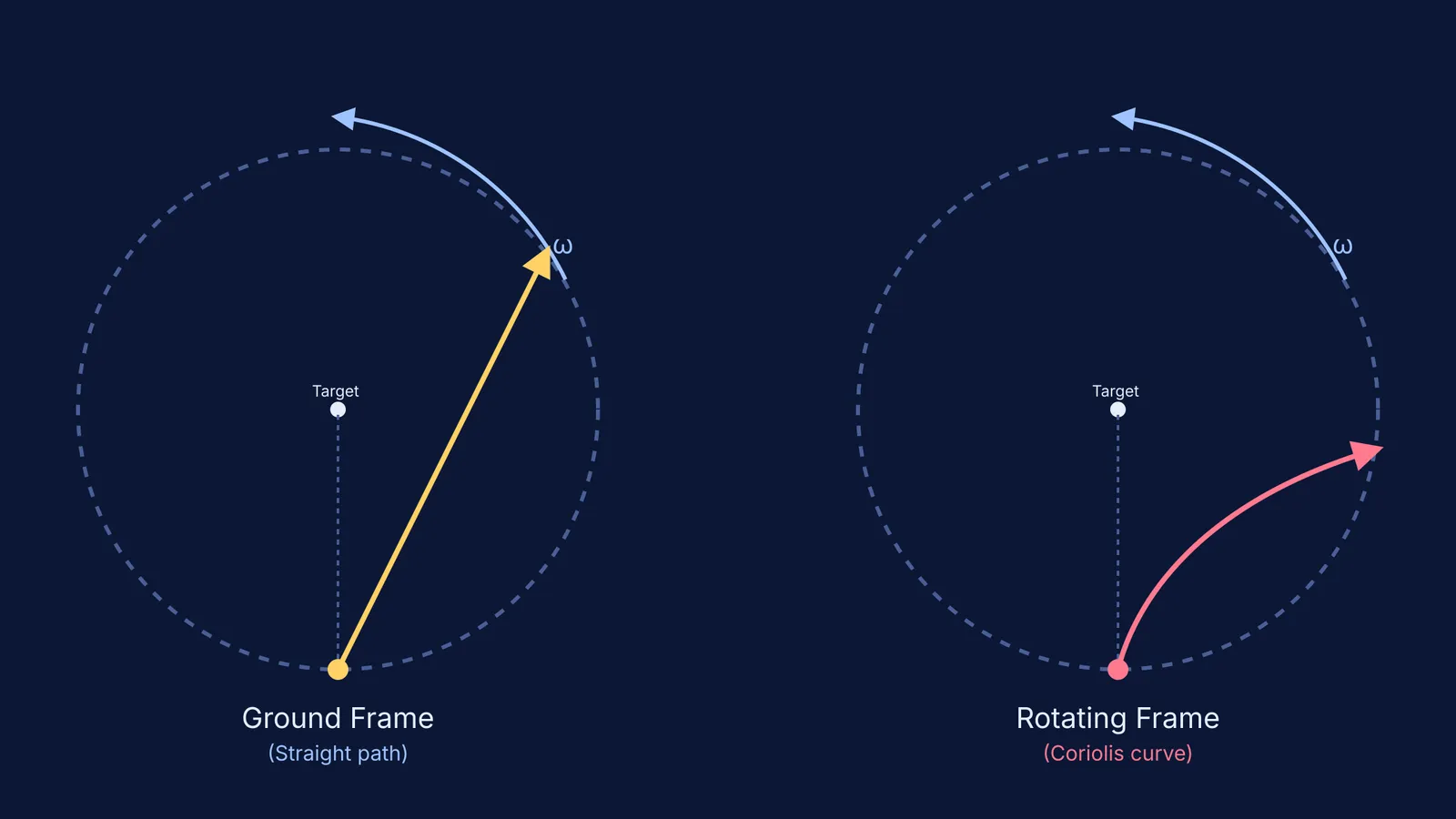
If you stand on the solid ground next to the platform and watch the ball slide across a smooth, frictionless surface, the path is simple. Because there are no horizontal forces pushing or pulling the ball, it obeys Newton's First Law and travels in a perfect straight line.
From this stationary perspective, known as an inertial reference frame, the physics makes perfect sense. The ball is not turning; the platform is simply rotating beneath it. When you are reading about pseudo forces: solving problems from an accelerating frame, the golden rule is that in an inertial frame, you only ever account for real physical pushes and pulls.
Why does the path curve on a merry-go-round?
If you are riding on the spinning platform, the situation looks completely different. When you push the ball toward the centre, it appears to veer away from its intended target in a wide curve. This apparent deflection is caused by the Coriolis effect, a fictitious force that must be introduced to make Newton's laws work inside a rotating reference frame.
As the ball travels straight relative to the ground, your frame of reference is turning. Because you feel stationary, you perceive the ball as actively changing direction. The Coriolis acceleration pushing the ball sideways is calculated mathematically as a = 2ωv, where ω is the platform's angular velocity and v is the ball's speed relative to the platform. If the platform rotates counter-clockwise, the ball will always deflect to the right of its direction of motion.
This same principle governs massive systems on Earth. Because our planet is a giant rotating sphere, winds rushing toward low-pressure zones are deflected by the Coriolis effect, creating the distinctive spiral shapes of hurricanes and cyclones.
What happens if the ball grips the surface?
The classic sliding ball assumes a perfectly frictionless surface, but things get much stranger if the ball has friction and rolls without slipping. When a ball rolls across a spinning disk, the friction forces continuously twist it in unexpected ways.
A 2021 study published in Physics Education found that a solid ball placed on a rotating turntable rolls in a circular path 3.5 times slower than the turntable itself. Rather than sliding in a straight line or a simple outward spiral, the friction acting on the rolling ball mathematically mirrors the magnetic force on a charged particle, trapping the ball in small, closed circular orbits.
Understanding these unexpected interactions is critical, as they are common rotational motion mistakes in JEE physics. Students often assume the ball will just fly straight off the edge, failing to account for how the rolling friction continually redirects its momentum.
How do you solve reference frame problems?
Whether you are facing a question about a merry-go-round, a rolling cylinder, or the Earth's rotation, you need a reliable method to avoid getting confused by the shifting perspectives. Stick to this strict framework when solving problems:
Choose your frame carefully: Pick the ground frame to keep the forces simple and avoid fictitious forces. However, if the target you are aiming at is also moving, it is often mathematically easier to choose the rotating platform and use pseudo forces.
Add fictitious forces: If you choose to work in the rotating frame, you must add the Coriolis force and the centrifugal force to your free-body diagram before writing any equations.
Keep real forces consistent: Gravity, friction, and the normal force remain exactly the same in both frames of reference. A fictitious frame does not change the physical forces acting on the object.
Compare results: The physical outcome must be identical. If the ball rolls off the platform at a specific physical mark in one frame, it must do exactly the same in the other. Your equations must agree on the final event.
If you find rotating reference frames hard to picture, you are not alone. Inside the Fermi Simulation Lab, you can run this exact experiment. Fermi's AI tutor will run the simulation, draw the figure to show both the straight and curved paths side-by-side, and check your understanding as it goes, building a plan for the session so you know exactly what to tackle next.


