

On this page
In February 1996, the Space Shuttle Columbia let out a satellite on the end of a copper wire nearly 20 km long. As the shuttle orbited, the wire cut through Earth's magnetic field and a few thousand volts appeared along it. This is the same motional emf, vBL, that you meet in Class 12 electromagnetic induction, only with a wire 20 km long moving at orbital speed. It also shows Lenz's law at work: the current that the emf drives pushes back on the satellite and lowers its orbit.
What is an electrodynamic tether?
An electrodynamic tether is a long conducting wire attached to a spacecraft, kept straight along the line to Earth's centre. Gravity pulls slightly harder on the lower end, so the wire hangs vertically, like a plumb line.
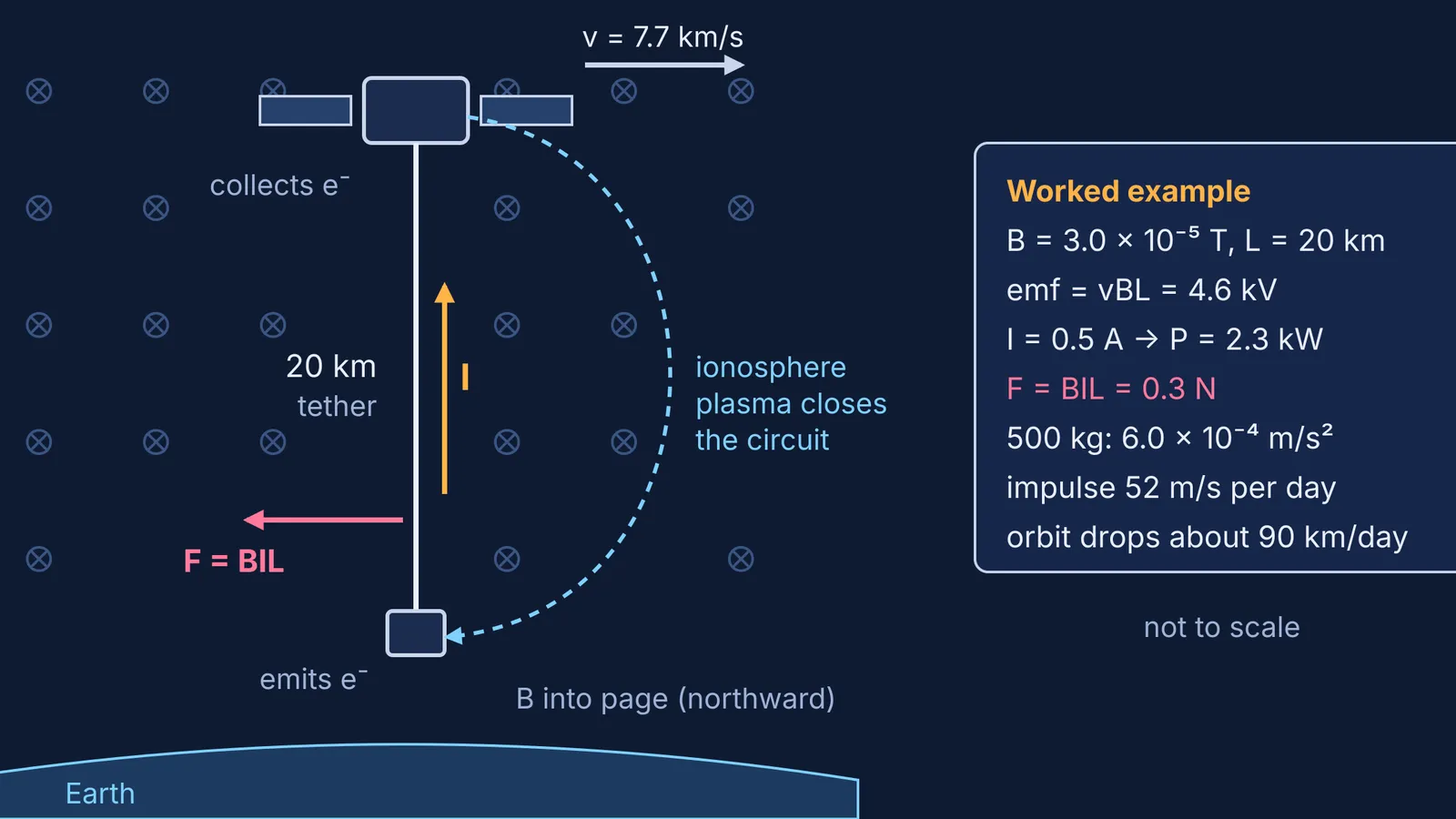
Because the whole wire moves sideways through Earth's magnetic field, every free charge in it feels a force qv × B. That pushes positive charge to one end and negative charge to the other, and an emf builds up along the wire. For a straight wire of length L moving at speed v, with B perpendicular to both, the emf is vBL.
You have seen this worked for an aircraft in the emf between aeroplane wing tips, where it comes out at a fraction of a volt. Two things change in orbit. The speed is about 30 times larger, and L is kilometres instead of tens of metres. Together they turn millivolts into kilovolts.
How big is the emf on a 20 km tether?
A worked example with round numbers (the field is an illustrative value, not a measurement):
Speed. A satellite in a 400 km circular orbit has v = √(GM/r) with r = 6,771 km, which gives about 7.7 km/s.
Field. Take the component of Earth's field perpendicular to both the wire and the velocity as B = 3.0 × 10⁻⁵ T.
Length. L = 20 km = 2.0 × 10⁴ m.
Emf. vBL = 7,700 × 3.0 × 10⁻⁵ × 20,000 = 4,620 V, about 4.6 kV.
Check the units: (m/s) × T × m = (m/s) × (V s/m²) × m = V.
Which end is positive? Picture a satellite moving east over the equator. Earth's field there points roughly north, horizontally. With x east, y north and z up, v × B points along x × y = z, upwards. So positive charges are pushed to the upper end, and conventional current, once it can flow, runs up the wire.
Two refinements matter. First, only the component of B perpendicular to both the wire and the velocity counts, and that changes as the satellite goes round, so the emf varies through each orbit. Second, Earth's field turns with Earth, so the speed that counts is the speed relative to the rotating field, about 0.5 km/s less than 7.7 km/s for an eastward orbit near the equator.
Can a voltage alone do anything?
No. An emf with no closed circuit drives no current. In orbit the circuit is closed by the ionosphere, the thin layer of charged gas (plasma) around Earth at these heights. The upper end collects electrons from the plasma, the lower end gives electrons back to it, usually with an electron emitter, and the plasma carries the return path. Without good contacts at both ends, very little current flows.
This was the main question for NASA and the Italian Space Agency's tethered satellite on shuttle mission STS-75. According to NASA's TSS-1R mission report, the system was generating 3,500 volts DC and up to 0.5 A during deployment. The tether was copper wire with insulation, wrapped in Kevlar strands for strength. It broke when about 19.7 km had been unreeled: a breach in the insulation let an arc burn through much of the tether until the rest failed under tension. The satellite then drifted away with the tether still attached.
The measured 3.5 kV is lower than our 4.6 kV, which is not a contradiction. Our field is a round value, the useful component of B changes round the orbit, and a wire carrying current also loses some voltage in its own resistance and at the plasma contacts.
Why does the current brake the satellite?
Once current I flows in the wire, the wire is a current-carrying conductor in a magnetic field, and it feels a force F = IL × B. With current upwards (along z) and B northwards (along y), z × y points along −x: backwards, against the motion. That is Lenz's law. The induced current always acts to oppose the motion that causes it, the same way eddy currents brake a magnet falling through a copper pipe.
Continue the worked example with I = 0.5 A:
Electrical power. P = emf × I = 4,620 × 0.5 = 2,310 W, about 2.3 kW.
Force. F = BIL = 3.0 × 10⁻⁵ × 0.5 × 20,000 = 0.30 N.
Check by energy. Fv = 0.30 × 7,700 = 2,310 W. The electrical power exactly equals the rate at which the magnetic force takes energy from the orbit. Every watt you take out comes from the satellite's orbital energy.
Deceleration. For a 500 kg satellite, a = F/m = 0.30/500 = 6.0 × 10⁻⁴ m/s².
Per day. 6.0 × 10⁻⁴ × 86,400 s = 52 m/s of backward impulse each day.
Orbit change. For a near-circular orbit, Δr ≈ 2rΔv/v = 2 × 6,771 km × 52/7,673 ≈ 92 km per day, in round terms about 90 km. The energy route agrees: 2.3 kW for a day is 2.0 × 10⁸ J, which also gives about 92 km.
The energy bookkeeping is worked step by step in why air drag speeds a satellite up.
Why would anyone want a tether in orbit?
Old satellites and spent rocket stages crowd low orbits. Bringing one down normally needs fuel for a braking burn. A tether does the braking with the satellite's own motion and Earth's field, so it has been proposed as a fuel-free way to deorbit dead satellites.
It works in reverse too. Use solar panels to push current down the wire, against the emf. Now IL × B points forwards, and the tether becomes a motor that raises the orbit, with no propellant. The energy then comes from the panels, not the orbit.
If you want to see how the force direction flips with the current, the cross products are easy to try in the Simulation Lab, and the Fermi Problem Library has motional emf and force-on-wire problems with a step-by-step solver that explains the reasoning.
Quick checklist
A tether moving at v across Earth's field has emf = vBL; at 7.7 km/s, 3.0 × 10⁻⁵ T and 20 km that is 4.6 kV.
Use only the component of B perpendicular to both the wire and v, and the speed relative to Earth's turning field.
No closed circuit, no current: the ionosphere closes it, with electron collection and emission at the ends.
F = BIL opposes the motion (Lenz's law): 0.30 N for 0.5 A, and Fv equals the electrical power.
A backward force lowers the orbit and the satellite ends up faster.
NASA's TSS-1R tether reached about 19.7 km and 3,500 V before an arc burned through it.


