

On this page
An electric eel makes its shock the same way a torch gets power from a row of batteries: it stacks many small voltages end to end. One of its electric cells gives a fraction of a volt. Several thousand in a row give hundreds. Here is how one cell works, how the numbers add up, and what is still unknown.
How does an electric eel produce electricity?
The eel's electric organs are masses of flat cells called electrocytes, stacked in regular rows along its body (Biology Pages: electric organs).
Each electrocyte has two faces that are built differently. Jian Xu and David LaVan describe them in a 2008 Nature Nanotechnology paper that modelled the eel electrocyte as a guide to designing artificial cells (Xu and LaVan, 2008). The innervated face, the one a nerve touches, is packed with acetylcholine receptors and voltage-gated sodium channels. The other face carries sodium-potassium pumps and potassium and chloride channels.
At rest, the inside of each electrocyte is negative compared with both outer faces, so the two face voltages point in opposite directions and cancel, and no current flows (Biology Pages). It is the same kind of resting potential your own nerve cells hold, which we explain in why the axon sits at −70 mV.
When the eel's brain gives the command, the nerve releases acetylcholine onto the innervated face, sodium ions flow in, and that face's charge reverses. In the Xu and LaVan model, the innervated face swings to a peak of +65 mV while the other face stays at about −85 mV (Xu and LaVan, 2008). Now the two faces no longer cancel. They add.
Why do thousands of cells make 600 volts?
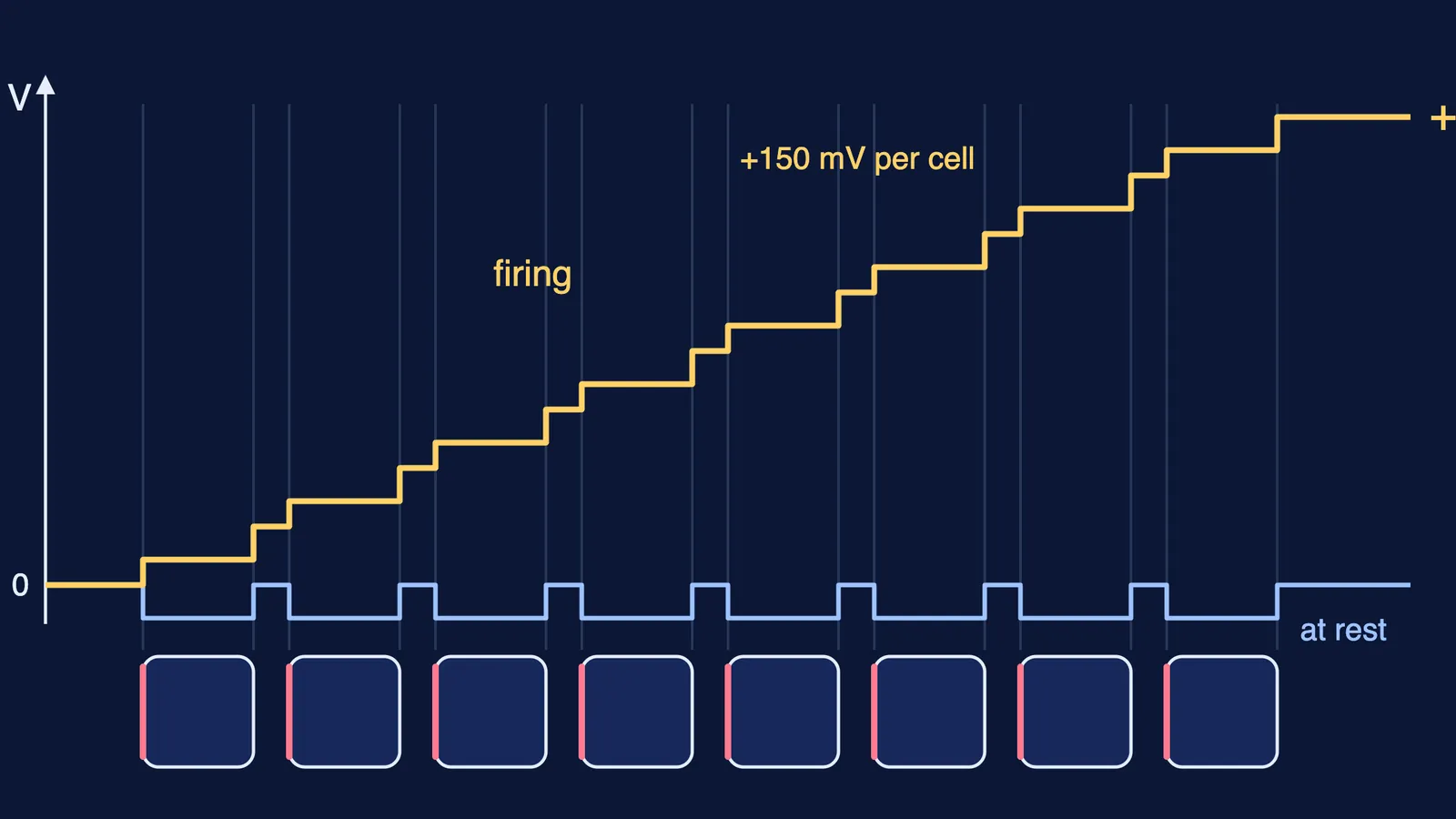
Walk across one firing cell and add the steps: up 65 mV going in through the innervated face, then up another 85 mV going out through the other face. That is about 150 mV per cell, our arithmetic from the two values in Xu and LaVan's model.
The electrocytes are lined up face to back, so each cell's 150 mV adds to the next one, like cells in series in a torch. With several thousand electrocytes, the electric eel Electrophorus electricus produces up to about 600 V at a current of 0.25 to 0.5 A (Biology Pages). The circuit rule behind this is the one in why more cells make a bulb brighter.
In 2019 a team led by C. David de Santana split the electric eel into three species and measured one of them, Electrophorus voltai, discharging up to 860 V, against 650 V for E. electricus (de Santana et al., Nature Communications; ScienceDaily summary).
Worked example: how many cells is that?
Voltage per firing cell: 65 mV + 85 mV = 150 mV = 0.15 V.
Cells needed in one column for 600 V: 600 ÷ 0.15 = 4,000.
Cells needed for the 860 V of E. voltai: 860 ÷ 0.15 ≈ 5,700.
Rows placed side by side, in parallel, do not raise the voltage; by the circuit rule, they add current instead.
Real organs are messier than this model. Each cell has some internal resistance that turns part of the energy into heat, as in a battery that warms up when short-circuited, so treat these counts as estimates, not a census. They do match the "several thousand" electrocytes in the textbook picture.
Why does an electric eel not shock itself?
The honest answer: it is not settled. In a 2005 answer for Scientific American, the electric-fish researcher Angel Caputi wrote that, to his knowledge, there were no specific studies on the question (Scientific American). He explains that harm depends on how much current flows and for how long. The current flows for only about 2 milliseconds, and a large part of it escapes through the eel's skin into the water.
Size matters too: Caputi points out that prey 10 times shorter than the eel has about 1,000 times less volume, so the shock it receives is far more concentrated (Scientific American). That 1,000 is 10 cubed: volume grows with the cube of length.
How do you explain it in an exam answer?
Use this five-line checklist for a biology or physics answer:
Name the cell: electrocyte, a flat cell with one nerve-supplied face and one plain face.
At rest: the two face voltages cancel, so no current flows.
Firing: nerve signal, acetylcholine, sodium ions flow in, and the innervated face flips.
Series: about 150 mV per cell times thousands of cells gives hundreds of volts.
Parallel rows: same voltage, more current.
If the flipping faces are hard to picture, draw the potential as a staircase, as in the diagram above. Fermi's AI tutor writes on a board, draws the figure and checks your understanding as it goes, so you can work through the staircase with it. For ideas that are easier to see than to read, the Fermi Simulation Lab has interactive simulations.
Next time you put two batteries in a torch, you are doing what the eel does with thousands of living cells.


