

On this page
One cell makes a small bulb glow dimly. Add a second cell positive to negative and the bulb gets clearly brighter. Three steps explain it: the voltages add, the current rises, and the power rises faster still.
Why do more cells make a bulb brighter?
A cell does not store current; it keeps a potential difference across its terminals. NCERT's Class 10 chapter on electricity explains that the chemical action inside a cell generates this potential difference, and that a battery consists of one or more electric cells (NCERT Class 10 Science, Chapter 11: Electricity). The same chapter's Ohm's law activity uses cells of 1.5 V each.
When voltage sources are in series, their emfs add algebraically and their internal resistances add too (OpenStax College Physics 2e, section 21.2). So two 1.5 V cells joined positive to negative give 3 V.
Two equations then do the rest:
Ohm's law, I = V/R: for the same bulb, more voltage pushes more current through it (NCERT, Chapter 11, linked above).
Electric power, P = V²/R: the power rises with the square of the voltage, and OpenStax puts it plainly: if you increase the voltage, you also increase the power (OpenStax College Physics 2e, section 20.4).
A filament bulb glows because it gets hot, so the more power it takes in, the brighter it glows.
If that feels shaky, read why current is not used up in a series circuit.
How much brighter does a second cell make the bulb?
Suppose the bulb has a resistance of 6 Ω and each cell has an emf of 1.5 V and an internal resistance of 0.5 Ω (values we chose, not measurements). OpenStax gives the current as total emf divided by total resistance, internal resistances included (section 21.2, linked above). The bulb's power is P = I²R (OpenStax University Physics Volume 2, section 10.2).
One cell: I = 1.5 / (6 + 0.5) = 0.23 A. Bulb power = 0.23² × 6 = 0.32 W.
Two cells in series: I = 3.0 / (6 + 0.5 + 0.5) = 0.43 A. Bulb power = 0.43² × 6 = 1.10 W.
Compare: twice the cells gives about 3.4 times the power in the bulb.
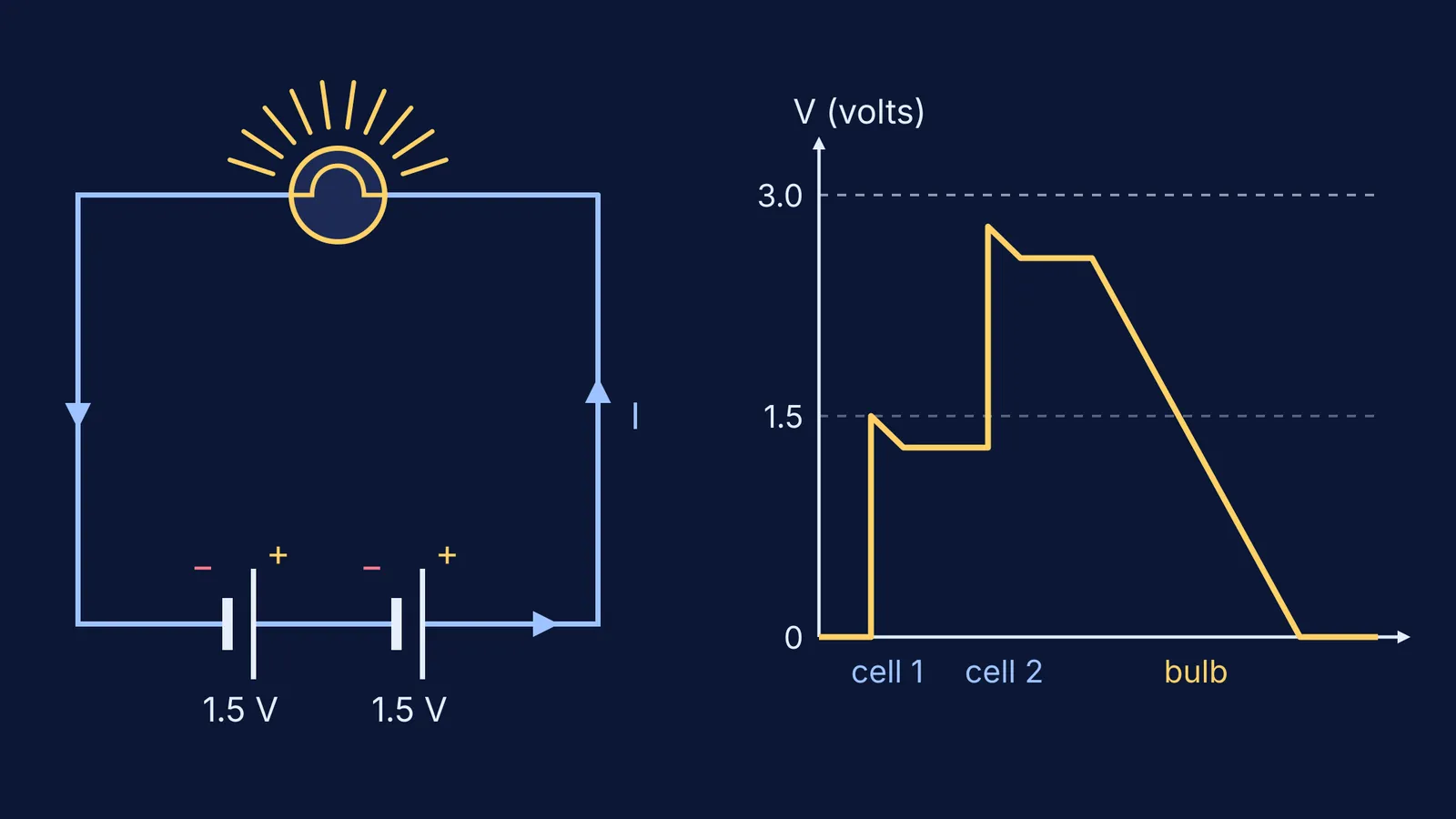
Ideal cells would give exactly 4 times, because power goes as V². Real cells lose a little inside: each drops I × r = 0.43 × 0.5 = 0.21 V, so the bulb gets about 2.57 V, not 3.0 V, as the diagram above shows. The same internal resistance explains why a battery gets warm when short circuited.
Why doesn't a real bulb take four times the power?
Internal resistance is one reason, as the example shows. The filament is the other: its resistance is not fixed. OpenStax notes that when a bulb is switched on, its initial power quickly decreases as its temperature and resistance increase (OpenStax College Physics 2e, section 20.4). At 3 V the filament runs hotter than at 1.5 V, so its resistance is higher and the power grows by less than the ideal four times. The bulb is still brighter, just not by the full V² factor. Most textbook questions treat the bulb's resistance as constant unless they say otherwise.
What happens if one cell is put in backwards?
OpenStax notes that if cells oppose one another, as when one is put into an appliance backward, the total emf is less, since it is the algebraic sum of the individual emfs (OpenStax College Physics 2e, section 21.2). With our example values:
Two cells, one reversed: 1.5 − 1.5 = 0 V. No current flows and the bulb stays dark.
Three cells, one reversed: 1.5 + 1.5 − 1.5 = 1.5 V, but all three internal resistances still count. I = 1.5 / (6 + 1.5) = 0.20 A, a little less than with one cell alone.
Three cells, yet dimmer than one. If you mix up the terminals, check the standard circuit symbols for a cell and a battery: the longer line is the positive terminal.
A checklist for cells-in-series questions
Mark + (long line) and − (short line) on every cell before you write anything.
Walk around the loop one way. Add each emf pushing that way; subtract each one pushing against it.
Add every internal resistance, whichever way the cell faces.
Find the current: I = total emf / (bulb resistance + total internal resistance).
Find the bulb's power with P = I²R, and compare powers to decide brightness.
If step 2 keeps going wrong, the Fermi Problem Library has worked problems with a step-by-step solver that explains the reasoning rather than printing an answer. For ideas like this that are easier to see than to read, the Fermi Simulation Lab has interactive simulations.
Next time you change a torch's cells, predict what one reversed cell would do before you try it.


