On this page
Textbooks often state the number and move on: a neuron at rest is about 70 mV more negative inside than outside (OpenStax Biology 2e). Many students then write "the pump makes it negative". That is only partly right: the pump builds the ion gradients, and the leaky membrane turns them into a voltage. Here is how.
What is the resting membrane potential?
The resting membrane potential is the voltage across a neuron's membrane when it is not firing, measured inside relative to outside. In nerve cells it varies between about −40 and −90 mV, depending on the cell (University of St Andrews neuroscience tutorial); −70 mV is the value most commonly used (OpenStax Anatomy and Physiology 2e).
It rests on two uneven ion distributions. In OpenStax's table for neurons, Na⁺ is 145 mM outside and 12 mM inside, while K⁺ is 155 mM inside and 4 mM outside (OpenStax Biology 2e). The cytosol also holds a high concentration of anions, in the form of phosphate ions and negatively charged proteins (OpenStax Anatomy and Physiology 2e).
How does the sodium-potassium pump create the resting potential?
The Na⁺/K⁺ pump moves three Na⁺ out and two K⁺ in for every ATP it uses (OpenStax Biology 2e). We cover why the ratio is 3:2 in why the sodium-potassium pump moves 3 Na⁺ out and 2 K⁺ in. Step by step:
The pump builds the gradients: lots of K⁺ inside, lots of Na⁺ outside.
The membrane has far more potassium leak channels than sodium leak channels, so K⁺ diffuses out much faster than Na⁺ leaks in (OpenStax Biology 2e).
Each K⁺ that leaves carries a positive charge out. The large negative proteins it leaves behind cannot follow, so the inside turns negative.
The negative inside pulls K⁺ back until the electrical pull balances the concentration push: the potassium equilibrium potential, E(K).
The small Na⁺ leak brings positive charge in, holding the voltage a little above E(K).
The pump keeps running, putting back the Na⁺ and K⁺ that leak, so the gradients do not run down.
Why is it −70 mV and not the potassium value?
At body temperature (37 °C), the Nernst equation is E = 61.5 mV × log(C outside ÷ C inside) for a +1 ion. If you know 0.059 V from chemistry, that is the 25 °C version; see where the 0.059 in the Nernst equation comes from. With the OpenStax concentrations (OpenStax Biology 2e):
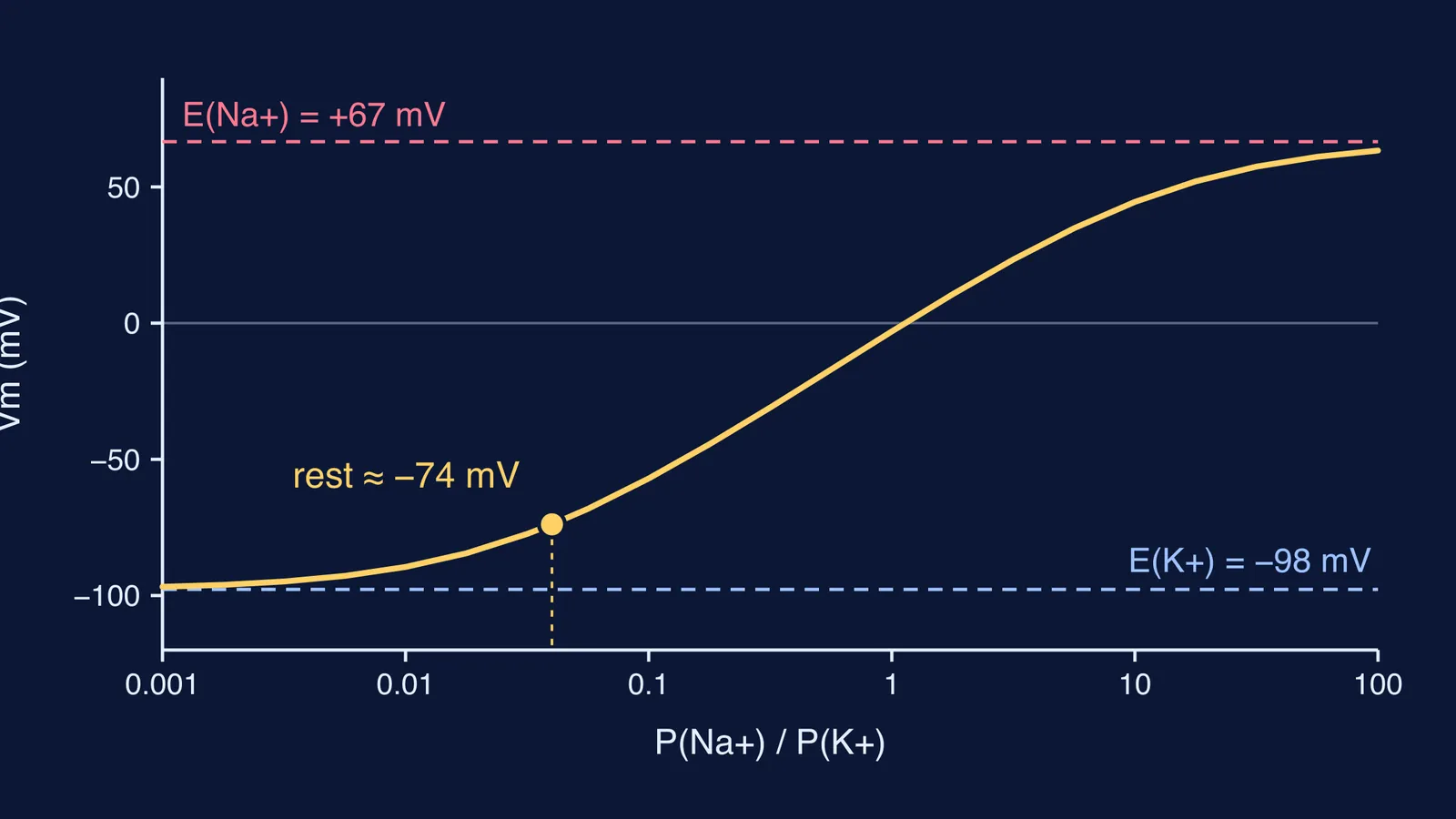
E(K) = 61.5 × log(4 ÷ 155) = 61.5 × (−1.59) ≈ −98 mV
E(Na) = 61.5 × log(145 ÷ 12) = 61.5 × 1.08 ≈ +67 mV
The real potential is a compromise between these, weighted by the membrane's permeability to each ion (the Goldman equation, St Andrews tutorial). Leaving out Cl⁻, it reads V = 61.5 × log[(P(K)·K outside + P(Na)·Na outside) ÷ (P(K)·K inside + P(Na)·Na inside)].
The same tutorial lists the resting squid giant axon's permeability to Na⁺ as 0.04 of its permeability to K⁺. The classic measurements come from squid-axon studies such as Hodgkin and Katz (1949) in The Journal of Physiology. Borrow that ratio for the OpenStax concentrations above:
Top: 4 + 0.04 × 145 = 4 + 5.8 = 9.8
Bottom: 155 + 0.04 × 12 = 155 + 0.48 = 155.5
Ratio: 9.8 ÷ 155.5 ≈ 0.063, and log(0.063) ≈ −1.20
V ≈ 61.5 × (−1.20) ≈ −74 mV
That lands close to −70 mV. Real neurons differ in their ratio and in Cl⁻, so treat this as an illustration. The lesson holds: the voltage sits near E(K) because the membrane is mostly permeable to K⁺, and the Na⁺ leak pulls it up about 24 mV.
Does the pump itself make the inside negative?
A little. Each cycle moves one more positive charge out than in, so the pump is electrogenic and adds a few millivolts directly. In the St Andrews worked squid-axon example, the potential is −64 mV with the pump's 3:2 ratio counted and −60 mV without it (St Andrews tutorial). Its main job is indirect: without it, leaks would slowly flatten the gradients.
How do you write this answer in an exam?
For a 3-mark board or NEET-UG-style answer, hit five points in order:
Define it: about −70 mV, inside negative relative to outside (OpenStax Anatomy and Physiology 2e).
State the gradients: K⁺ high inside, Na⁺ high outside, maintained by the Na⁺/K⁺ pump (3 Na⁺ out, 2 K⁺ in, one ATP).
Permeability: at rest the membrane is far more permeable to K⁺, so K⁺ leaks out.
Trapped anions: negative proteins stay inside, so the inside becomes negative.
Balance: Na⁺ leak and the pump's small electrogenic effect fine-tune the value.
Common mistakes to avoid:
Saying the pump alone creates −70 mV.
Swapping the ions: three Na⁺ go out, two K⁺ come in.
Calling the membrane impermeable at rest. It leaks, mostly K⁺.
If the link between permeability and voltage still feels shaky, the Fermi Concept Library gives each biology concept its own lesson and shows its place in the map.
For the history, read about Julius Bernstein's membrane theory of the resting potential.