

On this page
Stand with the Sun low behind you and a bank of thin fog in front, and you may see a huge pale arch where a rainbow should be. It sits at about the same angle as a rainbow and is made in the same way, by light bending into water drops and reflecting once inside them. Yet it is almost colourless, sometimes with only a faint reddish outer edge. This is a fogbow, sometimes called a white rainbow or cloudbow. Ray optics cannot explain why it loses its colours; diffraction can.
What is a fogbow and how is it different from a rainbow?
A fogbow is a bow of light centred on the antisolar point, the point directly opposite the Sun, formed by sunlight entering fog or cloud droplets, reflecting once inside and coming back out. That is the same path that makes the primary rainbow. The difference is the size of the drops. Rain drops are about a millimetre or more across. Fog drops are tens of micrometres across.
A peer-reviewed study of Arctic fogbows by Horváth and colleagues in Applied Optics (2011) sums up the measurements: fog drops have radii below about 50 µm, usually 25 to 50 µm, so they diffract light strongly. Because of the small droplet size, the differently coloured arcs overlap and the fogbow looks white. They also note, citing earlier work by Lynch and Schwartz, that the bow is paler for smaller drops and shows colours only when drops are larger, of order 100 µm.
Two other sights are often confused with it. A halo is a ring around the Sun or Moon, usually at 22°, made by ice crystals. A glory is a small set of coloured rings around the shadow of your own head, seen on fog or cloud below you. A fogbow is large, like a rainbow, and you face away from the Sun to see it.
Why does a rainbow show colours at all?
Each colour leaves a drop at a slightly different angle because water's refractive index depends on wavelength. For each colour, light bunches up near the angle of minimum deviation, and that bright edge is the bow. The full derivation, and why it comes out near 42°, is in why a rainbow appears at 42 degrees. Here you only need the result:
Angle of incidence at minimum deviation: cos²i = (n² − 1)/3
Deviation: D = 180° + 2i − 4r, with sin i = n sin r
Bow angle from the antisolar point: 180° − D
Red has a smaller n than violet, so red ends up on the outside of the bow and violet on the inside. The gap between them is the colour spread.
Why does diffraction blur each colour?
Ray optics treats each colour's bow as a sharp line. Light is a wave, though, and a drop of diameter d acts like a small aperture. Anything that limits a wave to a width d spreads it over an angle of roughly λ/d in radians. The same rule sizes the ring around the Moon in how a lunar corona gives the droplet size.
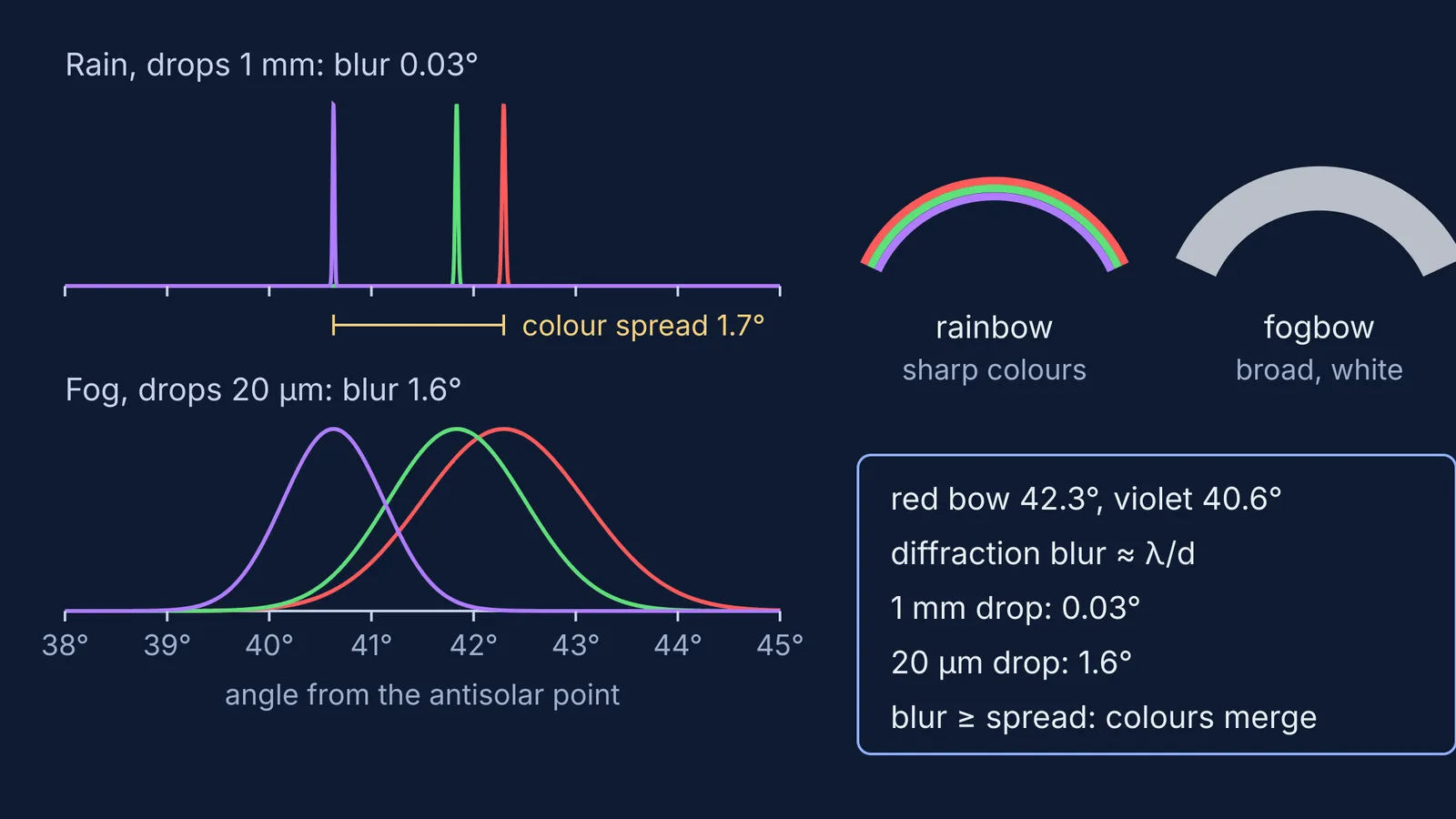
So each colour's bow is not a line but a band about λ/d wide. If that blur is much smaller than the colour spread, the bands sit side by side and you see a rainbow. If the blur is as large as the spread, the red, green and violet bands pile on top of each other and add up to white.
Worked example: when does a bow turn white?
Use the refractive index of water at 20 °C measured by Daimon and Masumura in Applied Optics (2007): n = 1.3315 for red light at 656 nm and n = 1.3431 for violet light at 405 nm.
Red. cos²i = (1.3315² − 1)/3 = 0.2576, so i = 59.50°. sin r = sin 59.50° ÷ 1.3315, so r = 40.32°. D = 180° + 118.99° − 161.29° = 137.70°. The red bow sits at 180° − 137.70° = 42.30°.
Violet. The same steps give i = 58.82°, r = 39.57° and D = 139.37°. The violet bow sits at 40.63°.
Colour spread. 42.30° − 40.63° = 1.67°, about 1.7°.
Blur for a 1 mm rain drop. Take λ = 550 nm, the middle of the spectrum. λ/d = 550 × 10⁻⁹ ÷ 1 × 10⁻³ = 5.5 × 10⁻⁴ rad = 0.032°. That is about 2% of the colour spread. The colours stay sharp.
Blur for a 20 µm fog drop. λ/d = 550 × 10⁻⁹ ÷ 20 × 10⁻⁶ = 0.0275 rad = 1.58°. That is about 95% of the colour spread. The colours merge.
Crossover size. Set λ/d equal to the spread: d = 550 × 10⁻⁹ ÷ (1.67° in radians) ≈ 19 µm.
The other sizes follow the same rule: a 2 mm drop blurs by 0.016°, a 0.1 mm drizzle drop by 0.32° and a 10 µm drop by 3.2°, almost twice the colour spread.
Is λ/d the whole story?
No. λ/d is an order-of-magnitude blur. The full wave theory of the rainbow, worked out by George Airy in 1838, shows that the bright band near the rainbow angle shrinks more slowly with drop size, roughly as the two-thirds power of λ/d rather than λ/d itself. For small drops that makes the band even wider than our estimate. So the simple model understates the effect, and the crossover from coloured to white happens at drops larger than 19 µm. That fits real fog, where drops 50 to 100 µm across already give pale bows.
Horváth and colleagues measured the angular width of 16 Arctic fogbows and found values from about 5° to 19°, several times the 1.7° colour spread. Wave theory also predicts that small drops shift the bow slightly inward, which is why fogbows often look a little smaller than rainbows; the same study describes the main fogbow at radii of about 30° to 45°.
Wave theory also explains the faint extra bands sometimes seen just inside a fogbow. These supernumerary bows come from interference between rays taking slightly different paths through the drop. They are not the same as the secondary bow outside a rainbow, which comes from two internal reflections, as explained in why double rainbows form with reversed colours.
If you want to check the minimum-deviation step for other colours, the Fermi Problem Library has a step-by-step solver that explains the reasoning.
Where can you see a fogbow?
Look for thin fog or low cloud with the Sun low and behind you: early morning over a valley, a hill station after rain, or the sea from a ship's deck. If the fog hides the Sun, there is no direct light to form a bow.
Quick checklist
A fogbow is a rainbow made by fog drops, centred on the antisolar point with the Sun behind you.
Ray optics gives each colour its own bow angle: red about 42.3°, violet about 40.6°, a spread of about 1.7°.
Diffraction blurs each colour by roughly λ/d.
1 mm rain drop: 0.03° blur, colours sharp. 20 µm fog drop: 1.6° blur, colours merge.
The full Airy theory gives an even wider band, so real fogbows are pale for drops well above 20 µm.
A halo comes from ice crystals around the Sun; a glory is a small ring around your own shadow.


