

On this page
When you stand with your back to the Sun after a shower of rain, a rainbow forms a perfect arc in the sky ahead of you. But it does not appear just anywhere. The bright band of colours always sits at a precise angle: approximately 42 degrees from the shadow of your head (the antisolar point).
This specific angle is not a coincidence of weather, but a rigid result of geometry. In 1637, René Descartes traced the paths of light rays through a spherical water droplet to explain this limit, calculating the primary bow's angle long before the nature of light was fully understood.
How do reflection and refraction build the bow?
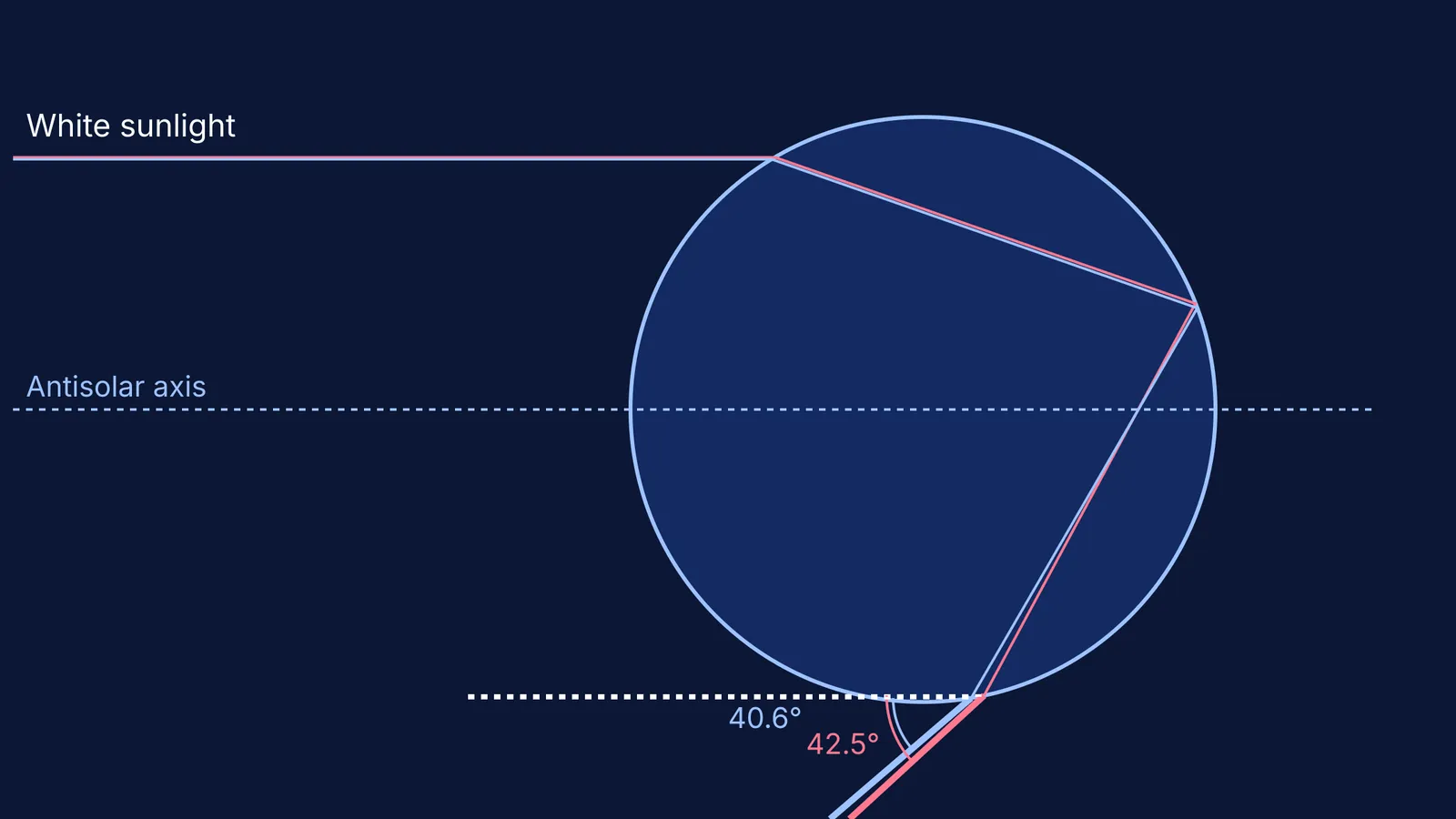
A rainbow is the combined result of millions of tiny, spherical raindrops doing the same thing at once. When a ray of white sunlight strikes a raindrop, it undergoes three steps:
Entry: The light crosses from air into denser water, slowing down and bending (refraction).
Reflection: It hits the back wall of the droplet. Most light passes through, but a portion reflects inward like a mirror.
Exit: The reflected light travels back to the front of the drop and exits into the air, bending a second time.
Because of the spherical shape of the drop, light rays entering at different heights leave at different angles. Most rays scatter in various directions. However, at a specific entry point near the edge of the drop, the light rays "pile up" at a maximum exit angle. This bunching creates a bright, concentrated rim of light (a caustic), which is the rainbow you see. Any light that enters higher or lower than this sweet spot exits at a smaller angle, scattering inside the arc of the bow.
Why are the colours separated?
While Descartes figured out the 42-degree concentration of light, he could not fully explain the colours. That requires understanding dispersion—the fact that different colours of light bend by slightly different amounts.
The refractive index of water changes with wavelength. For red light, the index is about 1.330, but for shorter blue light, it is 1.343.
Red light bends the least. When you calculate the maximum exit angle using water's refractive index for red light, the rays bunch up at 42.5°.
Blue light bends the most. Its maximum exit angle is smaller, bunching up at 40.6°.
Because the red light comes back at a steeper angle relative to the incoming sunlight, you must look higher in the sky to see the red rays hitting your eye. This is why red forms the outer, top edge of the primary rainbow, while blue and violet form the inner, bottom edge.
Why does the rainbow appear at 42 degrees?
The 42-degree angle means that a rainbow is fundamentally a circle of light with a 42-degree radius, centered directly opposite the Sun.
When you see a rainbow, you are standing at the tip of a cone. The droplets sending red light to your eye are all sitting on the rim of that cone, 42.5 degrees away from the central axis. If you move, the rainbow moves with you, formed by an entirely new set of raindrops in that exact geometric arrangement.
This rigid angle also dictates when you can spot a rainbow. If the Sun is higher than 42 degrees above the horizon, the entire circle is pushed below the ground. You will only see rainbows in the early morning or late afternoon when the Sun is low enough to let the arc rise into the sky.
If you are studying optics and want to build a similar ray-tracing setup to see how angles change with the refractive index, you can experiment in the Fermi Simulation Lab. For instance, you could see why a rainbow on Saturn's moon Titan (raining liquid methane) would appear at 49 degrees instead of 42. Whether you are tracing a ray through a glass slab or studying the dispersion of white light by a glass prism, the rules of refraction remain exactly the same.


