

On this page
On a night with thin, patchy cloud, you sometimes see the Moon sitting inside a small disc of light with a faint coloured edge: bluish on the inside, reddish on the outside. That is a lunar corona. It is a few degrees across and hugs the Moon, unlike the big pale ring that sometimes sits much farther out. The corona is diffraction, the same physics as a single slit or a camera aperture, and the size of the ring tells you how big the cloud droplets are.
What causes the coloured ring close to the Moon?
Each cloud droplet is a tiny obstacle in the path of moonlight. Light bends around it and spreads into a pattern of bright and dark rings, centred on the direction of the Moon.
You might expect a hole to be needed for a ring pattern. Babinet's principle says you don't. An opaque disc and a hole of the same size give the same diffraction pattern everywhere except in the straight-through direction. So a droplet of diameter d behaves like a circular hole of diameter d. That is the Airy pattern you met in why f/16 softens a photo and the Airy disc, only now the "aperture" is a water drop.
The pattern depends on direction, not on where the droplet sits. So millions of randomly placed droplets all send their first bright ring to the same angle from the Moon, and their intensities add up into one visible ring.
How do you find the ring angle from the droplet size?
For a circular obstacle in the far-field (Fraunhofer) limit, the rings sit at fixed values of sin θ:
First dark ring: sin θ = 1.220λ/d
First bright ring: sin θ = 1.635λ/d
Second bright ring: sin θ = 2.679λ/d
These Airy-function coefficients are the ones Joseph Shaw and Paul Neiman use to turn corona photographs into particle sizes in Coronas and iridescence in mountain wave clouds (Applied Optics, 2003). You need 1.635, because what you see is the coloured bright ring, not the dark gap.
Two things follow straight from sin θ = 1.635λ/d:
Smaller drops make bigger coronas. Halve d and the ring angle doubles. Most people guess the opposite.
Each ring is blue inside and red outside. Blue light (shorter λ) is diffracted through a smaller angle than red. Shaw and Neiman note exactly this colour order.
Worked example: what droplet size makes a 3° red ring?
Suppose you judge the red edge of the corona to be about 3.0° from the centre of the Moon. Take red light as λ = 650 nm.
Write the bright-ring condition. sin θ = 1.635λ/d, so d = 1.635λ / sin θ.
Find sin θ. sin 3.0° = 0.0523.
Substitute. d = 1.635 × 650 × 10⁻⁹ m / 0.0523 = 2.03 × 10⁻⁵ m.
Answer. d ≈ 20 µm. Units check: metres divided by a pure number gives metres.
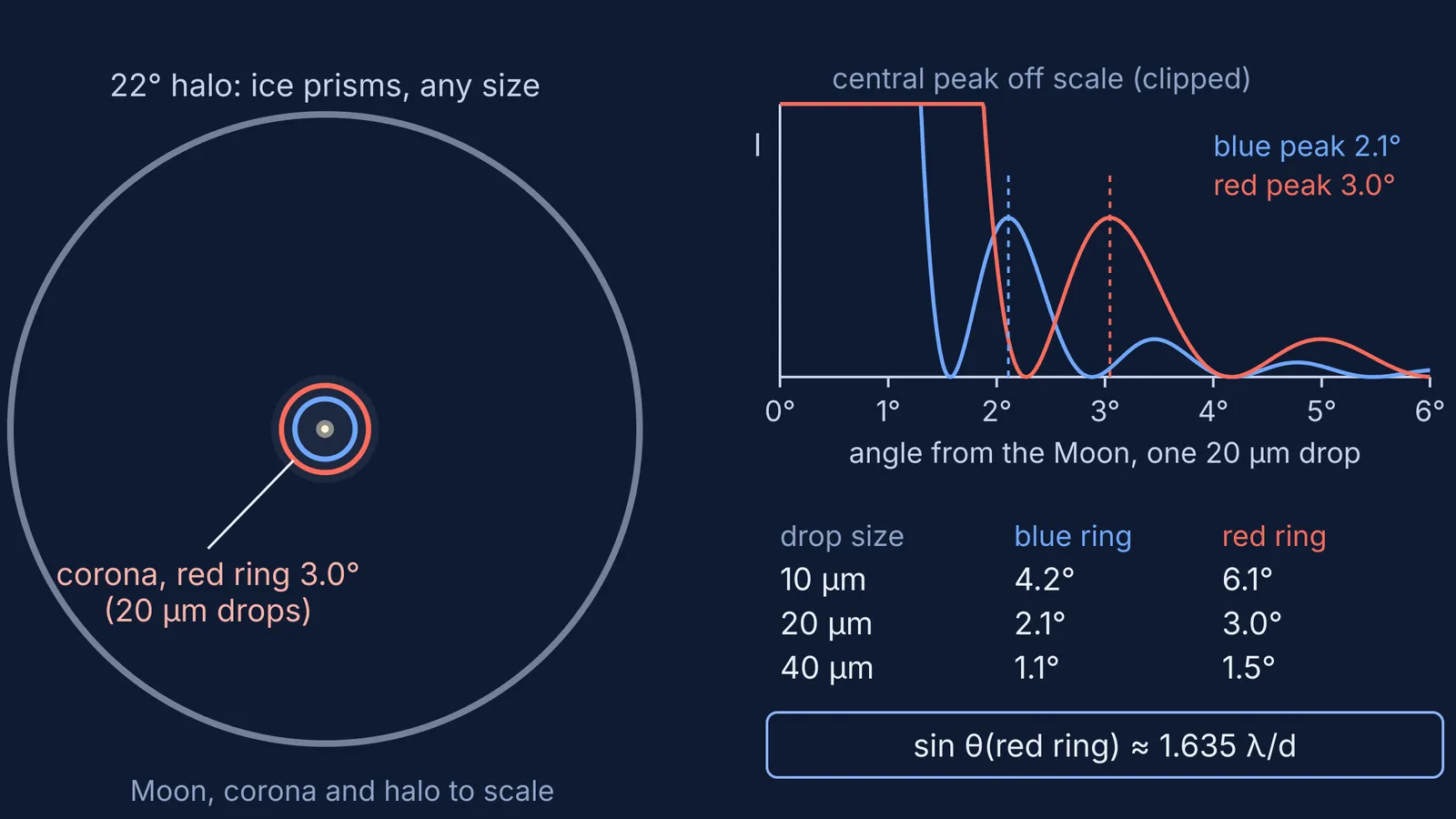
Check the blue ring. With λ = 450 nm and d = 20 µm, sin θ = 1.635 × 450 × 10⁻⁹ / 2.0 × 10⁻⁵ = 0.0368, so θ = 2.1°. The blue edge sits about one degree inside the red edge.
The same formula, run the other way, gives the red ring for other sizes:
10 µm drops: red ring at 6.1°, blue at 4.2°.
20 µm drops: red ring at 3.0°, blue at 2.1°.
40 µm drops: red ring at 1.5°, blue at 1.1°.
And from a measured red ring at 650 nm:
Red ring at 1.5° means drops of about 41 µm.
At 2.0°, about 30 µm.
At 3.0°, about 20 µm.
At 5.0°, about 12 µm.
These are the right size for real clouds. Shaw and Neiman found mean particle sizes from 7.6 to 24.3 µm in the coronas they photographed (Applied Optics, 2003). They also found that in mountain wave clouds over half the displays needed tiny, nearly round ice particles rather than water drops. Diffraction only cares about the obstacle's size.
Why is the 22° halo a different thing?
The large ring at about 22° is refraction, not diffraction. Hexagonal ice crystals act as prisms with a 60° angle between alternate faces, and minimum deviation through such a prism is about 22°. That angle is set by the prism angle and the refractive index of ice, not by the crystal size, so the halo is always the same size. It is explained in why there is a ring around the Moon at night, so we only compare the two here.
Size. A corona's ring is a few degrees from the Moon and changes as different clouds drift past. A halo is fixed at about 22°.
Colour order. A corona is blue inside, red outside. A halo is reddish on its inside edge.
Cloud. A corona needs small particles of nearly equal size. A halo needs ice crystals.
For scale, the Moon is only about 0.52° across. A corona with a 3° red ring is roughly 11 Moon-widths across. A halo is about 85 Moon-widths across.
Why are some coronas bright and coloured while others are just a glow?
The colours need droplets of nearly the same size. If the cloud mixes 10 µm and 30 µm drops, their red rings land at 6.1° and 2.0°, and the colours smear into a whitish glow. Les Cowley's atmospheric optics site notes that a sharp corona with several rings needs cloud droplets of similar size, and that a gradient in droplet size can push the rings off centre (Atmospheric Optics: coronae).
The 1.635 factor is exact only for one drop. A real corona is an average over a spread of sizes, so your answer is a typical (mean) diameter, not every drop's size. Pollen grains can also make coronas in clear air. Shaw and Neiman mention that pollen coronas can be noncircular when the grains are not round, for example from pine or birch.
To see how the Airy rings move as you change the obstacle size and the wavelength, try the diffraction models in the Simulation Lab. For a refresher on how slit width sets the spread of light, see the width of the central maximum in single-slit diffraction.
Can you look for a corona around the Sun?
Coronas form around the Sun too, but never look at the Sun to find one. Staring at or near the Sun can permanently damage your eyes, even through cloud. Les Cowley's guidance is to cut the glare by looking at the Sun's reflection in still water or a plain glass mirror, never by looking straight at it (Atmospheric Optics: coronae). Even then, keep the Sun itself hidden, for example behind a building. The Moon is safe to look at, and it is where you will see coronas most easily.
Quick checklist
A corona is diffraction by cloud particles; by Babinet's principle a drop acts like a hole of the same size.
First bright ring: sin θ = 1.635λ/d. First dark ring: sin θ = 1.220λ/d.
Smaller drops give bigger rings; a 3° red ring means drops of about 20 µm.
Rings are blue inside, red outside.
Colours need drops of nearly equal size; a mix gives a white glow.
The 22° halo is refraction in ice prisms and does not depend on crystal size.
Never look at or near the Sun to find a solar corona.


