

On this page
Look at the small clear chamber under a saline bottle on a hospital ward and you see drops forming and falling one at a time. Drip sets are labelled with a drop factor, the number of drops that make 1 mL. Staff count drops because the size of each drop is fixed by physics: a drop hangs from the tip until its weight beats the surface tension holding it up, and that balance depends on the tip and the liquid, not on how fast the drops come.
This post is about the physics only. It gives no medical instructions. Drip sets are chosen, set up and adjusted by trained medical staff, who follow the drop factor printed on the set and use infusion pumps where accuracy matters. How high the bottle hangs and why the fluid flows at all is covered in how high a saline drip must hang, so it is not repeated here.
What holds a drop on the tip?
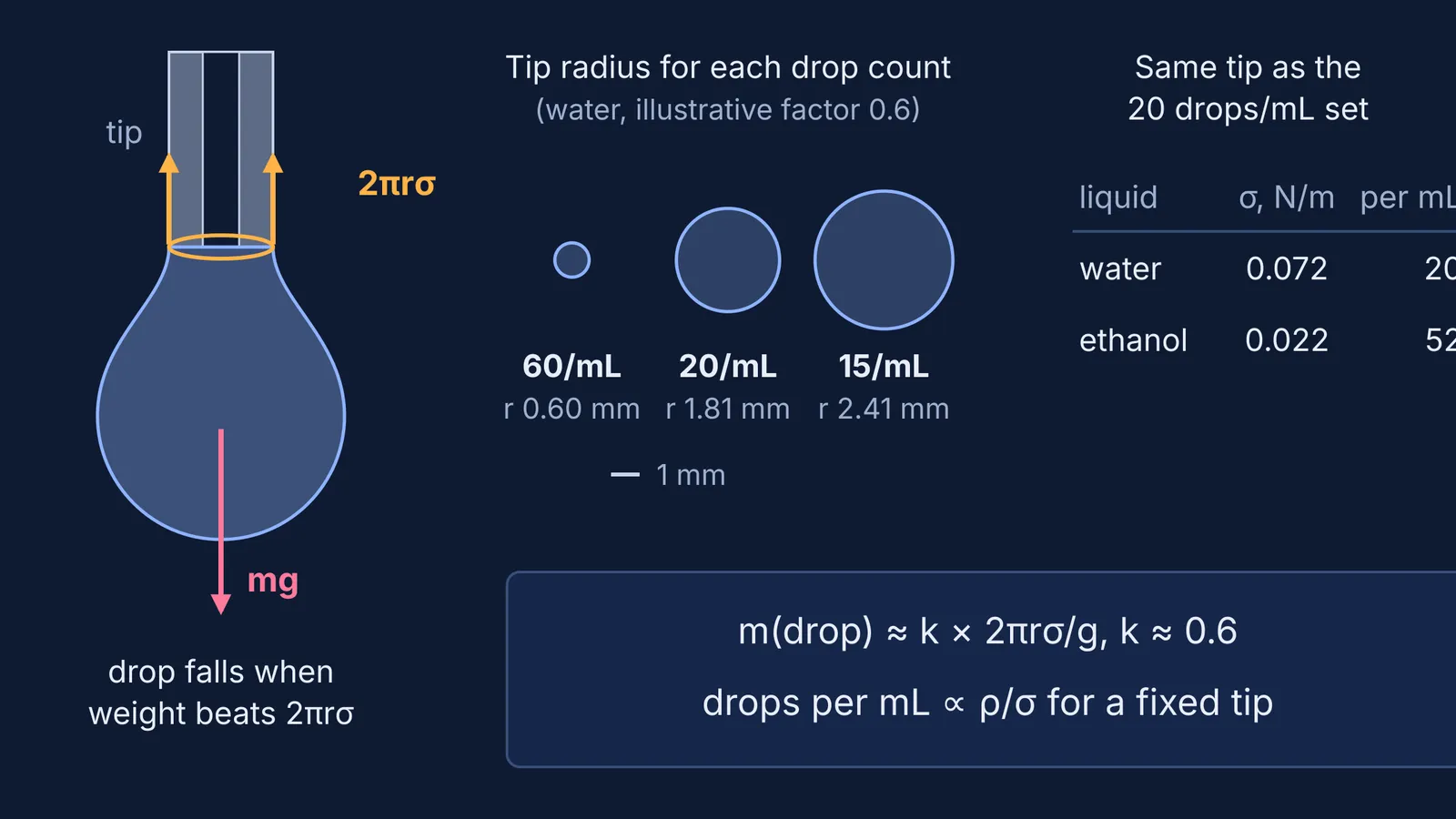
Surface tension σ is a force per unit length along the edge of a liquid surface. Where the liquid surface meets the rim of the tip, it pulls along the whole circumference. If the rim has radius r, the edge is 2πr long, so the largest upward force the surface can give is 2πrσ. This is the same "force = σ × length" you use for the force of surface tension on a wire frame, but here the length is a circle.
While the drop is small, its weight mg is less than 2πrσ and it hangs. As liquid keeps arriving, the drop grows. When its weight would exceed the most the rim can hold, it breaks away. The simple balance, called Tate's law, is:
mg = 2πrσ, so m = 2πrσ/g.
For a liquid that wets the tip, r is the outer radius, because the liquid spreads to the outer edge. For one that does not wet it, the drop can hang from a smaller circle.
Why does only part of the drop fall?
Tate's law assumes the whole hanging drop falls. It does not. Just before it lets go, the drop narrows into a neck, the neck pinches off, and a part of the liquid stays on the tip to start the next drop. So the mass that falls is only a fraction k of 2πrσ/g:
m(drop) = k × 2πrσ/g.
The fraction depends on how big the tip is compared with the drop, and careful drop-weight measurements use correction tables for it. In this post we use k = 0.6 as an illustrative round value. Drop size also changes slightly if drops form very fast, which is one reason a drip chamber is designed to make drops one at a time.
The key point survives the correction: for a given tip and a given liquid, every drop has the same mass. That is why a count of drops is a measure of volume.
How big must the tip be for 20 drops per millilitre? A worked example
Take water at room temperature, σ = 0.072 N/m and density 1,000 kg/m³, with g = 9.8 m/s² and k = 0.6. Use the common drop factors in a maker's guide: BD's tip sheet on calculating flow rates lists macrodrip tubing as typically 10 to 20 drops per mL and microdrip tubing as typically 60. The figure that counts for any one set is the one printed on its packet.
Mass of one drop. 1 mL of water has mass 1 g. At 20 drops/mL each drop is 1/20 g = 50 mg = 5.0 × 10⁻⁵ kg.
Weight of one drop. mg = 5.0 × 10⁻⁵ × 9.8 = 4.9 × 10⁻⁴ N, about 0.49 mN.
Rearrange. r = mg/(k × 2πσ).
Substitute. r = 4.9 × 10⁻⁴ / (0.6 × 2π × 0.072) = 1.81 × 10⁻³ m, so the rim radius is about 1.8 mm and its diameter about 3.6 mm.
Check units. N / (N/m) = m.
Without the correction (k = 1) the same drop would need r = 1.08 mm. Ignoring the liquid left behind underestimates the tip by 40%.
The 60 drops/mL set. Each drop is 16.7 mg, a third of the mass, so the radius is a third too: r = 0.60 mm.
Other counts. By the same rule, 15 drops/mL needs r = 2.41 mm and 10 drops/mL needs r = 3.61 mm.
Since m ∝ r for a fixed liquid, drops per mL ∝ 1/r. Halve the tip radius and you double the count.
What happens with a liquid other than water?
Keep the tip of the 20 drops/mL set, r = 1.81 mm, and change the liquid. The drop's mass is k × 2πrσ/g, so it scales with σ. Its volume is mass divided by density. So:
drops per mL ∝ ρ/σ for a fixed tip.
For ethanol, σ = 0.022 N/m and ρ = 789 kg/m³ (approximate textbook values). Each drop has mass 0.6 × 2π × 1.81 × 10⁻³ × 0.022 / 9.8 = 1.53 × 10⁻⁵ kg, or 15.3 mg. Its volume is 15.3 mg / 0.789 g/mL = 0.0194 mL, so the same tip gives about 52 drops/mL instead of 20.
That is why a drop factor holds only for the kind of liquid the set was made for, usually water-like solutions.
How do you measure surface tension by counting drops?
The same idea runs backwards in the lab. Let the same volume of two liquids drip from the same clean tip and count the drops, n₁ and n₂. Since each drop's mass is proportional to σ:
σ₁/σ₂ = (ρ₁ n₂)/(ρ₂ n₁).
A liquid with lower surface tension gives more drops. This drop-count method sits alongside the capillary-rise method in finding surface tension by capillary rise, and it has the advantage that the correction factor k cancels when both liquids use the same tip and give drops of similar size.
If you want more surface tension numericals worked one step at a time, the Fermi Problem Library has a step-by-step solver that explains the reasoning.
Quick checklist
A drop hangs from the rim of the tip; the most the surface can hold is 2πrσ.
Tate's law, mg = 2πrσ, overestimates the falling drop; a fraction stays behind.
With an illustrative factor of 0.6: m(drop) ≈ 0.6 × 2πrσ/g.
For water, 20 drops/mL needs a rim radius of about 1.8 mm and 60 drops/mL about 0.6 mm.
For a fixed tip, drops per mL ∝ ρ/σ, so ethanol gives about 52 drops/mL from a 20-drop tip.
Drop counting compares surface tensions: σ₁/σ₂ = (ρ₁n₂)/(ρ₂n₁).
Real drip sets are set up by trained medical staff using the drop factor on the packet.


