

On this page
Lay one glass slide on another and slip a single hair under one end. Look down at the pair in yellow sodium light and you see a row of straight dark lines, evenly spaced, running across the glass. Count them and you know the hair's thickness, with no screw gauge. The same lines are how lens makers check that a surface is flat to a few tens of nanometres.
What is an air wedge in interference?
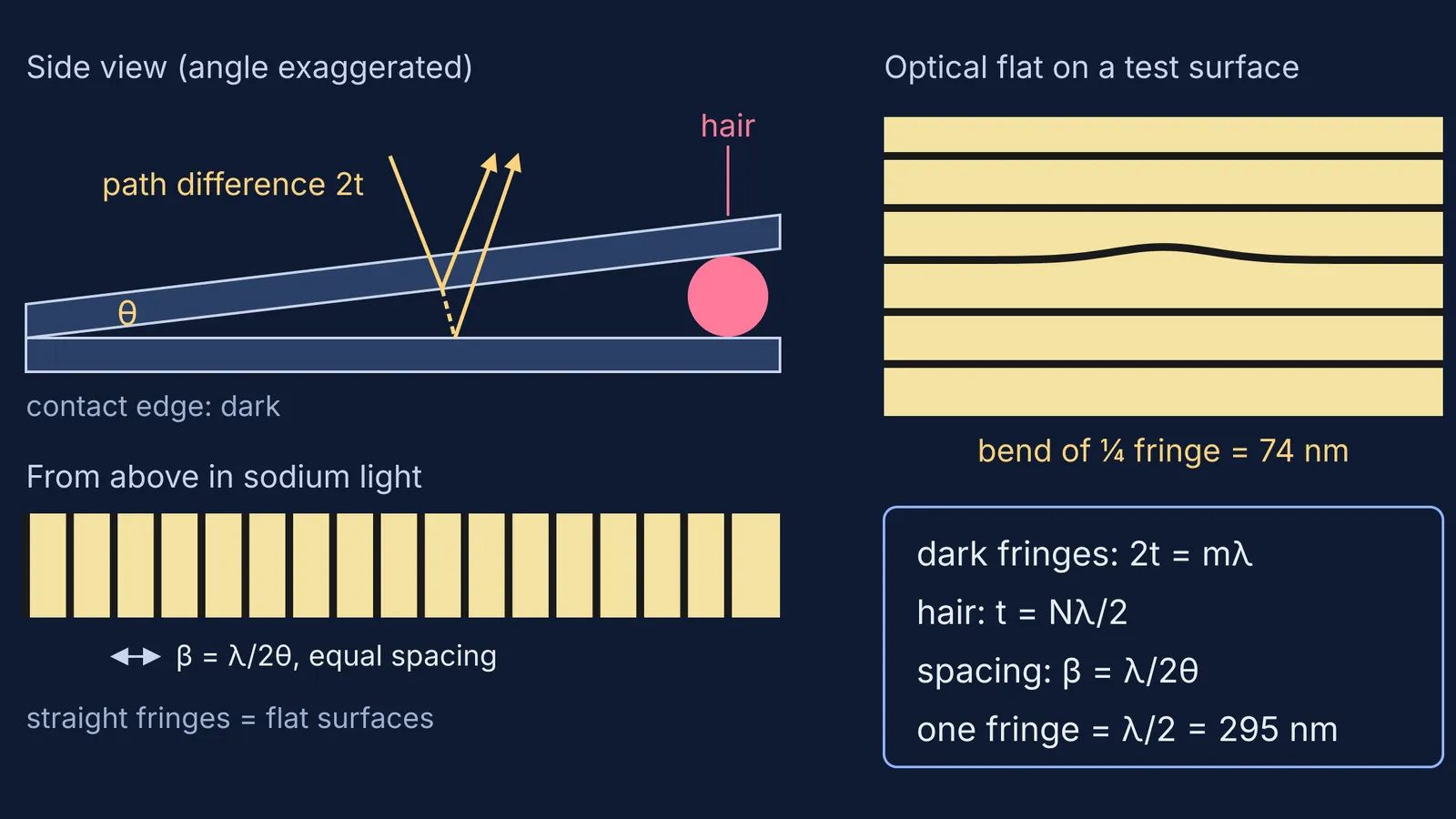
An air wedge is the thin layer of air trapped between two flat glass plates that touch along one edge and are held slightly apart at the other. The spacer is often a hair, a thin wire or a strip of paper. The gap is zero at the contact edge and grows steadily to t at the spacer, so its shape is a very thin wedge with angle θ = t/L, where L is the distance from the contact edge to the spacer.
Light falling almost straight down is partly reflected at the bottom face of the top slide and partly at the top face of the bottom slide. The second ray travels down through the gap and back up, so it goes an extra distance 2t. The two reflected rays then interfere. This is thin-film interference, the same idea behind the minimum thickness of an anti-reflection coating, except that here the film's thickness changes from place to place instead of being fixed.
Why is the contact edge dark and not bright?
At the contact edge the gap is zero, so you might expect the two rays to arrive in step and give a bright line. They do not. The first reflection happens where light in glass meets air: no phase change. The second happens where light in air meets glass, a denser medium: a phase change of π, equal to half a wavelength of extra path. So even at t = 0 the two rays are half a wave apart and cancel. The contact edge is dark.
Including that half-wave shift, the conditions for air (refractive index 1) at near-normal incidence are:
Dark fringe: 2t = mλ, with m = 0, 1, 2, ...
Bright fringe: 2t = (m + ½)λ
The same half-wave flip is why the edge fringe is dark in Lloyd's mirror experiment.
How do you find the thickness of a hair from the fringes?
Each step from one dark fringe to the next means the gap has grown by λ/2. Start counting at the dark contact edge as m = 0. If the last dark fringe, sitting right at the hair, is number N, then:
t = Nλ/2
Because the gap grows evenly, the fringes are straight, parallel to the contact edge and equally spaced. The spacing β follows from 2θβ = λ:
β = λ/2θ
Worked example: a hair between two slides
Two microscope slides, each 75 mm long, touch at one end. A hair lies across the other end, 75 mm from the contact edge. In sodium light (λ = 589.3 nm) you count 240 dark fringes beyond the contact edge. The count is an illustrative number chosen to match a typical hair.
Height per fringe. λ/2 = 589.3 nm ÷ 2 = 294.65 nm, about 295 nm.
Thickness. t = 240 × 294.65 nm = 70,716 nm = 70.7 µm.
Sanity check. Scalp hair is usually about 60 to 80 µm across, according to a review of hair structure by Wolfram in the Journal of the American Academy of Dermatology. 70.7 µm fits.
Wedge angle. θ = t/L = 70.7 × 10⁻⁶ m ÷ 0.075 m = 9.43 × 10⁻⁴ rad, about 0.054°.
Fringe spacing. β = λ/2θ = 589.3 × 10⁻⁹ m ÷ (2 × 9.43 × 10⁻⁴) = 3.13 × 10⁻⁴ m = 0.31 mm. Check: 75 mm ÷ 240 = 0.3125 mm. Same answer.
Now run it backwards, the way a lab would. With a travelling microscope you find that 10 fringe spacings cover 3.125 mm, so β = 0.3125 mm. Then θ = λ/2β = 9.43 × 10⁻⁴ rad, and t = Lθ = 0.075 m × 9.43 × 10⁻⁴ = 70.7 µm.
A laser and the hair's diffraction pattern give a second, independent number. That method is worked in measuring a hair with a laser pointer.
How do optical flats show bumps of a few nanometres?
An optical flat is a disc of glass polished so flat that its surface is within a small fraction of a wavelength of a true plane. Lay it on a lens blank or a gauge block and tilt it very slightly, and the thin air gap between them is an air wedge. As the Wikipedia article on optical flats explains, two neighbouring fringes mark a height difference of half a wavelength, and straight, parallel, evenly spaced fringes mean the test surface is flat.
Each fringe is a contour line of constant gap, like the contour lines on a map. If the surface has a bump or a hollow, the gap changes there, so the fringe swerves to follow the new contour. How far it swerves, as a fraction of the normal spacing, tells you the height:
A bend of one full fringe spacing means λ/2 = 295 nm.
A bend of a quarter spacing means 295 ÷ 4 ≈ 74 nm.
A quarter-fringe bend is easy to see by eye, yet 74 nm is far below the 0.01 mm least count of a screw gauge.
Is the defect a bump or a hollow?
A single picture cannot tell you. Fringes are contours, and a contour map without numbers does not show uphill from downhill. Opticians use a second view. The optical flat article describes a finger-pressure test: press gently near the middle. If the surface is concave, the flat flexes slightly and the fringes appear to move inward. If it is convex, the flat is already resting on the high spot, so it cannot flex down and the fringes stay put. For exams, remember the reason a second step is needed: fringes of equal thickness show where the gap changes, not which way.
If interference is easier to see than read, the Fermi Simulation Lab has interactive simulations you can play with. The curved air gap under a lens, which turns these straight fringes into circles, is covered in the history and explanation of Newton's rings.
Quick checklist
Air wedge: two plates touching at one edge, spacer of thickness t at distance L.
Path difference 2t, plus a half-wave shift at the lower reflection, so the contact edge is dark.
Dark fringes at 2t = mλ; thickness t = Nλ/2 counted from the dark edge.
Fringes are straight and equally spaced, β = λ/2θ with θ = t/L.
With sodium light, each fringe is a 295 nm height step; a quarter-fringe bend is about 74 nm.
One view of the fringes cannot tell a bump from a hollow; press or shift your eye to decide.


