On this page
In 1834 Humphrey Lloyd first described an experiment showing that one slit and one flat mirror are enough to make interference fringes. He published it in the *Transactions of the Royal Irish Academy* as further evidence that light is a wave (Wikipedia: Lloyd's mirror). For JEE and board exams, it is also a clear demonstration that reflection can flip a wave's phase.
What is Lloyd's mirror experiment?
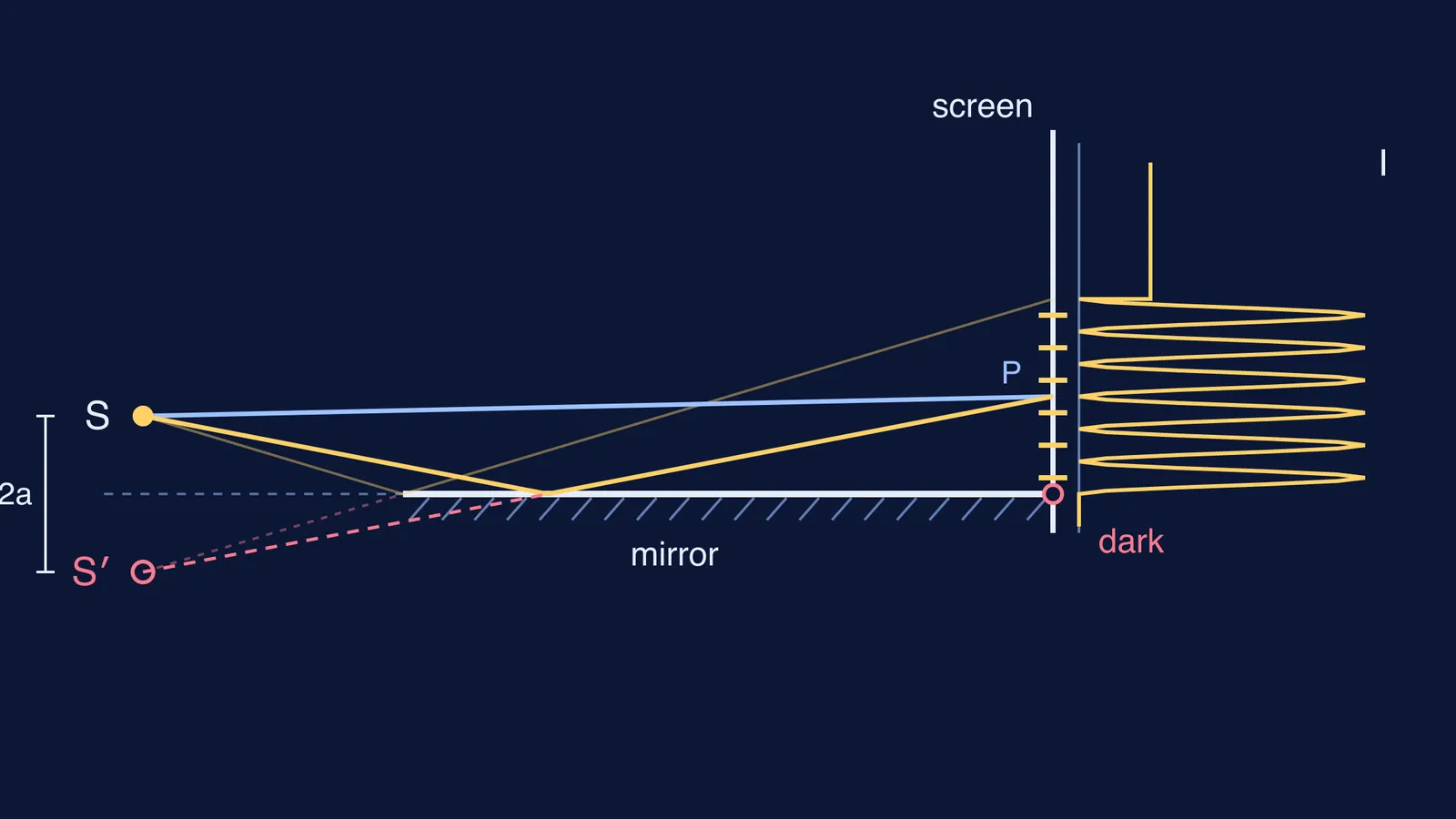
A narrow slit S sits a small height a above a flat mirror. Its light reaches the screen two ways: straight across, and after skimming off the mirror at a grazing angle.
The reflected light appears to come from the slit's mirror image S′, a distance a below the mirror plane. In Wikipedia's words, the reflected light forms a virtual second source that interferes with the direct light (Wikipedia). That turns the setup into a two-source problem with source separation d = 2a.
Why are S and S′ coherent? Both beams come from the same wavefront of the same slit, so their phase difference stays fixed. Two separate bulbs cannot do this; see why two independent light sources cannot produce interference.
Why does reflection add a π phase shift?
Light changes phase by 180° when it reflects from the surface of a medium with a higher refractive index than the one it is travelling in (Wikipedia: Reflection phase change). Light in air bouncing off a glass mirror is that case. Light inside glass reflecting at a boundary with air is not, and gets no shift.
A 180° (π) phase shift has the same effect as an extra path of λ/2. So in Lloyd's mirror the reflected wave always carries a half-wavelength handicap on top of its geometric path.
Why is the fringe at the mirror edge dark?
Where the mirror plane meets the screen, the direct and reflected paths are equal. In Young's double-slit experiment, equal paths give the bright central fringe. Here the reflected wave has been shifted by π, so the two waves arrive exactly out of step and cancel.
The fringe nearest the mirror, where the path lengths are equal, is dark rather than bright because of this 180° shift (Wikipedia). That dark edge is why Lloyd's mirror is a classic demonstration of phase reversal on reflection.
Two more differences from Young's pattern: you see only the half above the mirror plane, because the mirror blocks everything below it, and fringes appear only where both beams reach the screen.
Where do the bright and dark fringes fall?
For two sources a distance d apart and a screen at distance z, the fringe spacing is w = zλ/d, as long as the screen is far away compared with d (Wikipedia: Double-slit experiment). In Lloyd's mirror, d = 2a and z = D, so the fringe width is β = λD/2a.
What changes is where the fringes sit. At height y above the mirror plane, the geometric path difference is 2ay/D. Add λ/2 for the reflection:
Dark fringes: 2ay/D = nλ, so y = nλD/2a (n = 0, 1, 2 and so on)
Bright fringes: 2ay/D = (n + ½)λ, so y = (n + ½)λD/2a
These are the Young's conditions with bright and dark swapped. To compare them with the YDSE versions, see the position of the nth bright and dark fringe in YDSE.
A worked example
Take the numbers from Wikipedia's double-slit example: sources 0.5 mm apart, 0.6 μm light and a screen 1 m away, which give fringes 1.2 mm apart (Wikipedia). In Lloyd's mirror, a 0.5 mm separation means the slit sits a = 0.25 mm above the mirror.
Fringe width: β = (0.6 × 10⁻⁶ m × 1 m) / (0.5 × 10⁻³ m) = 1.2 mm.
Dark fringes: y = 0, 1.2 mm, 2.4 mm, 3.6 mm and so on.
Bright fringes: y = 0.6 mm, 1.8 mm, 3.0 mm and so on.
With two real slits, the bright fringes would sit at 0, 1.2 mm and 2.4 mm: the spacing is the same, but every fringe has moved by half a fringe.
How do you solve Lloyd's mirror questions without slipping?
Run these five checks:
Reflect the slit in the mirror plane to find S′. Then d = 2a, not a.
Measure y from the mirror plane, not from the middle of the screen.
Add λ/2 for the reflection, so the bright and dark conditions swap.
Count fringes only above the mirror plane and inside the region both beams reach.
Check the edge: your answer must give a dark fringe at y = 0.
If adding λ/2 feels like a rule to memorise, revisit the conditions for constructive and destructive interference. The Fermi Concept Library gives every concept in physics its own lesson, and the Fermi Problem Library has worked problems with a step-by-step solver that explains the reasoning rather than printing an answer.
Next time you see a Lloyd's mirror question, find S′ first and check that the edge comes out dark.