

On this page
Many YDSE questions in Class 12 boards and JEE Main start with one step: find where a particular fringe sits on the screen. If you know where the two formulas come from, you will not mix up "nth dark" with "nth bright", and you can handle questions that ask for the gap between two fringes on opposite sides of the centre.
We use the usual symbols: d is the distance between the two slits, D is the distance from the slits to the screen, λ is the wavelength, and y is measured on the screen from the centre of the pattern, where the central bright fringe sits.
Where do the fringe formulas come from?
Light from the two slits reaches a point on the screen by two paths of slightly different length. In OpenStax University Physics, the path difference to a point at angle θ is d sin θ, and you get a bright fringe when d sin θ = mλ, and a dark fringe when d sin θ = (m + ½)λ, with m = 0, ±1, ±2 and so on.
In a typical set-up the slits are a millimetre or less apart and the screen is about a metre away, as OpenStax describes Young's apparatus. So θ is tiny, and sin θ ≈ tan θ = y/D. Put that in and the path difference becomes:
Path difference = d × y / D
Now set this equal to the bright or dark condition and solve for y. That is the whole derivation; everything else is counting.
What is the position of the nth bright fringe?
Set dy/D = nλ. Then:
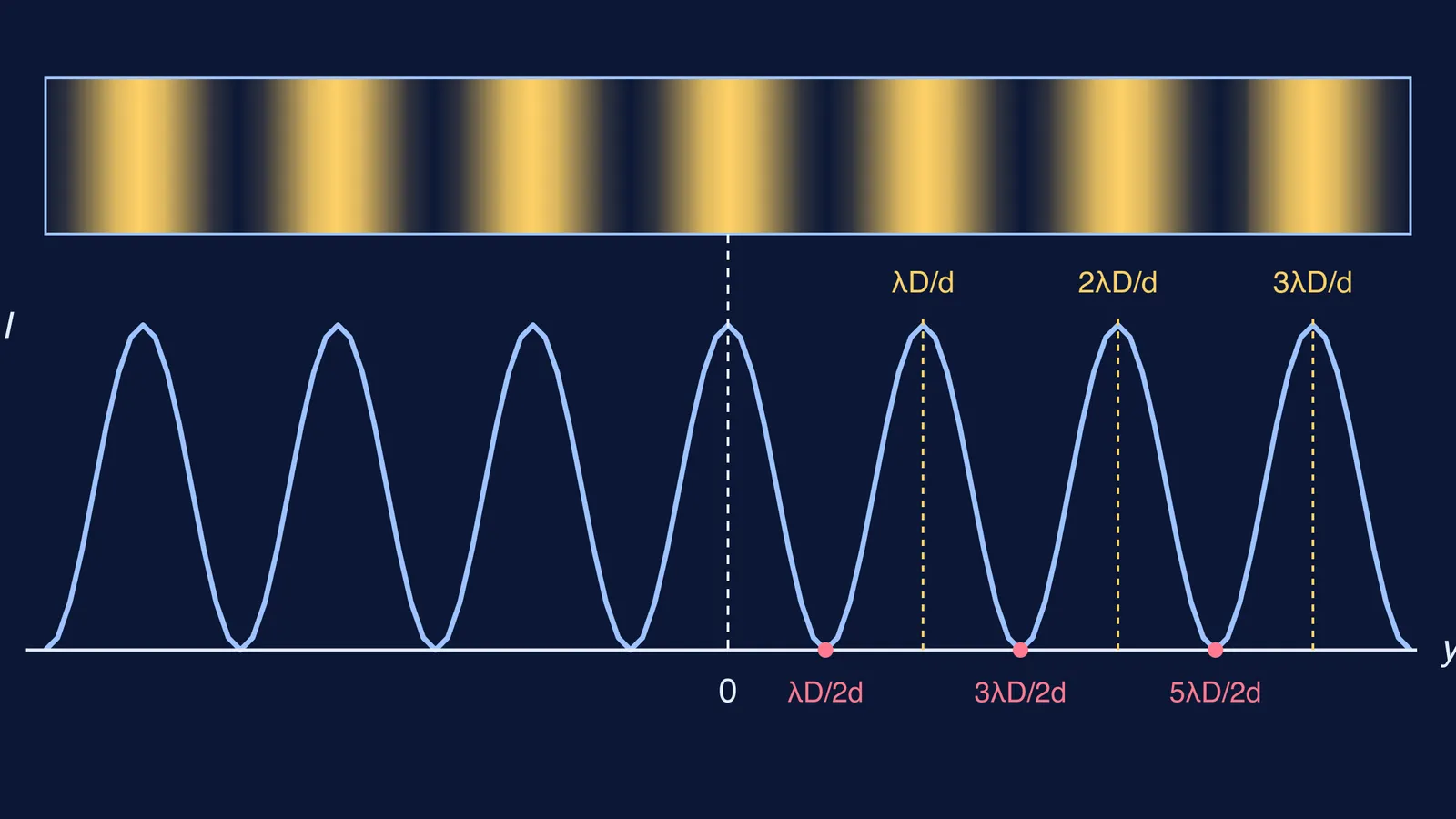
y(bright, n) = nλD/d, with n = 0 for the central bright fringe, n = 1 for the first bright fringe beside it, and so on. OpenStax gives the same small-angle result for bright fringes, y = mλD/d.
The gap between two neighbouring bright fringes is the fringe width, β = λD/d. So the nth bright fringe is simply n fringe widths from the centre.
What is the position of the nth dark fringe?
Set dy/D = (n − ½)λ, with n = 1 for the first dark fringe. Then:
y(dark, n) = (2n − 1)λD/2d
The first dark fringe is at β/2, the second at 3β/2, the third at 5β/2. Each dark fringe sits exactly halfway between two bright ones.
A worked example: third bright and third dark fringe
Take λ = 600 nm, d = 0.50 mm and D = 1.0 m. Work in metres.
Fringe width: β = λD/d = (600 × 10⁻⁹ × 1.0) / (0.50 × 10⁻³) = 1.2 × 10⁻³ m = 1.2 mm.
Third bright fringe: y = 3β = 3.6 mm from the centre.
Third dark fringe: y = (2 × 3 − 1)β/2 = 5β/2 = 3.0 mm from the centre.
Small-angle check: θ ≈ 3.6 mm / 1.0 m = 0.0036 rad. That is tiny, so sin θ ≈ tan θ holds.
Now two common follow-ups:
Second bright and third dark on the same side: 3.0 − 2.4 = 0.6 mm apart.
Second bright on one side and third dark on the other side: 2.4 + 3.0 = 5.4 mm apart.
The pattern is symmetric, so the fringes on the left of the centre are at the same distances as those on the right. Distances on the same side subtract; distances on opposite sides add.
What mistakes cost marks in fringe-position questions?
Counting the central fringe as the first bright fringe. The central one is n = 0. The "first bright fringe" is at β, not at 0.
Using nλD/d for a dark fringe. That lands you on a bright fringe. Dark fringes are at odd multiples of β/2.
Mixed units. Convert nm and mm to metres before you divide, then convert the answer back.
Applying the formula at large angles. y = nλD/d needs a small θ. For large angles, go back to d sin θ = mλ and find θ first.
If you want to see how changing λ, d or D squeezes or stretches the pattern before you solve, an interactive model helps: the Fermi Simulation Lab has interactive simulations for ideas that are easier to see than to read. For more practice, the Fermi Problem Library has worked problems with a step-by-step solver that explains the reasoning rather than printing an answer.
Where to go next
These positions are the starting point for harder YDSE questions. Revise the conditions for constructive and destructive interference if the path-difference step felt shaky. Then try how many fringes fit on the screen when the wavelength changes, and how a thin glass sheet shifts the whole pattern, which uses the same y = (path difference) × D/d idea.


