

On this page
A common Young's double-slit question: you see 12 fringes in a region of the screen, then the light is changed. How many do you see now? It looks as if you need the slit gap and the screen distance, but you don't. Below are the reasoning, three worked examples and a quick check to run before you answer.
How many fringes fit in a fixed width of screen?
The bright fringes sit at y = mλD/d, where m is the order, λ the wavelength, D the slit-to-screen distance and d the slit separation (OpenStax University Physics, Vol. 3, Section 3.2). This uses the small-angle approximation, which HyperPhysics notes is usually accurate enough for laboratory set-ups.
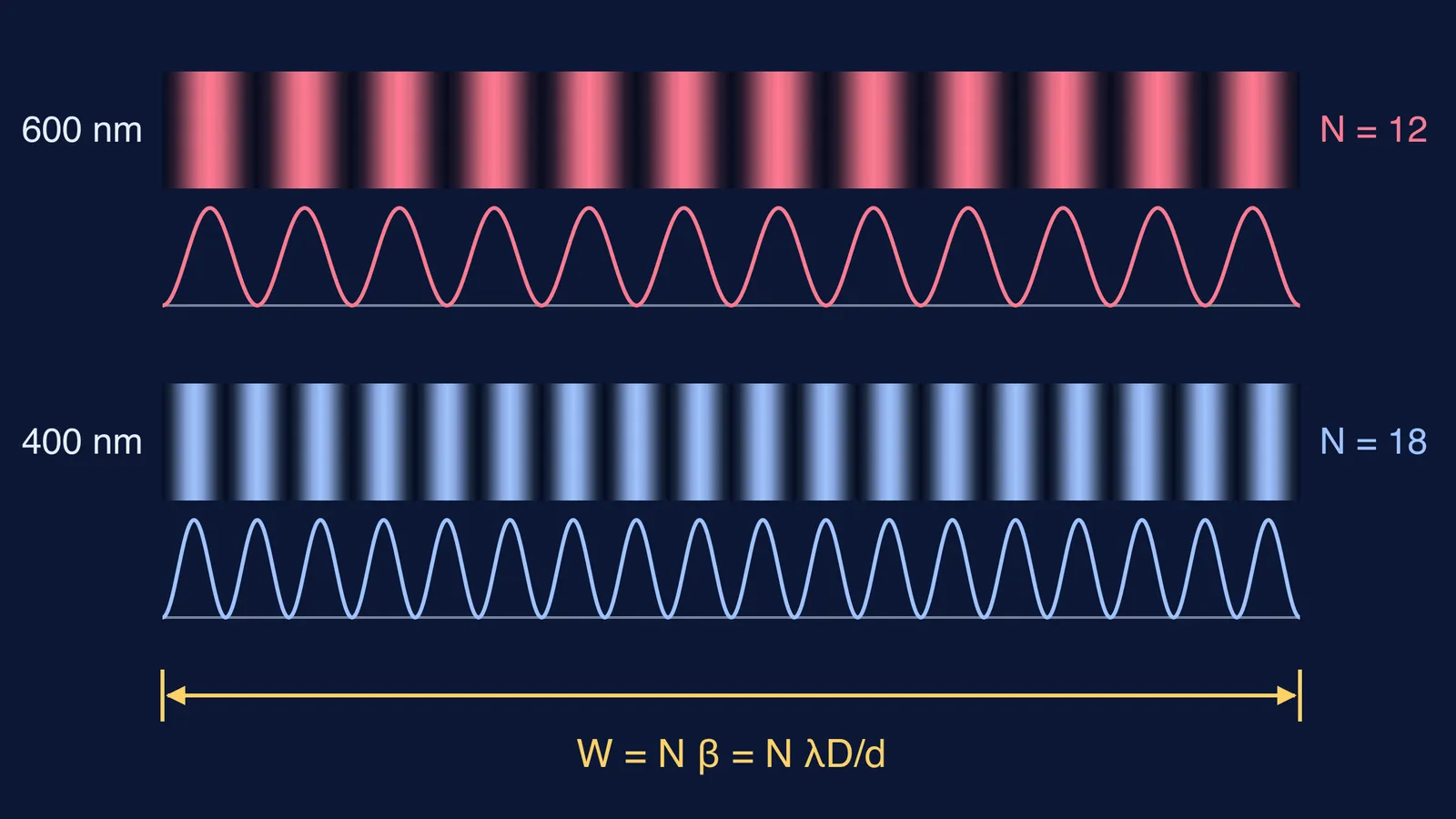
Subtract the positions of two neighbouring bright fringes and you get the fringe width: β = λD/d. Every fringe has the same width, so a fixed stretch of screen W holds
N = W/β = Wd/(λD)
Now the key step. If the apparatus stays the same (same D, same d) and you look at the same stretch W, then everything except λ is fixed. So:
N × λ = constant, or N1λ1 = N2λ2.
The number of fringes in a fixed field of view is inversely proportional to the wavelength. Halve the wavelength and you see twice as many fringes, each half as wide.
What happens to the number of fringes when the wavelength decreases?
Worked example 1. In a double-slit set-up, 12 fringes are seen in a region of the screen with light of wavelength 600 nm. The source is replaced by one of wavelength 400 nm. How many fringes are seen in the same region?
Nothing about the slits or screen changed, so use N1λ1 = N2λ2.
N2 = N1 × λ1/λ2 = 12 × 600/400.
N2 = 18 fringes.
Check the direction: shorter wavelength, narrower fringes, more of them. 18 is more than 12, so the answer makes sense.
Worked example 2: red versus violet. NASA puts the visible range at about 380 to 700 nm, with violet near 380 nm and red near 700 nm (NASA Science, Visible Light). With the same slits and screen, the ratio of fringe counts is 700/380, about 1.84. So a region that holds 12 red fringes holds 12 × 700/380 ≈ 22 violet fringes. This is also why white light gives coloured edges: each colour packs a different number of fringes into the same space, as our post on why white-light YDSE fringes are coloured explains.
What if the whole set-up is put under water?
This is the same question in disguise. Inside a medium of refractive index n, the wavelength becomes λn = λ/n (OpenStax, Section 3.4). The refractive index of fresh water at 20 °C is 1.333 (OpenStax, Table 1.1).
Worked example 3. 12 fringes fill a region in air. The whole apparatus goes under water with n = 1.333.
The wavelength in water is λ/1.333, so the fringe width shrinks by the same factor.
N2 = 12 × 1.333 ≈ 16 fringes.
The frequency of the light does not change, but its wavelength does, and the fringe width follows the wavelength.
How do you check your answer quickly?
Run through this before you mark an option:
Is anything else changing? N1λ1 = N2λ2 holds only if D, d and the stretch of screen stay fixed. If D or d also changes, go back to N = Wd/(λD) and take the ratio.
Direction check. Shorter wavelength means more fringes. Longer means fewer.
Medium check. Replace λ with λ/n for a medium, and keep the vacuum value in air.
Count what was asked. If the question counts fringe widths, keep counting fringe widths. Don't switch to counting bright bands halfway through.
Whole number? If your ratio gives 22.1, the screen shows 22 complete fringes plus a part of one.
For more traps in the same chapter, see fringe width problems and traps in Young's double-slit experiment. For the related question of where two colours line up, read where bright fringes of two wavelengths coincide.
Where to practise this next
Every version of this question works the same way: find what is fixed, then let the fringe width carry the change. If you are not sure why β = λD/d holds, the Fermi Concept Library gives every concept in physics its own lesson. If you keep getting the ratio upside down, try worked problems in the Fermi Problem Library, where a step-by-step solver explains the reasoning rather than printing an answer.


