

On this page
When you study Young's Double Slit Experiment (YDSE) in physics, you typically assume the light source is monochromatic—like a single yellow sodium lamp or a single-wavelength red laser. This setup produces a neat, predictable pattern of equally spaced dark and bright fringes. But what happens if you replace that laser with a standard white light bulb?
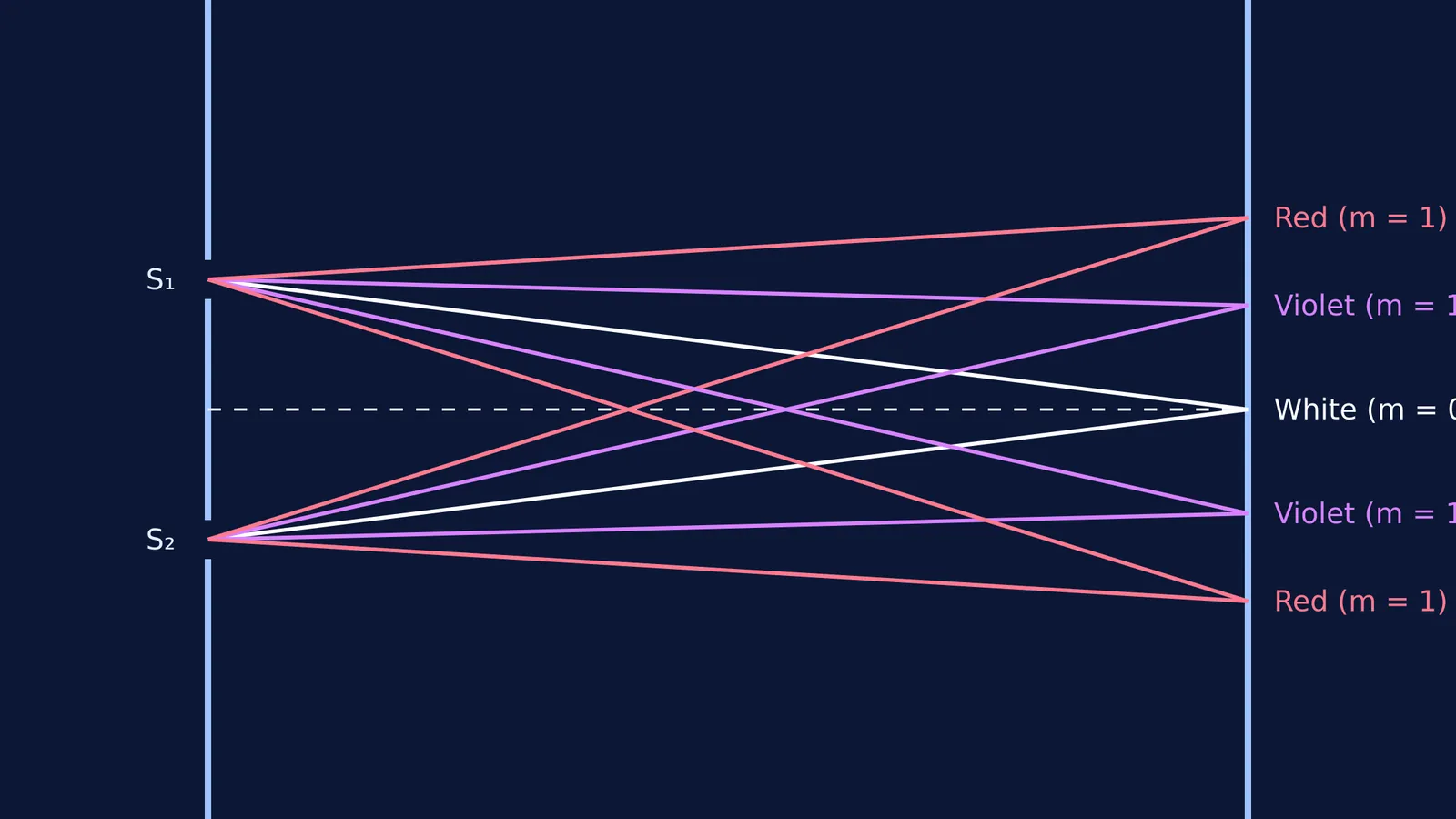
The interference pattern changes dramatically. Instead of endless repeating stripes of black and a single colour, you see a bright white line directly in the middle of the screen. On either side of this centre line, you see a few rainbow-coloured bands. Beyond that, the distinct fringes fade, and the interference pattern seemingly disappears into a continuous blurred pattern of colours.
Here is a step-by-step breakdown of why the physics of wave interference creates this exact pattern, how the varying path differences influence what you see, and why the distinct vivid colours do not last forever on the viewing screen.
Why is the central fringe white?
White light is not a single colour; it is a continuous mixture of the entire visible spectrum. The human eye detects wavelengths from roughly 380 nm (violet) to 700 nm (red). When these different wavelengths combine in roughly equal proportions, our brain perceives the result as white light.
For a bright fringe to form on the screen, light waves from both slits must arrive perfectly in phase, meaning they undergo constructive interference. At the exact geometric centre of the screen, the distance travelled by the light from the upper slit equals the distance from the lower slit. The path difference is exactly zero.
Because the path difference is zero for every wavelength, all the individual colours present in the white light interfere constructively at that exact same central spot. When violet, blue, green, yellow, orange and red all reach their peak intensity together, they recombine on the screen to form a bright, pure central maximum.
Why are the surrounding fringes coloured?
As you move your eye away from the central white fringe, the path length from one slit becomes slightly longer than the path length from the other. The condition for a bright fringe is that this path difference must be an exact whole-number multiple of the wavelength (mλ).
Because the displacement of a bright fringe on the screen (denoted by y) is directly proportional to its wavelength—a relationship given by the standard interference formula y = mλD / d—different colours will reach their maximum intensity at different physical positions on the screen.
Violet light has the shortest wavelength (~380 nm). Because its wavelength is small, its first-order maximum (m = 1) happens at a very small path difference. Therefore, the first bright violet band appears closest to the central white fringe.
Red light has the longest wavelength (~700 nm), meaning its first-order maximum requires a larger path difference and is pushed further out along the screen.
This wavelength dependence means that each bright fringe acts like a tiny prism, dispersing the light. The inner edge of the fringe (the side closest to the centre) is always violet or blue, while the outer edge of the fringe stretches out into red.
Why do we only see a few coloured fringes?
If the formula holds true for every positive integer order (m = 1, 2, 3...), why doesn't the screen show dozens of perfectly repeating rainbow fringes?
The answer lies in how quickly the different wavelengths begin to overlap as you move further from the central maximum. Because the visible spectrum is broad, the distinct fringes of different colours quickly start to step on each other's toes. The red part of one fringe overlaps heavily with the blue and green parts of the next fringe.
As the fringes for different colours overlap, the result is a blurred pattern of colours where distinct interference fringes are no longer visible. The peaks and troughs of the different wavelengths fall randomly across the screen, washing out the pattern.
If you want to explore more variations of this classic setup—such as what happens when you physically move the source slit itself—read our article on YDSE source slit shift: why the central fringe moves opposite.
A checklist for YDSE with white light
When answering a question about replacing monochromatic light with white light, use this framework to verify your answer:
The central maximum is always white: The path difference is identically zero for all wavelengths at the centre.
The inner and outer edges: For the first coloured fringe, violet is always on the inside edge, while red is always on the outside edge.
Missing colours imply destructive interference: If a specific point on the screen appears purely green, it is because the complementary colours (like red and blue) are undergoing destructive interference at that exact path difference.
Verify with the displacement formula: Use y = mλD / d to calculate where the maximum of any specific wavelength will fall on the screen.
If you have concept gaps in wave optics, the Fermi Concept Library has a lesson for every concept in physics.


